
13 December 2024
Enhancing biodiversity – Ken Gill’s approach
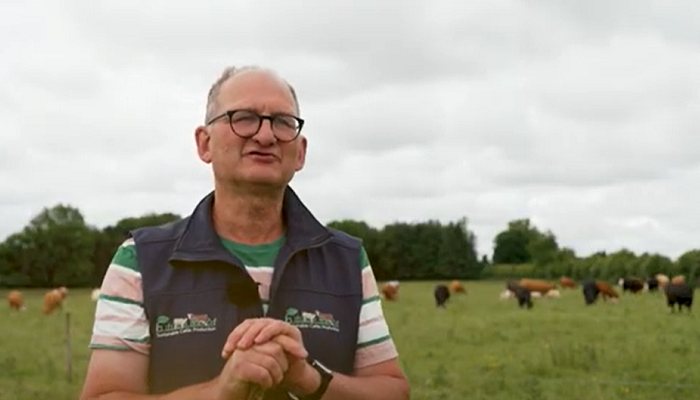
Operating an organic suckler system in Clonbullogue, Co. Offaly, Ken Gill was crowned the winner of the Enhancing Biodiversity category of the Teagasc FBD Environmental Sustainability Awards 2024.
Dr Siobhán Kavanagh, Signpost Programme Communications and Engagement Specialist, takes a closer look at the actions being taken on his farm.
A full symbol organic producer and trading as Ballydermot Organic Farm Ltd, Ken operates a suckler to beef system with 70 autumn calving cows. This farm is a really good example of an organic farm operating at a high level of technical efficiency while also looking after the environment. All progeny are brought to beef with the aim to finish them at 24 months. 100% A.I. is used to avail of the best genetics available.
Hedgerow management
There has been an emphasis on good hedgerow and field boundary management, making sure there is plenty of flowering plants in the hedgerows. Ken cuts one side every third year and one-quarter of hedges are cut every four years. The margins are fenced and being organic are free from pesticides and herbicides, providing a useful habitat for wildlife.
He has recently planted 500 metres of new hedgerow on the farm and has worked closely with Woodlands of Ireland on native woodland creation and hedge laying.
Trees
Ken has always planted a lot of trees. The farm has a semi-natural woodland (14ha) which was planted over 20 years ago. He is managing that by coppicing of standards and managed to provide continuous cover, something Ken is very proud of.
For more insights on Ken’s farming system, watch the below video:
Crop rotation
Being organic means that crop rotation is vital to ensure the continued health of the soil and to aid weed suppression in new swards. Oats are grown for sale into the organic breakfast market. Red clover is grown for quality silage and winter fodder crops, including turnips, rape and kale, are also sown in certain areas of the farm. The farm is 95 hectares in one large block all of which is owned. Soil type on the farm is grey brown podzolic and soil texture is silty clay loam.
Ken is very aware of what’s going on under the soil – the soil biodiversity. He believes that good crop rotation is important for this, but as is retaining one-third of the farm in old permanent pasture.
Concluding these practices nicely, Ken explained: “If you look at Teagasc’s 12 steps to reduce your gaseous emissions on the farm, 10 of them only affect me because two of them are to do with spreading fertiliser, which I don’t do, but there is not one thing on that list that isn’t good for the environment and good for your bottom line.”
More information on the Teagasc FBD Environmental Sustainability Awards 2024
Also read: Championing environmental sustainability – what set the Walsh family apart
Also read: Water quality actions in motion in Limerick
Also read: How this suckler farmer is going the extra mile to protect water quality
Also read: Award winning Meath dairy-beef farmer prioritises farm-to-farm sourcing
Also read: Edwin Thompson’s steps to reducing greenhouse gas emissions
Also read: Balancing sheep, beef and tillage – Brian Nicholson’s route to partial organic conversion