
16 October 2024
How this suckler farmer is going the extra mile to protect water quality
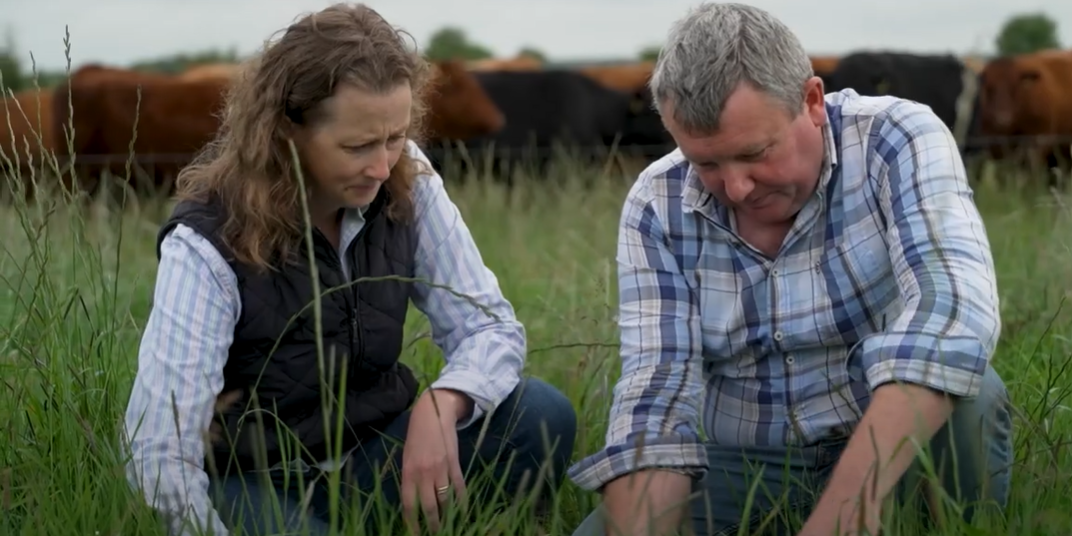
Shane Keaveney, a suckler farmer from Ballinlough, Co. Roscommon, is going above and beyond to lessen the impact of his farming practices on water quality – specifically the watercourse bounding his farm.
Fresh after being crowned the Suckler Beef Enterprise winner of the Teagasc FBD Environmental Sustainability Awards, Dr Siobhán Kavanagh, Signpost Programme Communications and Engagement Specialist, Gabriel Trayers, Manager of the Roscommon/Longford Advisory Region, and Kieran Kenny, ASSAP Advisor, detail the steps taken on farm to protect water quality.
Farm background
Shane, with the help of his wife Grainne and three children, operates a successful suckler farming enterprise consisting of around 38 cows, and is a participant in the Teagasc Future Beef Programme. Male progeny from the system enter an under 16 month bull production system, while non-replacement heifers are carried to forward store stage before being marketed. Split between three blocks, the 35ha farm is heavy in nature due to the underlying clay and peat soils.
Shane explained: “To make money out of the farm, I have to have both an efficient farming system and capitalise on relevant schemes.” Such scheme involvement includes participation in ACRES and the Farming for Water EIP.
For more information on Shane’s farming system, watch the video below:
Actions to protect water quality
Shane’s focus on protecting water quality was merited by the judging panel of the Teagasc FBD Environmental Sustainability Awards. The Roscommon man’s consciousness of the need to do more, along with his follow through of actions, was clear to see throughout the judging process.
Shane’s farm adjoins the Island River. It is currently at moderate ecological status and has been since 2014. In the hope of sparking a change in the water quality status, Shane’s starting point was to meet his local ASSAP Advisor, Kieran Kenny and walk the farm to identify the risks to water quality.
The PIP (Pollution Impact Potential) maps have been developed by the EPA to help focus on the areas and sources that might be impacting water quality. The maps help identify diffuse phosphorus (P) and diffuse nitrogen (N) losses. These PIP maps are available to all farmers and can be found at catchments.ie, or talk to your local Teagasc advisor about accessing them.
These maps have helped Shane identify where the highest risk to nutrients, P and N, getting into watercourses are on the farm. Given the nature of the soils on Shane’s farm, phosphorus and sediment lost through runoff is the biggest risk.
Kieran and Shane drew up a plan to prevent losses from vulnerable areas of the farm. There were a number of actions implemented:
- The dungstead was upgraded and Shane was advised to plant a hedge beside a main drain to act as a buffer or trap for any losses.
- Shane fenced off watercourses under the ACRES scheme.
- He has a 1.5m riparian strip back from all the watercourses. These margins help protect water and also add to the biodiversity of the farm.
- In completing recent drain maintenance work, Shane strategically left a 20m uncleaned section at the drainage outlet of the farm to act as an important trap to filter out suspended sediment in the water.
Shane has signed up for the new Farming for Water EIP (European Innovation Partnership) scheme. There is a budget of €50 million for this scheme and it’s expected that 15,000 farmers will sign up to the end of 2027. Farmers in specific water catchments will get paid to implement a range of measures designed to help improve water quality. It provides funding for measures such as stream fencing, alternative water supply, nose pumps, solar pumps, fenced margins, riparian buffer zones, hedge and tree planting etc. Shane’s farm is located in the Islands River catchment which qualifies under the scheme.
He has decided to:
- Put in a number of earthen bunds alongside watercourses, where the ground is low to stop surface run-off pathways and;
- To install a targeted riparian buffer zone with trees to intercept nutrients;
- Planting trees in the buffer zone;
- The resurfacing of gateways;
- Creation of a rainwater management plan;
- To enhance his interest and awareness of water quality, he has committed to further training and to hosting an event to demonstrate actions to other Water EIP farmers.
Find out more about the Teagasc FBD Environmental Sustainability Awards here
Also read: Championing environmental sustainability – what set the Walsh family apart
Also read: Award winning Meath dairy-beef farmer prioritises farm-to-farm sourcing