
14 June 2023
Rising gross output fails to lift cattle rearing income in 2022
Although gross output levels increased by 6% on cattle rearing farms in 2022, in part due to improved prices for young stock, the average Family Farm Income declined by 13% to €9,408 on these farms.
Published earlier this week, the results of the Teagasc National Farm Survey 2022, which was representative of approximately 17,900 cattle rearing farms – with suckler cow production being the dominant enterprise – indicated that reducing direct payments and higher production costs had a negative impact on the levels of income generated.
Table 1 outlines the key components of average Family Farm Income on cattle rearing farms in 2022, with a gross output of €44,505 recorded. The average amount of direct payments received on cattle rearing farms declined by 5% in 2022, to €14,309. This average reduction was due to a decline in the number in receipt of payments such as GLAS, with small reductions in other schemes also.
Sector specific payments made through the BEEP-S and BDGP continued to contribute positively to farm income in 2022, with an average payment for participating farmers of approximately €1,900 for BEEP-S and €1,600 for BDGP. In 2022, the average payment received through the Fodder Support Scheme on Cattle Rearing farms was close to €1,000. This benefitted 80% of farms.
Table 1: Components of average cattle rearing Family Farm Income 2022
| 2022 | 2022/2021 change | |
|---|---|---|
| € | % | |
| Gross output | 44,505 | +6 |
| Of which Direct Payments | 14,309 | -5 |
| Total costs | 35,097 | +13 |
| Of which direct costs | 14,749 | +6 |
| Of which overheads | 20,348 | +19 |
| Family Farm Income | 9,408 | -13 |
Production costs
Total production costs for the average cattle rearing farm in 2022 were up 13% compared to the previous year. This was the smallest increase observed across farm systems, reflective of a tightening of input usage due to price inflation.
Data from the survey indicate that both concentrate and fertiliser use were down significantly on cattle rearing farms in 2022, with nitrogen use down 33%. Direct costs increased by 6% on the average cattle rearing farm in 2022. Despite the reduction in usage, fertiliser expenditure increased by 32%, with the average farm spending €3,249 in 2022.
Similarly, expenditure on concentrates increased, but to a much smaller degree, up 3% year-on-year to €3,906, on average. Concentrate usage was down approximately 10% on the average farm.
Although a much smaller cost item, purchased bulky feed expenditure declined to a farm average of €624. Spending on contracting charges increased on cattle rearing farms in 2022, up 17% to €3,812, on average. Livestock and veterinary costs were down 9% to €2,217, with other direct costs increasing by 18% to €1,489.
Overhead costs
Overhead costs increased by 19% to €20,348 on the average farm. In line with inflationary pressures in the wider economy, an increase in general depreciation was recorded in 2022 relative to 2021. With regard to specific cost items, there was a 59% increase in machinery depreciation (to €4,193), with a 43% increase in building depreciation (to €3,425) on the average cattle rearing farm in 2022.
Car, electricity and phone costs were also up 7% to €2,652 and machinery operating costs were also up slightly, by 4% to €3,090. Fuel costs also increased by 28% to €1,534. Other overhead costs also increased, up 18% to €2,778. Average expenditure relating to building maintenance, although small, was relatively stable at €662 and spending on land improvement maintenance was down 7% to €915.
Cattle rearing farm indicators
Table 2 indicates that there was a 4% decrease in the average sized cattle rearing farm in 2022 to 31ha. Total livestock units also decreased on the average cattle rearing farm in 2022, to 35 on average. The average gross margin on a per hectare basis on cattle rearing farms in 2022 increased by 10% to €951. This included an average Basic Payment of €249.
Table 1: Average cattle rearing farm indicators 2022
| 2022 | 2022/2021 change | |
|---|---|---|
| Farm size (ha) | 31 | -4% |
| Livestock units | 35 | -6% |
| Livestock units (per ha) | 1.11 | – |
| Basic Payment (€/ha) | 249 | +1% |
| Gross margin (€/ha) | 951 | +10% |
Distribution of income
Figure 1 presents the demonstration of income on cattle rearing farms from 2020 to 2022. The proportion of farms reporting an average FFI of less than €5,000 increased to 47% in 2022. The data indicates that 65% of cattle rearing farms earned less than €10,000 in 2022.
The proportion of farms with an FFI of between €10,000 and €20,000 declined to 19%. Those farms earning between €20,000 and €50,000 also declined slightly to 13%. Just 3% of cattle rearing farms earned more than €50,000 in 2022, unchanged on the 2021 figure.
Figure 1: Distribution of cattle rearing Family Farm Income 2020–2022
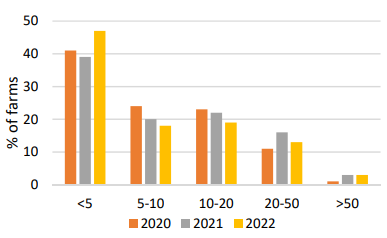
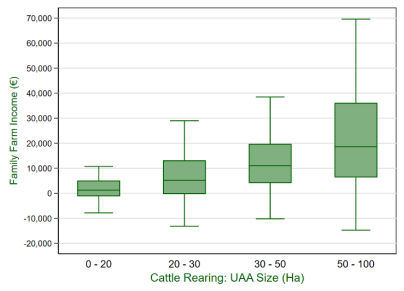
It should be noted that on 44% of cattle rearing farms, the holder also worked off-farm in 2022. In disaggregating the data further, Figure 2 illustrates the variation in FFI on cattle rearing farms across farm size categories, with a broad range reported for farms in the larger Utilisaed Agricultural Area (UAA) categories in particular.
In terms of the overall population, approximately 19% of cattle rearing farms had a UAA between 50 and 100ha and 33% in the 30 to 50ha bracket. The 20 to 30ha size category contained 30% of cattle rearing farms, with the remaining 18% found in the below 20ha size category.
Figure 2: Distribution of R Family Farm Income by farm size 2022
This article was taken from the Teagasc National Farm Survey 2022, access the full publication here.
Also read: Increase in farm incomes largely confined to dairy and tillage farms in 2022
Also read: Milk price rise offsets steep production cost increases on dairy farms in 2022