
16 May 2025
Agroforestry – the integration of farming and forestry
Thinking of establishing agroforestry? Lindsey H. Madden, who’s recently established agroforestry in Westport, and Teagasc Forestry Liaison Officer, Paul Butler fill us in on establishment and some of the potential benefits.
Agroforestry is a land-use practice where trees are integrated with crops or livestock. This offers a range of attractive ecological and economic benefits due to positive interactions between trees and agriculture.
As part of Ireland’s Forestry Programme (2023-2027), the Forest Type 8 (FT8) Agroforestry option promotes the integration of forestry with agriculture, supporting farmers and non-farmers alike in creating dynamic, ecologically resilient landscapes.
Case study – Agroforestry in Westport
Lindsey Madden and Donough Moran farm 33ac outside Westport. The land is heavy and returns from livestock are limited. Lindsey decided to plant trees in order to improve the ground conditions and encourage grass growth. She chose the Agroforestry option, as they can still use planted land for grazing.
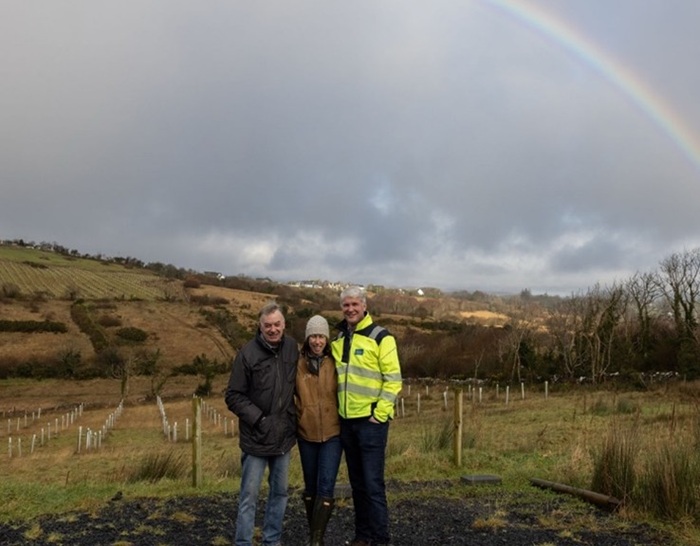
Pictured from left to right are Gabriel Joyce, Lindsey Madden and Donough Moran. Photo by Karen Cox
A registered forester completed the application for them. This was a simple process, and costs were covered by grants following successful completion of the establishment works. Eligible applicants under the Department of Agriculture, Food and the Marine (DAFM) Agroforestry option also receive a premium payment each year for 10 years, making the decision to plant trees financially sound.
Establishment
In 2022, approximately 1,700 trees were planted on the farm. The initial species mix was mostly birch, alder and oak. There have been some failures and replacement species include oak, sweet chestnut and cherry. The trees are individually protected by tall plastic tubes, though biodegradable tree tubes are now available. Sheep graze around the trees. The rows of trees are spaced 5 metres apart, leaving room for any machinery work that needs to be done for grass management.
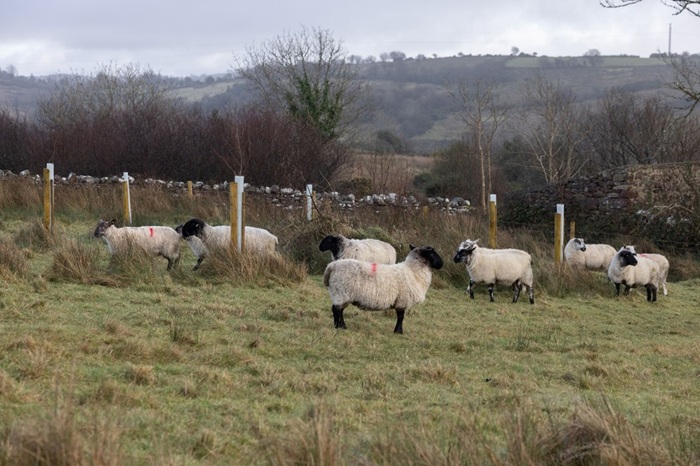
Photo by Karen Cox
Lindsey and Donough were fortunate to have worked with Gabriel Joyce as their site preparation and fencing contractor prior to planting.
Bridges needed to be put in place to access some paddocks. With natural springs on the land, and heavy clay in some areas, it was very important that the correct and sustainable water management be put in place to help bring on planted trees, grass and wildflowers.
While Lindsey believes that “rewilding” is a nice concept that has a role on some land, their piece of land has some unique characteristics that needed human input to help bring it along. Working with a professional who has a lifetime of experience with site preparation work in this part of Ireland was critical to the success of their project. Gabriel Joyce, with his knowledge of the land and skills, was able to help improve the site substantially. One of the paddocks is now full of Devil’s Bit Scabious, which the Marsh Fritillary Butterfly depends on. The Marsh Fritillary is a protected insect species in Ireland.
Benefits
There are many benefits of planting trees on their farm. The trees will help the ground dry out a bit more and improve soil conditions. Grass growth will be improved due to the shelter provided by the trees, especially as the farm lies in a windswept valley. Livestock will benefit during hot weather in summer as the trees will provide shade. The trees will contribute to improved soil structure, via the benefits of Mycorrhizal fungi. As the trees mature, the family will be able to sell high quality timber as a source of future revenue. Finally, Lindsey and Donough’s young daughters are particularly happy about the ecological benefits of planting agroforestry, such as carbon sequestration and biodiversity enhancement.
Conclusion
Agroforestry is a practice that integrates trees with agriculture, offering dual-income streams and significant ecological benefits. Trees can enhance soil health through improved carbon cycling and water infiltration, extend the grazing season and reduce livestock losses through shelter and microclimate creation. Trees can also provide essential nutrients like zinc and cobalt, naturally boosting animal health while supporting biodiversity and carbon sequestration.
With flexibility to maintain grazing and produce silage or hay, agroforestry creates resilient, sustainable farms. The FT8 Agroforestry option enables farmers to adopt this innovative practice, improving productivity, environmental health and long-term financial stability.
For landowners considering the agroforestry and other planting options, independent and objective advice is available from your local Teagasc forestry advisory staff.
Farmers who chose to pursue agroforestry may consider joining the Irish Agroforestry Forum, which is an excellent resource of knowledge, skills and research for those participating in agroforestry systems.
More from Teagasc Daily: The potential of Japanese red cedar and western red cedar in Irish forestry
More from Teagasc Daily: All you need to know about planting a small native woodland on your farm