
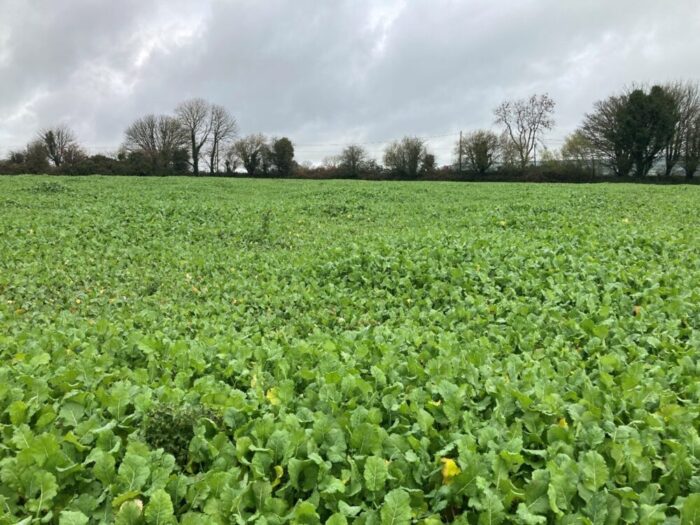
Aisling Molloy, Future Beef Programme Advisor, writes on the management practices required when grazing forage crops, focusing on the steps that will maximise animal performance while safeguarding soil structure and compliance on your farm this winter.
Forage crops are used for winter grazing because they provide a low-cost, high-energy feed that keeps livestock outdoors, while reducing housing and labour demands. However, careful feeding management is required to reduce the risk of digestive upsets and environmental impact. Key areas to consider are:
1). Adaptation
Cattle and sheep should be gradually introduced to a forage over the course of a week to prevent bloat and toxicity. Start with small allocations and increase daily, keeping access to roughage at all times.
2). Fibre source
As forage crops are low in dry matter (8-16%), at least 30% of the animal’s diet must come from silage or hay to provide adequate fibre in the diet.
3). Minerals
Brassicas are low in key trace elements and contain goitrogens. Provide a quality mineral (bolus preferred) with high iodine plus copper, cobalt and selenium before turnout. Cows and in calf heifers should be removed at least one month before calving.
4). Water
Stock must have access to clean, fresh water at all times. They are not permitted to drink from watercourses.
5). Ration
Ration can be fed to young stock to provide extra energy based on sample results of the silage being fed. 1-2kg of ration per head per day for a 350kg weanling is typically sufficient to achieve 0.6 kg/day of an average daily gain. Troughs should be located at least 20 metres from a watercourse and moved regularly to prevent over-poaching.
6). Prevent poisoning
- Do not move the wire or offer fresh crop during frost – wait until the crop is thawed to reduce the risk of nitrate toxicity.
- Graze out brassicas before they flower in spring; flowering crops can be poisonous. Aim to complete grazing by mid-March.
7). Lie back area
A minimum lie back area of 30% is required for grazing catch crops, for example if you have 1 ha of redstart, you’ll need at least another 0.3ha of lie back. Stock must have access to it at all times. It can be grass or stubble, but it must have good cover and no heavy poaching must take place.
8). Buffer zones
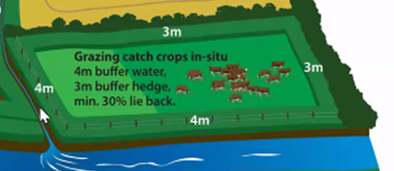
If you have any watercourse – even a small drain or dry ditch – you must leave a 4m fenced buffer strip beside it in the case of 1 watercourse, or 6 metres where 2 watercourses meet. These areas must stay uncultivated, unsown, ungrazed and unfertilised.
Supplementary feeding of silage, hay or meal troughs must be at least 20 metres from watercourses.
A minimum 3m uncultivated margin must also be in place around other crop boundary, e.g. from a boundary wall, fence, hedge etc. (as there is a 4m margin above for waters). There is no obligation on the farmer to fence the 3m non-water grass/vegetated buffers. Fencing of the buffer zones above is not advised, and grazing livestock should have access to this buffer space. Best practice would be to minimise the grazing of these buffer zones in periods of heavy rainfall or possible run-off to avoid nutrient and sediment loss.
There is also no GAEC requirement to fence the 3m buffer strip in tillage fields where catch crops are being grazed. However, the 1.5m fencing requirement applies to watercourses identified on a 1:5000 OSI map, on holdings with a grassland stocking rate greater than 170kg N/ha before N exports under Nitrates.
Figure 1: Minimum buffer zones required when grazing forage crops
9). Grazing
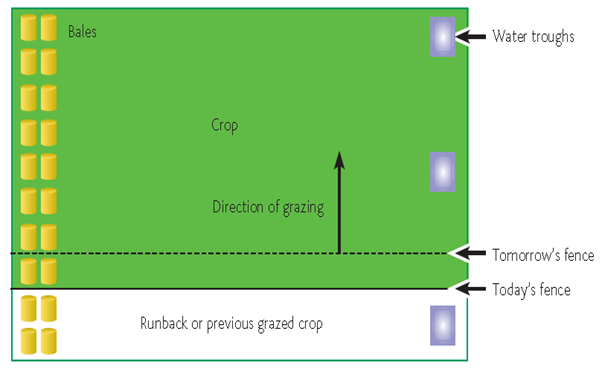
Stock should graze towards a watercourse to prevent any runoff of nutrients or sediment. Strip grazing of the crop from the longest side in long, narrow strips works well to provide daily allocations so all stock reach fresh feed and trampling is limited. A double fence also make sit easier for moving stock and reduces the risk of bloat from gorging themselves if they break through one fence.
Figure 2: Recommended grazing management of the forage crop
10) Yield and allocation
Depending on the crop and sowing date, yields can vary widely. Assessing the yield and knowing the weight of the stock grazing the crop can help to estimate how many days grazing are available, and how much of the crop to allocate daily.
Calculate the yield and available feed
- The yield can be calculated as follows:
- Weight in kg (from 0.5m by 0.5m area) x 40,000 x10% dry matter = kg dry matter/ha
- g. 0.4kg x 40,000 x 10% = 1600 kg DM/ha
- The expected utilisation rate is >75% so multiply the yield by this figure.
- g. 1600 kg DM/ha x 75% = 1200 kg DM/ha available feed
Calculate days of grazing
- If a 350kg weanling heifer is consuming 3% of its body weight daily, it will eat 10.5 kg DM per day.
- Assuming 70% of this is coming from the forage crop, it will eat 7.3kg DM of the forage crop.
- Each 1ha of the crop with 1,200kg DM/ha will feed 10 weanlings for 16.4 days (1,200 kg DM/ha divided by 73kg DM/day for 10 weanlings)
Calculate the allocation
- Assume the daily allowance is 7.3kg DM/day for a 350kg weanling
- Weight of 1m2 of forage crop is 1.6kg (0.4kg per 0.25m2 above x 4)
- Divide allowance by weight of 1m2, i.e. 7.3kg / 1.6kg = 6m2 required per animal per day
11). Cross compliance
The GAEC 4 rule under conditionality is all about protecting our water and soil. Therefore, every effort should be made to reduce the risk of poaching and soil liquification while grazing such as:
- Back fencing after grazing
- Providing over 30% lie back area
- Avoiding leaking water troughs
- Moving round feeders and troughs regularly
- Limiting number of stock grazing
- Removing wire fencing so that access point to lie back isn’t solely through one gap in field
12). Extra rules in SAC areas
If your land lies in a Special Area of Conservation (SAC), such as near the Barrow, Nore, or Blackwater in Co. Cork, extra care is needed. Work within 20 metres of a river or 50 metres of a wetland may need consent – this includes ploughing, spraying, or even fencing. Check your farm maps or ask your advisor to confirm if these rules apply to you.
Forage crops have the potential for excellent weight gains in weanlings over the winter and have ranged from 0.5 to over 1kg per head per day on Future Beef farms. Stock tend to be healthier as there are no ventilation issues or parasite burdens. However good shelter is required and the weather during grazing ultimately dictates weight gains.
In summary, success hinges on gradual adaptation, strong fencing, reliable water, consistent fibre and minerals, timely breaks, careful weather calls and robust soil/water protection. These steps will maximise animal performance while safeguarding soil structure and compliance on your farm this winter.