
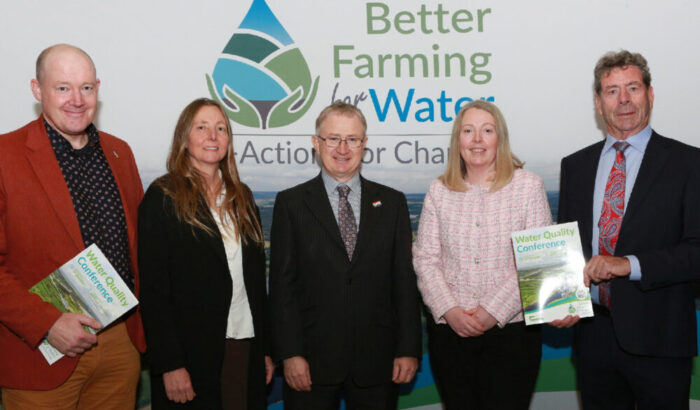
The supports available to Irish farmers and the sector as a whole to improve water quality were outlined at a major event, the Teagasc Water Quality Conference in Laois, today, October 29.
The attending delegates were informed of the latest water quality policy and regulatory challenges by speakers from government departments and the EPA. This was set against backdrop where the latest EPA Water Quality report, covering the period 2019 to 2024, showed that 52% of surface water bodies had satisfactory (≥ good) ecological status, a decrease from 54% over the period 2016 to 2022.
Opening the conference and attesting to the importance of water quality, Teagasc Director, Professor Frank O’Mara said: “We all want plentiful food, which is safe, nutritious, high quality and affordable while returning a decent living to farmers.
“Abundant, clean water is a cornerstone of our society, our economy and the rural landscapes that sustain food production. Marrying these objectives is a key focus of our work in Teagasc.”
Given the importance of water quality, Professor O’Mara added: “It is clear that water quality must improve,” before noting that farmers are already implementing actions and measures to improve water quality.
“Teagasc has a role to support them in taking further actions, in co-ordination with all other interested parties. In 2024, we launched the ‘Better Farming for Water: 8-Actions for Change’ campaign. The objective of the campaign is to support all farmers to reduce the loads of nitrogen, phosphate, sediment and pesticides entering our river network,” Professor O’Mara said.
Expanding further on the Teagasc Better Farming for Water Campaign, Head of Teagasc Water Quality Knowledge Transfer Department, Noel Meehan said it represents a comprehensive, multi-year, multi-actor commitment to support farmers in achieving national water quality targets.
“By focusing on the 8-Actions for Change, grounded in improved nutrient, farmyard, and land management, the campaign provides practical solutions for reducing nutrient, sediment, and pesticide loss,” Noel Meehan told those in attendance.
By following a Priority Catchment Selection Process, he added, it ensures that resources, especially Knowledge Transfer efforts, are targeted efficiently to “At Risk” waterbodies where agricultural intervention is most critical and where the specific pollutant issue can be identified through the FLAG map proxy.
“The expected impacts include enhancing farmer knowledge, reducing pollutant loss, and increasing the proportion of agricultural water bodies achieving high or good ecological status,” he said.
For more insights, Fiona Doolan caught up with Noel Meehan at the Water Quality Conference:
View this post on Instagram
Deirdre Glynn, ASSAP advisor in the Teagasc Kilkenny/Waterford region said: “The ASSAP programme and the Farming for Water EIP represent a transformative approach to improving water quality in agricultural landscapes.
“By working collaboratively with farmers and stakeholders, these initiatives demonstrate that sustainable farming and environmental protection can coexist. Their success highlights the importance of cooperation, innovation, and shared commitment to address complex environmental challenges.”
Fiona Doolan spoke to Deirdre Glynn at the Teagasc Water Quality Conference, find out more below:
View this post on Instagram
To view Deirdre Glynn’s presentation (PDF) from the Teagasc Water Quality Conference, visit here.