
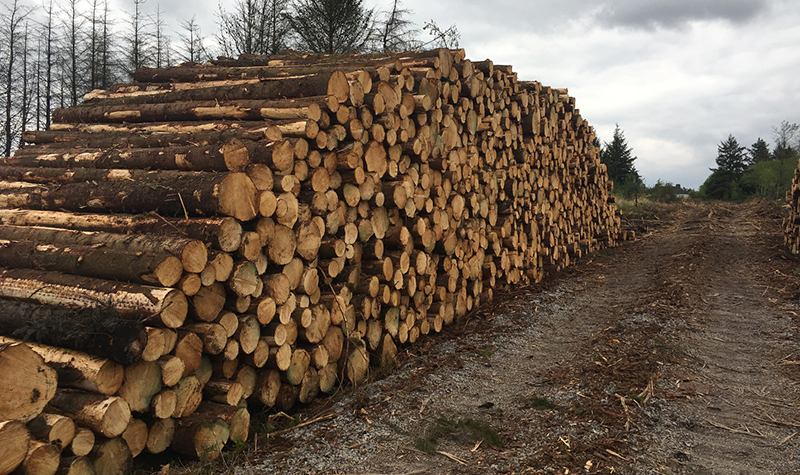
Ireland’s conifer forests are primarily grown and managed to produce timber that can be cut to size for use in a range of timber markets.
These include construction materials, the manufacture of pallets, fencing and panel board or for energy production as firewood and biomass. When conifer trees are harvested during thinning and clearfelling operations, the timber is generally cut into categories or assortments based on the diameter and length of the logs.
The quantity and value of each category depends on the size, age and quality of the trees being harvested. For example a younger forest with smaller trees at first thinning stage will produce a higher proportion of smaller, lower value assortments such as pulpwood. In general, older forests, especially those that have been thinned a number of times, will produce larger diameter logs which often include higher value assortments including sawlog.
Timber products
Sawlog
Sawlogs are cut from the lower part of older trees and are the most valuable commercial timber. Standard sawlog lengths are typically 4.9 m, with a minimum small end diameter of 20 cm, though specifications can vary. Sawlogs are primarily used in the construction industry to produce sawn timber. First and second thinnings rarely yield sawlogs, so proactive forest management and well-timed thinning operations are essential to maximise sawlog production.
Palletwood
Palletwood provides commercial timber for pallets, packaging, garden furniture, and fencing. Log lengths vary from 2.5 m to 3.7 m, with a minimum small end diameter of 14 cm. While generally unsuitable for construction, palletwood represents a mid-range value timber assortment.
Stakewood
Stakewood is used for fencing stakes and straining posts. Logs with straight stems and small diameters, 7–13 cm, are ideal. Increasingly, buyers prefer logs of 3.4–3.7 m, which allow flexible production of fencing products. Stakewood can be harvested during both thinning and clearfelling, depending on quality and market demand.
Pulpwood
Pulpwood comes from small diameter trees, tops of larger trees, or poor-quality timber unsuitable for sawlog or stakewood. Usually harvested during first and second thinnings, pulpwood has a minimum small end diameter of 7–13 cm and is cut to standard 3 m lengths. It is processed into products such as door panels, oriented strand board (OSB), and medium-density fibreboard (MDF).
Energywood
Timber not suitable for higher-value markets can be sold for energy production. Pulpwood and other assortments can be used for firewood or chipped for biomass energy. Proper seasoning of timber is crucial for maximising heat output.
Brash
Brash refers to the branches, tops, and offcuts left on site after harvesting. Recently, brash has found a market in biomass energy, where it is collected, dried, and chipped. Removing brash creates a tidier site and increases replanting space. However, on less fertile sites, leaving brash can help recycle nutrients, so removal should be carefully considered.