
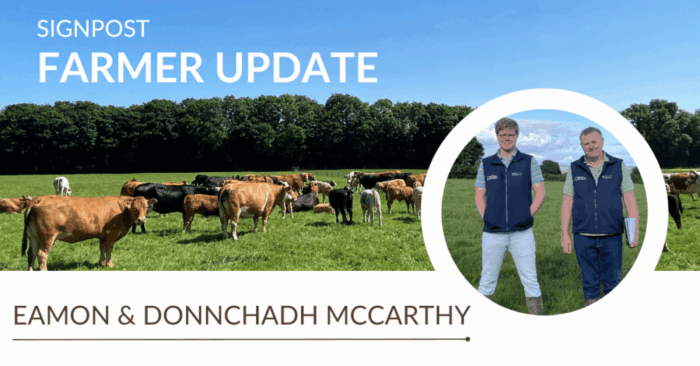
Future Beef and Signpost Programme participant, Eamon McCarthy writes on a new infrastructure investment on farm that he hopes will bring labour savings, and the genetics of their cow herd – an area they’ve worked to improve.
We mentioned earlier in the year that we were planning to build a 4-bay easy-feed unit this year. We received our TAMS approval in July and currently the shed is erected and most of the concrete work in the shed is completed.
This new build will reduce the labour requirement and also streamline animal handling on the farm. We are very conscious of making the farm more labour efficient as both of us work off farm.
Although we always try to get stock out in the spring as early as possible, this new build will allow us to practice on-off grazing far more easily in the future.
The shed is designed so animals can be drafted from any pen in the shed to the animal handling unit without having to set up any gates/wires etc. For finishing animals, we see the benefit of knowing the weight gains of the animals so better decisions can be made.
As to another labour saver, Eamon McCarthy outlines how his fertiliser dispensing stand which is used for loading the half tonne of fertiliser into the spinner, saves time and reduces the need for a second tractor. It also makes emptying the bags safer.
Watch the video below:
Silage quality and quantity
Our three cuts of silage have been analysed, with the silages ranging from 69% DMD up to the 75% DMD. The better-quality silage will be targeted to the weanlings, finishing animals and autumn calvers. The spring-calving cows will be fed the 69% DMD silage ad lib.
We completed the final fodder budget after the third cut in early September. We should have enough silage to carry us through to April next year. We will monitor silage usage monthly and a decision will be made early if we need to stretch the silage stock. This can be done by introducing straw or fillers to the well-conditioned spring-calving herd.
Better cows
In the last few articles, we have focused on the performance of the finishing bulls and the role good genetics play in producing a profitable animal for sale. We also have placed a big emphasis on increasing the genetic merit of the cows on the farm by using the Eurostar Index.
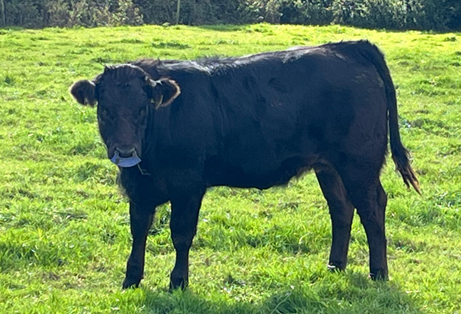
We are trying to improve the carcass weight and fertility of the herd while maintaining the milk yield of the cows. The 2025 spring-born heifers have an average Replacement Index of €155, with a milk sub index of 6.2kg and a calving interval of -1.77 days. The carcass weight has increased to 19.7kg. The main maternal sires used are Shannon Stan (LM9379), Erebos (LM6172), Curaheen Earp (SI2152), Turloughmore Magnificent (AU4683) and Knottown Roy (SA4604).
Table 1: Beef EuroStar Profile for Eamon and Donnachadh McCarthy. The Replacement Index of the 2025 spring-born heifers on the farm (source: ICBF)
| Jumbo | Sire | Replacement Index (€) | Replacement Index Stars (across) | Carcass weight (kg) | Daughter milk (kg) | Calving interval (days) |
| 877 | LM9379 | 168 | 5 | 16.6 | 7.7 | -1.21 |
| 878 | AU4683 | 201 | 5 | 14.6 | 8.6 | -4.54 |
| 881 | LM6172 | 116 | 4 | 19.8 | 6.8 | -0.59 |
| 882 | LM9379 | 189 | 5 | 18.2 | 3.6 | -1.67 |
| 884 | LM6172 | 157 | 5 | 23.7 | 6.1 | -0.93 |
| 885 | LM6172 | 157 | 5 | 20.9 | 5.9 | -1.34 |
| 886 | LM9379 | 141 | 5 | 20.2 | 8.7 | -0.11 |
| 887 | LM9379 | 162 | 5 | 24.5 | 8.8 | -0.65 |
| 890 | SA4604 | 130 | 5 | 19.1 | 5.2 | -2.21 |
| 893 | AU4683 | 192 | 5 | 12.9 | 7.3 | -3.35 |
| 894 | SI2152 | 165 | 5 | 16.8 | 6.6 | -2.05 |
| 898 | SA4604 | 128 | 4 | 24.8 | 3.9 | -1.56 |
| 899 | AU4683 | 174 | 5 | 13.2 | 6.8 | -3.18 |
| 904 | LM6172 | 169 | 5 | 19.8 | 5.2 | -1.59 |
| 907 | SA4604 | 135 | 5 | 22.4 | 5.5 | -1.66 |
| 908 | LM6172 | 140 | 5 | 18.5 | 5.4 | -1.97 |
| 883 | SI4147 | 103 | 3 | 28.9 | 4.2 | -1.6 |
| Average | 155 | 4.8 | 19.7 | 6.2 | -1.77 |
About the farm
Eamon and his son Donnchadh farm in Carrigeen, Glendine, Youghal, Co. Waterford and are part of the Teagasc Future Beef Programme with the Signpost Programme. They carry a suckler to beef enterprise of 55 suckler cows, split into spring (60%) and autumn (40%) calving. The males are finished as under 16-month bull beef, while the heifers, not retained for breeding, are finished at 18-20 months. Own heifers are kept for breeding.
The above article first appeared in the Farming Examiner.