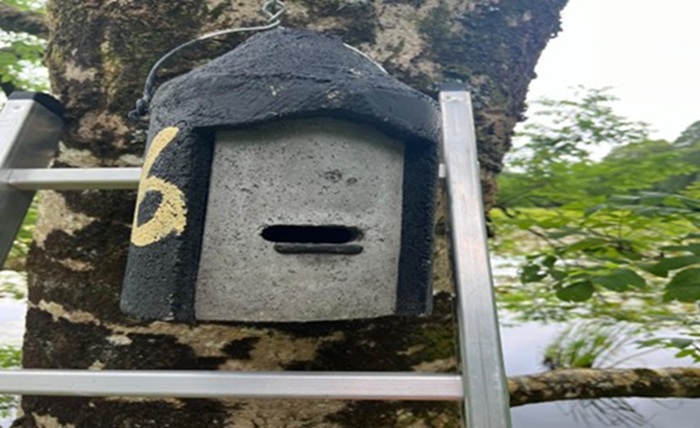
Kildalton College’s rich tapestry of landscapes and habitats, such as hedgerows, small woodlands and ponds, are well suited to Ireland’s bats, College Lecturer, Brian Clancy tells us more.
These nocturnal mammals are a familiar, beneficial part of rural life, quiet, secretive and highly valuable for on‑farm biodiversity and natural pest control. For students and staff at Kildalton College, bats offer a practical, local example of how agricultural practices, habitat management and conservation can work together.
Bats found at Kildalton
- Soprano and Common pipistrelles
- Small, widespread species that readily forage around hedgerows, woodlands and around the orchards. A single bat can eat anywhere from 1,000 to 6,000 insects in a single night, depending on its size, species, and whether it is nursing. For example, a common pipistrelle bat can eat over 3,000 tiny insects in a night, while a nursing mother brown bat might eat around 4,500 insects in a night.
- Leisler’s bat
- Often seen flying in open landscape.
- Daubenton’s bat
- Typically associated with the ponds, streams and ditches and hedgerows hunting low over the water.
- Brown long‑eared bat
- More likely to be found roosting in the buildings and trees around the college campus.
- Occasional visitors such as Nathusius’ pipistrelle may turn up during migration.
Bats prefer to commute along linear habitats such as hedges, watercourses and the edge of woodland because they use echo location (sonar) to guide them. All Irish bats feed on insects.
Why bats matter on the college farm
- Natural pest control: bats eat large numbers of flying insects, many of which are agricultural pests or nuisance species – reducing the need for chemical control.
- Biodiversity indicator: healthy bat activity often reflects healthy hedgerows, good water quality in ponds and ditches, and a diverse insect community.
- Educational value: bats provide practical learning opportunities for students and staff in sustainable farming in the environment, farm management, dairy, beef and sheep modules.
- Biodiversity, habitat assessment and management make excellent practical and learning for students.
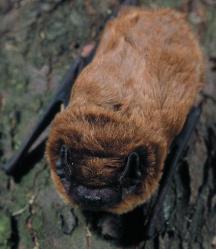
Leisler’s bat. Image source: Eddie Dunne
Practical management and good practice at Kildalton
Retaining and managing habitats
Keep mature trees and hedgerows, maintain ponds and waterways, and leave uncultivated field margins as foraging habitat. These features support insects and provide commuting routes.
Lighting design
Reduce night‑time lighting near known roosts and along hedgerows.
Avoid disturbance at critical times
Do not undertake intrusive work in buildings during the bat maternity season (generally late spring–summer) unless under licence and with appropriate measures. Autumn and winter are usually better for sensitive building work.
Reduce pesticides where possible
Integrated pest management supports insect prey populations and overall farm biodiversity.
Legal protection and responsibilities
Bats and their roosts are protected by law in the Republic of Ireland under the Wildlife Act 1976 and subsequent amendments. In Northern Ireland, bats are protected under the Wildlife (Northern Ireland) Order 1985.
In both jurisdictions there is a similar level of protection, it is an offence to intentionally disturb, injure or kill a bat or disturb its resting place and any work on a roost must be carried out with the advice of the National Parks and Wildlife Service in the Republic, or the Northern Ireland Environment Agency in Northern Ireland.
Bats are a valuable, protected component of the rural ecosystem around Kildalton College. With mindful management of buildings, hedgerows, trees and waterways, the college can support healthy bat populations while using them as a living resource for teaching and demonstrating sustainable farming practices.
Next Thursday via Teagasc Daily, Brian Clancy will fill us in on some of the bat surveys being conducted at Kildalton College through South East Technological University (SETU).
For more on Kildalton College, visit here.