
Re“coop”ing losses
A decade’s worth of collaborative research between Teagasc and industry partners has helped Ireland achieve one of the EU’s lowest rates of Campylobacter infection in broiler chickens.
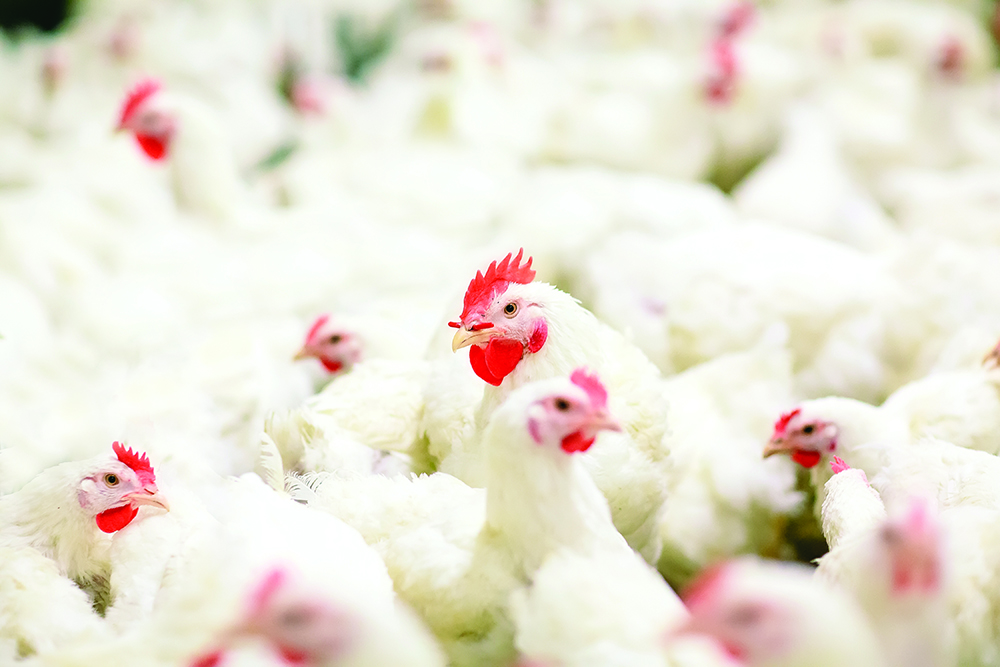
Photo credit: David Tadevosian/shutterstock.com
In just over a decade, Ireland has transformed from having the highest Campylobacter contamination rates in broiler chickens in Europe to being among the best in class, thanks to the collaboration of multiple stakeholders united by a common purpose.
Campylobacter is the most common foodborne bacterial infection in the developed world, with an estimated annual cost of €2.5 billion in healthcare and lost productivity across the European Union. Although multiple food sources are implicated, chicken meat is considered the primary reservoir, directly or indirectly accounting for up to 80% of human cases.
Stark results
In 2008, the European Food Safety Authority (EFSA) mandated all member states to conduct a baseline survey to assess contamination levels in broiler flocks and processed carcasses.
Declan Bolton, a Principal Research Officer at Teagasc Ashtown’s Food Research Centre, explains more: “The results for Ireland were stark, with 83.1% of broiler batches and 98.3% of broiler carcasses testing positive for Campylobacter. These figures placed Ireland third highest among member states for broiler batch contamination and the worst in Europe for carcass contamination.”
There was an urgent need to reduce these contamination levels to protect consumer health, safeguard confidence in Irish poultry products and preserve the international reputation of the food sector.
While numerous peer-reviewed studies had investigated various aspects of Campylobacter in broilers, their findings, when translated into control measures, had only a limited impact on Irish broiler farms, Declan notes.
“This highlighted the need for targeted research to understand the specific characteristics of Irish broiler production and to identify weaknesses within the poultry chain that allowed such high levels of contamination to persist.”
Collaborative effort
Research alone was not sufficient to bring Campylobacter under control. In 2011, the Food Safety Authority of Ireland (FSAI) published ‘Recommendations for a Practical Control Programme for Campylobacter in the Poultry Production and Slaughter Chain’, setting out the prevailing international knowledge at the time.
In 2015, at the request of Wayne Anderson of FSAI, the then Minister for Agriculture, Food and the Marine, Simon Coveney, established the Campylobacter Stakeholder Group (CSG), chaired by Patrick Wall of University College Dublin’s Institute for Food and Health. This group created a formal structure for stakeholder engagement and policy coordination.
A major achievement of the CSG was the establishment of the Campylobacter Monitoring Programme, notes Declan.
“This programme was operated by DAFM’s laboratories at their Backweston campus, with additional input from private laboratory testing. For the first time, every flock was tested, and farmers received feedback that identified problems and enabled corrective actions at farm level.”
Momentum increased in 2018 when the European Commission introduced Regulation (EU) 2017/1495, which established a hygiene criterion for Campylobacter on broiler carcasses during processing, with progressively stricter thresholds applied in 2020 and again in 2025.
Proof of effectiveness
More than a decade after the EFSA baseline survey, independent testing confirmed dramatic improvements. Flock prevalence decreased from 83.1% to 66%, and carcass contamination fell from 98.3% to 53%. In pre-thin (partial depopulation) flocks, contamination rates were as low as 30% and 4%, respectively.
These findings are supported by official 2022 data from the EU One Health Zoonoses Report, which reported that only 8.1% (food-borne outbreak testing) to 11.3% (DAFM testing) of Irish broiler carcasses exceeded the regulatory limit (Regulation (EU) 2017/1495). Only Hungary, the Netherlands, and Poland recorded lower contamination rates.
Today, the CSG is chaired by Teagasc Poultry Advisor Rebecca Tierney, ensuring strong collaboration links between the two bodies, notes Declan.
“In collaboration with industry and regulatory stakeholders, future research will prioritise reducing contamination during thinning and exploring new technological solutions to prevent and eliminate contamination on carcasses during processing.”
Four major studies
Between 2011 and 2020, Teagasc, together with the Department of Agriculture, Food and the Marine (DAFM), funded four major projects seeking to address knowledge gaps and improve Ireland’s Campylobacter infection rates.
The Control of Campylobacter in Irish Poultry (Teagasc, 2011–2014)
This project mapped the sources and transmission routes of Campylobacter across the poultry chain from farms and processing plants to retail and domestic environments.
A key recommendation was the thorough disinfection of the concrete apron outside broiler house doors, as bacteria from the previous flock were being carried back inside during restocking. The project also developed novel interventions across other stages of production.
Campylobacter Control on Irish Broiler Farms (DAFM, 2012–2015)
This work generated new data on farm-level sources and tested additional on-farm controls. It demonstrated that most cleaning and disinfection protocols then in use were ineffective, allowing feeders and drinkers to act as persistent carry-over points.
Importantly, it was the first project to show the critical role of farmers themselves as vectors for Campylobacter. It also provided science-based advice on stocking densities, with potential to improve both biosecurity and productivity.
Modifying Broiler Production Methods to Reduce the Incidence and Pathogenicity of Campylobacter in Poultry (Teagasc, 2016–2020)
This research focused on the genetics of Irish Campylobacter isolates and examined the broiler caeca (a pouch at the junction of the large and small intestines) as a critical niche. It revealed how the gut microflora created favourable conditions for Campylobacter, explaining the broiler’s particular susceptibility.
Findings showed that concentrations could reach up to 100 million Campylobacter per gram of caecal contents and demonstrated clear genetic relationships between broiler and human isolates.
Clean Broilers Through Enhanced Farm Biosecurity, Processing Prerequisites and HACCP-Based Interventions (DAFM, 2016–2020)
This project further explored questions raised by earlier research. It included anti-Campylobacter treatments and farm trials, as well as novel carcass decontamination approaches during processing. Importantly, it also placed a strong emphasis on knowledge transfer through training programmes for both farmers and processors.
Funding
This research was funded by Teagasc and the Department of Agriculture, Food and the Marine (project numbers 11SF328 and 15/F/641).
Contributors
Declan Bolton, Principal Research Officer, Food Research Centre, Teagasc Ashtown.
declan.bolton[at]teagasc.ie
Paul Whyte, School of Veterinary Medicine, University College Dublin.