
Coming full circle
More a sector-wide approach and way of thinking than a specific research area, the bioeconomy intersects across much of Teagasc’s work. In this issue’s Team Spotlight, we hear from four researchers across the organisation, all working in tandem to enhance Teagasc’s bioeconomy efforts.
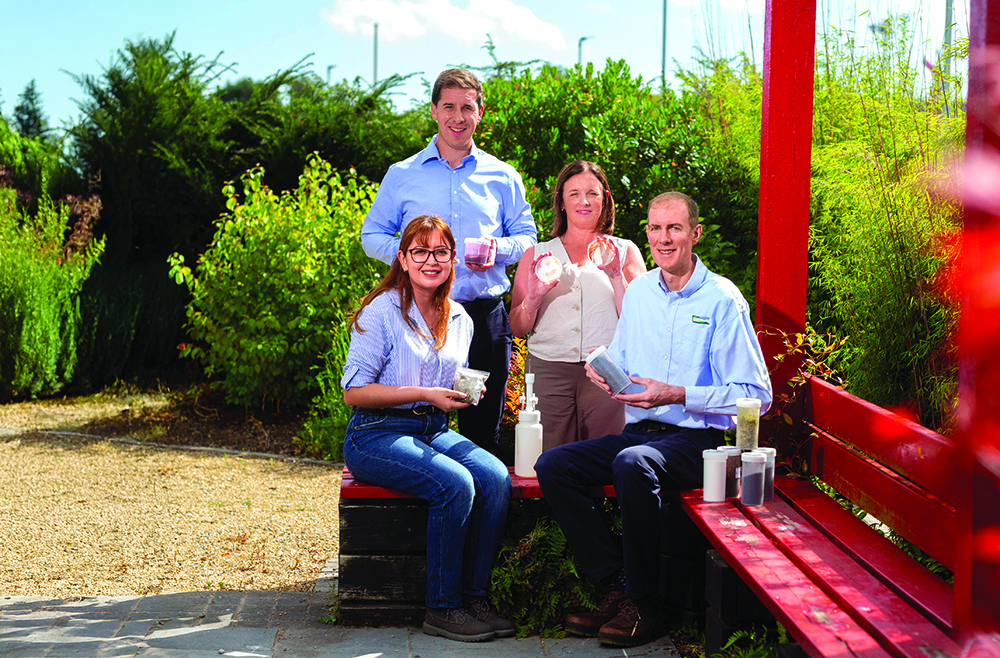
Pictured from left: Teagasc researchers Adriana Ferreira Maluf Braga, Shay Hannon, Olivia McAuliffe and Patrick Forristal all work in different subject areas, but it all comes together to help progress Ireland’s status as a leader and innovator in the bioeconomy. Photography: John Ohle
Bioeconomy involves fostering economic systems centred on biotechnology and sustainble practices. TResearch spoke to four researchers to learn more about how Teagasc is helping drive Ireland’s bioeconomy.
Patrick Forristal, Senior Research Officer at Johnstown Castle, works on nutrient recycling for the National Agricultural Sustainability Research and Innovation Centre. At Grange, Research Technologist Adriana Ferreira Maluf Braga focuses on anaerobic digestion for the Climate Centre. Shay Hannon, Manager of the National Prepared Consumer Food Centre at Ashtown, is helping future-proof Irish food companies. At Moorepark’s Food Research Centre, Principal Research Officer Olivia McAuliffe is one of the key players behind Teagasc’s Bioprocess Innovation Suite.
Can you explain how your work pertains to Teagasc’s bioeconomy efforts?
Patrick: Beginning with examining recycling of agricultural nutrients, it’s since expanded to include recovery and reuse of nutrients from municipal, industrial and food processing waste streams, plus nitrogen fixation.
Shay: The National Prepared Consumer Food Centre (NPCFC) focuses on product and process development for Irish food businesses. Companies are increasingly taking more circular approaches; we now talk about ‘by-products’ and ‘co-products’ rather than ‘food waste’. The NPCFC helps Irish food businesses reintegrate by-products into the food system, turning what was once discarded into valuable resources.
Adriana: In the 2010s, research at Grange showed the potential of anaerobic digestion (AD) from agri-feedstocks in Ireland. An AD research programme was established, building collaborations with national and international research groups. In parallel, we developed a pilot-scale AD plant for research and demonstration. The programme now covers analysis of sustainable feedstocks, optimising biomethane yields, and maximising nutrient recovery from digestate.
Olivia: Building on Teagasc’s research in cultures, enzymes and fermentation, we have begun focusing on the broader potential of fermentation technology and bioprocessing. Significant investment in our Bioprocess Innovation Suite, which enables bioprocess design, development and scale-up, helps us take a full-value-chain approach to bioprocess development.
What are your core priorities and objectives?
Adriana: Developing a sustainable agri-centric AD sector which can promote circularity, support Ireland’s energy transition towards renewables and the decarbonisation of Irish farming, while delivering profitability for both the farmers producing the feedstock and the AD operators.
Patrick: Supporting food production by improving nutrient recycling, mitigating loss at all points in the production chain and improving nitrogen fixation in the local bioeconomy.
Shay: Driving innovation, sustainability, and technical excellence across Ireland’s prepared consumer food sector.
Olivia: We work hand-in-hand with academic and commercial partners to translate research into scalable solutions that unlock the potential of natural resources, support the circular bioeconomy, and deliver real value to industry.
How does your research achieve these objectives? How are your findings used?
Patrick: Field trials have established the plant nitrogen and phosphorus availability of recycled nutrient sources and demonstrated that these sources can deliver comparable yields to conventional mineral fertilisers, once appropriately balanced. By using recycled nutrients and optimising soil pH, farmers can improve nitrogen fixation and boost production.
Olivia: Our research combines fundamental science with applied bioprocess development, and we share findings through scientific publications, conferences, and direct engagement with industry partners, while also providing practical solutions for companies.
Shay: We work with food businesses to trial new products, optimise processes, and explore by-product valorisation. Findings are shared through technical reports, industry workshops, and collaborative forums with stakeholders such as Bord Bia, Enterprise Ireland, and academic partners. Insights are used by companies to refine operations, launch new products, meet regulatory standards, and embed more sustainable practices.
Adriana: Our research combines desk-based analysis, laboratory experiments and pilot-scale AD operation. The Grange AD plant is a demonstration site for cross-disciplinary engagement with relevant stakeholders, disseminating knowledge through Teagasc channels, local media, scientific events and journal publications.
What are the key techniques and tools you use to achieve this work?
Shay: We use novel approaches and technologies such as hydrodynamic cavitation, ultrasound and pulsed electric field technology; and well-established technologies such as dehydration to transform surplus materials into new ingredients or products.
Patrick: Long-term field demonstration plots; Teagasc now has a long-term bio-based recycled fertiliser demonstration site in grassland and arable production.
Olivia: We link lab-scale fermentation with high end analytical capabilities and connect that directly with downstream capacity at pilot scale, enabling us to move seamlessly from lab discovery through to pilot-scale validation.
Adriana: At desk-scale, we have developed detailed models and applied machine learning algorithms to simulate biogas production from full-scale AD. We integrated AD into a livestock farming systems model for sustainable and economic assessment. At lab- and plant-scale we are expanding the microbial monitoring of the AD digester. We are also seeking to quantify and mitigate fugitive emissions in the AD plant.
What projects are you currently working on?
Shay: In collaboration with industry partners and other RPOs, the NPCFC is working on multiple projects – funded by the EU, Department of Agriculture, Food and the Marine (DAFM), and Enterprise Ireland – to reduce food waste from the meat, marine, and agri-crop sectors. We’re using innovative biorefinery processes to convert lower-value by-products into high-value products for sectors including food and cosmetics, reducing environmental impacts and creating new economic opportunities, and tackling food waste by developing alternative market standards for safe foods.
Adriana: Our team is involved in projects on nutrient recovery from anaerobic digestate through electrodialysis technology; improving biomethane yields; microbial ecology of AD process; and exploring the economic viability of products from AD.
Olivia: Several DAFM-funded projects, including U-Protein – which examines the role of crop and marine resources as alternative sources of protein – and UPLIFT, which focuses the application of fermentation technology as a processing tool for plant-based proteins.
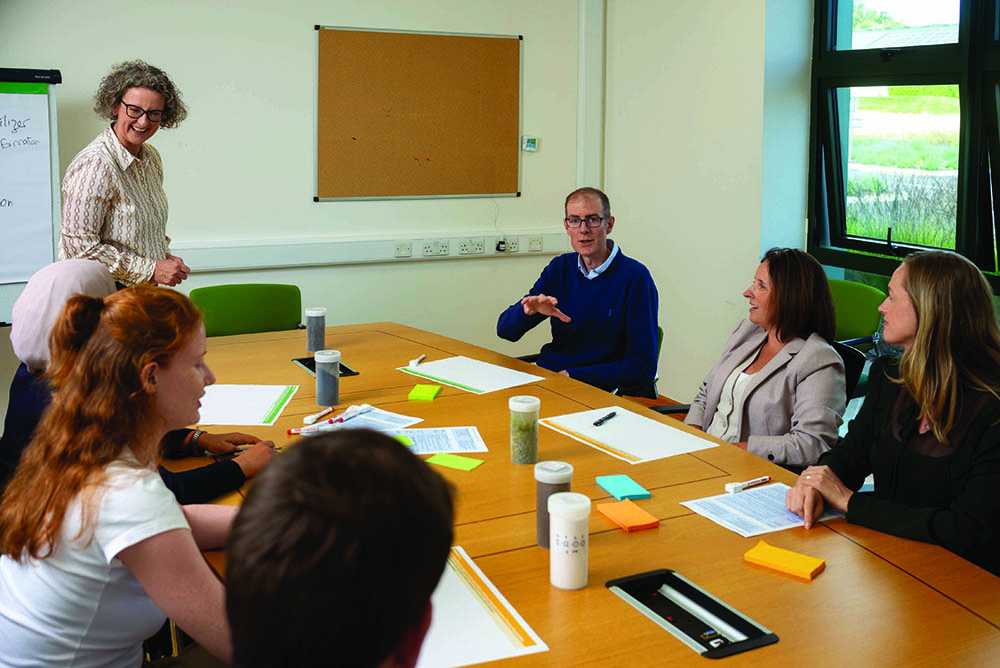
A meeting between researchers involved in the bioeconomy; a collaborative, multidisciplinary approach helpas drive innovation around circular thinking. Photography: John Ohle
Why is this work important in the context of the Irish agri-food sector?
Patrick: Efficient, appropriate nutrient recycling can reduce nutrient losses to the environment, holding nutrients for production, reducing reliance on imported nutrients and exposure to external market instabilities.
Adriana: Ireland has targets of 5.7TWh for indigenous produced biomethane and 25% GHG emission reduction for the agricultural sector. Livestock farms also need options to improve incomes and make use of surplus feedstocks such as grass and cattle slurry. AD can support all these objectives.
Shay: Valorising by-products and extending shelf life can reduce the supply chain’s environmental footprint and create new market and export opportunities.
Olivia: By developing new bioprocessing approaches, we are creating opportunities to add value to Irish crops, co-products, and by-products, turning them into high-quality ingredients and bio-based products.
What results have you seen so far?
Patrick: Technologies to separate, recover, recycle, and retain nutrients have been gaining traction over the past decade at farm, food processing and municipal level. Examples include manure separation, production of pelletised bio-based fertilisers, reduced nitrogen emissions from manure application, and recovering nutrients for high-phosphorus fertiliser.
Shay: Several companies we’ve supported have reformulated products to include by-products from Irish farms, such as surplus vegetables or dairy ingredients, reducing waste and creating new value streams.
Adriana: The data from Grange will be used for operational optimisation and economic feasibility assessment. Our work was used by the National Biomethane Strategy to recommend sustainable feedstocks. The integrated AD and farming modelling showed that digestate application to farmland can significantly reduce chemical nitrogen, phosphorus, and potassium fertilisation and unveiled market conditions necessary for a viable AD sector.
Olivia: While the full benefits of this work are long-term, the early results highlight the potential to influence food systems by opening new markets, improving resource use, and strengthening Ireland’s position in the bioeconomy.
How does Teagasc benefit from your work?
Patrick: My team provides guidance on nutrient availability and management for a host of new recycled nutrient options, testing and demonstrating them on the ground in-field and on-farm.
Shay: Since 2018, we’ve helped over 350 companies develop new products, improve processes, and adopt more sustainable practices. This strengthens Teagasc’s reputation as a leader in applied agri-food research, supports the delivery of Food Vision 2030, and ensures that Irish farming and food production remain competitive.
Olivia: We provide a platform for Teagasc researchers, academic partners and industry customers with full-value-chain bioprocessing capacity, providing evidence-based guidance in adopting innovative technologies to enhance efficiency across the food supply chain.
Adriana: Through supporting improvements in farmers’ living standards, while promoting sustainable circular bioeconomy principles and providing evidence and technologies to enable innovation and support Ireland’s environmental commitments.
Are there any upcoming trends that will affect your work?
Patrick: An increased focus on reducing losses of nitrogen and phosphorus, and a recognition that Ireland currently imports these nutrients means an increased need for solutions to recapture and reuse them efficiently on-farm.
Shay: Companies need to be agile as consumers increasingly demand clean label food products and innovation and reformulation, e.g. reduced fat, salt and sugar, while digitalisation and AI will affect product development and traceability.
Adriana: We expect a vibrant biomethane industry to emerge in Ireland, with the AD plant being a hub for more advanced processing technologies for high-value products.
Olivia: We’re adapting to sustainability and consumer-driven health trends by exploring advanced processing technologies, applying data analytics to optimise food production, and collaborating with industry partners on implementation.
What are your team’s values and principles?
Shay: Collaboration, innovation, sustainability, and impact.
Adriana: Promoting the circular economy to sustainably develop the agricultural, food and energy sectors in Ireland, while unveiling new business opportunities.
Olivia: Commitment to evidence-based research, proactive problem-solving, and continuous learning.
Patrick: Supporting the productivity and efficiency of Irish agriculture while mitigating nutrient losses to reduce impacts on the wider environment and society.
Is there an achievement you would like to highlight?
Patrick: Supporting the development and implementation of nutrient recycling to support production and soil health.
Shay: The scale and impact of the NPCFC’s industry engagement, completing over 520 projects and supporting the success of Irish food companies.
Adriana: With Ireland transitioning to a low carbon economy, we can provide evidence to support the development of the biomethane sector and circular economy.
Olivia: Developing a multi-cascade biorefinery approach to the valorisation of dairy by-products, reducing waste while creating novel bio-based products.