
Getting the balance right
Irish pasture-based dairy systems face challenges integrating cow–calf contact, balancing calf welfare and growth with cow productivity, health, and labour demands. Recent Teagasc research compared cow-calf contact and conventional calf rearing systems.
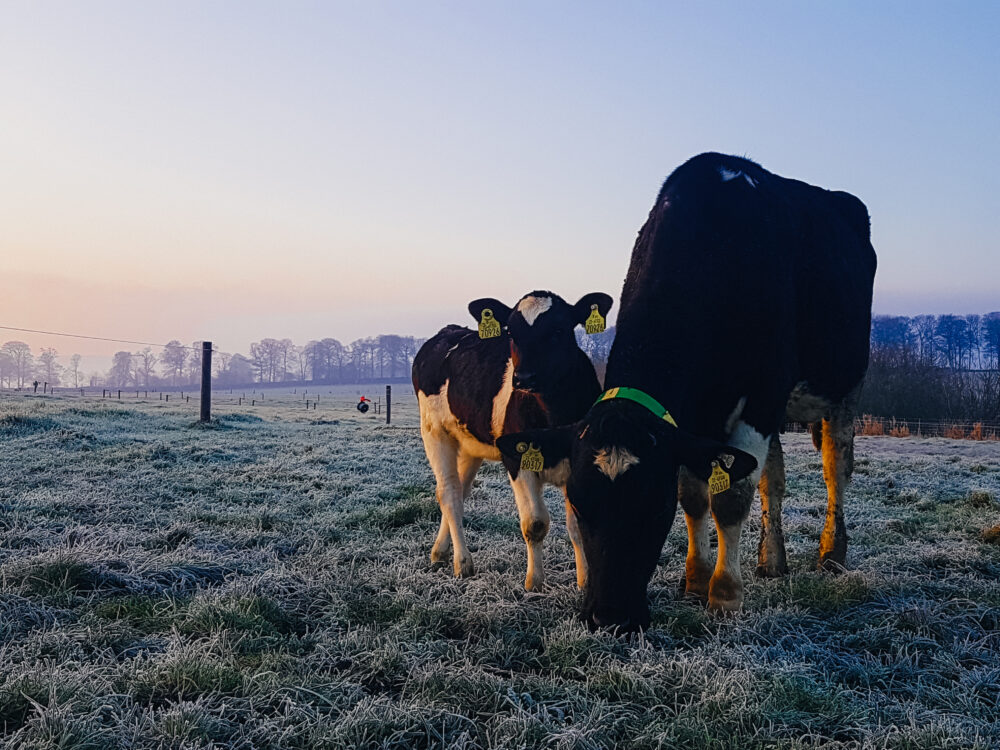
Photo credit: Teagasc
The practice of immediately separating dairy cows and calves shortly after birth is facing increasing societal scrutiny, due to ethical implications and public preference for more natural husbandry systems that allow animals to express natural behaviours like suckling and socialisation.
In Irish pasture-based dairy systems, integrating cow-calf contact (CCC) systems presents unique logistical challenges, particularly concerning calf welfare during inclement weather in late winter and early spring.
To date, much of the research on CCC has focused on indoor systems, as these are easier to implement and avoid the logistical difficulties associated with pasture-based systems.
Teagasc Moorepark conducted a study to evaluate two CCC approaches: one in which calves remained with their dams full-time, and another where calves were kept indoors to mitigate weather-related challenges while their dams grazed during the day before returning to them.
Both systems were then compared with the conventional calf-rearing system commonly used in Ireland. Weaning for all calves occurred at around eight weeks – however, the CCC calves had the additional stressor of separation from their dam.
In more detail, the three treatments were:
- full-time cow-calf contact outdoors (FT): calves had continuous access to their dams (22 h/day), separated only for twice-daily milking
- part-time contact indoors (PT): calves were indoors, dams went to graze by themselves at 8am, reuniting with their calves at 3pm; PT cows were milked once daily
- no contact indoors (CONV, conventional baseline): dams and calves were separated at birth.
Effects on calf health
Cow-calf contact systems, particularly the FT system, appeared to challenge calf health, notes Emer Kennedy, Dairy Enterprise Leader at Teagasc Moorepark.
“Throughout the study, issues related to faecal hygiene were observed most often in contact calves (FT and PT) compared to CONV calves. This might be due to the high volumes of milk consumed in CCC systems, which often results in softer faeces. However, when comparing calves in the pre-weaning period, morbidity requiring antibiotic treatment was highest in the FT system, affecting 37% of calves compared to 17% of PT and 6% of CONV calves.”
Illness complications led to the removal from the experiment of 22% (four out of 18) of calves in the FT system. This was attributed to environmental exposure to changeable weather experienced by the calves outdoors at young ages.
The risks associated with turning out young calves to pasture in late winter/early spring – especially cold stress, which diverts energy towards heat production – are relevant concerns in Irish pasture-based systems. In contrast, no calves were removed due to illness complications from the CONV or PT systems.
When assessing health physiologically around the weaning and separation process, calves had poorer clinical health scores and higher levels of inflammation post-weaning compared to pre-weaning, indicating weaning caused a decline in health status across all systems.
Calf growth and performance
Cow-calf contact systems provided clear advantages in pre-weaning growth. Both FT and PT calves achieved higher average daily gain (ADG) and body weight than CONV calves, reflecting unrestricted milk intake through suckling, continues Emer.
“At 56 days, contact calves averaged 82kg compared with 69kg for CONV calves. However, at weaning, the contact calves were weaned from milk and separated from their mother, which caused a sharp post-weaning decline in growth.”
Between 57 and 70 days of age, ADG dropped to 0.32kg/day for both FT and PT calves, while CONV calves grew faster at 0.68kg/day. Directly after weaning, CONV calves continued to grow better (1.04kg/day) than FT (0.42kg/day) and PT (0.40kg/day) calves.
Post-weaning, the PT calves showed the poorest growth overall, likely because of the stress from changes in diet, separation, and housing. The FT calves, however, recovered somewhat and eventually grew faster than both CONV and PT calves later in the post-weaning period. Blood tests suggested FT and PT calves experienced more nutritional stress during the transition compared to CONV calves.
Effects on the cow
During the CCC period (weeks 1–8), milk yield was reduced in FT and PT cows compared with CONV cows. Because calves had unrestricted access to their dams and other cows within the same system, they were able to nurse during contact times, which lowered the volume of milk harvested in the parlour. The PT cows produced about 25% less milk than FT cows, reflecting patterns often seen with once-a-day milking.
Although calf suckling provided additional stimulation that should have supported milk production, FT and PT cows did not match the yield of CONV cows after weaning and separation. Instead, they maintained lower production throughout the rest of lactation, resulting in 24% and 31% less cumulative milk yield, respectively.
The timing of weaning and separation may have intensified this effect, says Emer. “FT and PT cows experienced these changes during the same period when CONV cows were reaching peak milk yield. This disruption likely reduced their persistency, preventing recovery to CONV levels. Cows in all three systems showed good clinical health, with no differences in somatic cell scores.”
A modified approach?
Labour demands varied considerably between calf management systems. Conventional calves required significantly more labour immediately post-calving due to colostrum collection and feeding, while contact systems (FT, PT) needed far less.
However, during daily routines, the FT system required the most labour, largely from separating pairs for milking, raising concerns over handling difficulties, farmer safety, and human welfare during peak calving.
While CCC can be incorporated into pasture-based systems, the associated milk production losses may limit its practical adoption, concludes Emer.
“A modified PT approach, where calves are kept indoors with nighttime cow–calf contact and cows graze by day while being milked twice daily, may offer a better balance between animal welfare and productivity.”
Further research is needed to understand the mechanisms behind milk yield reductions and to develop strategies to mitigate these effects.
Funding
This project was funded by the VistaMilk Research Ireland Centre.
Contributors
Emer Kennedy, Dairy Enterprise Leader, Teagasc Moorepark.
emer.kennedy[at]teagasc.ie
Sarah McPherson, Sustainability Technologist, Teagasc Moorepark.
Alison Sinnott, PhD Walsh Scholar, Teagasc Moorepark.