
Hot topic
Gut health is an increasing area of focus for the food industry. Researchers at Teagasc Moorepark are collaborating with industry to further examine the potential health benefits of wasabi, an underused crop.
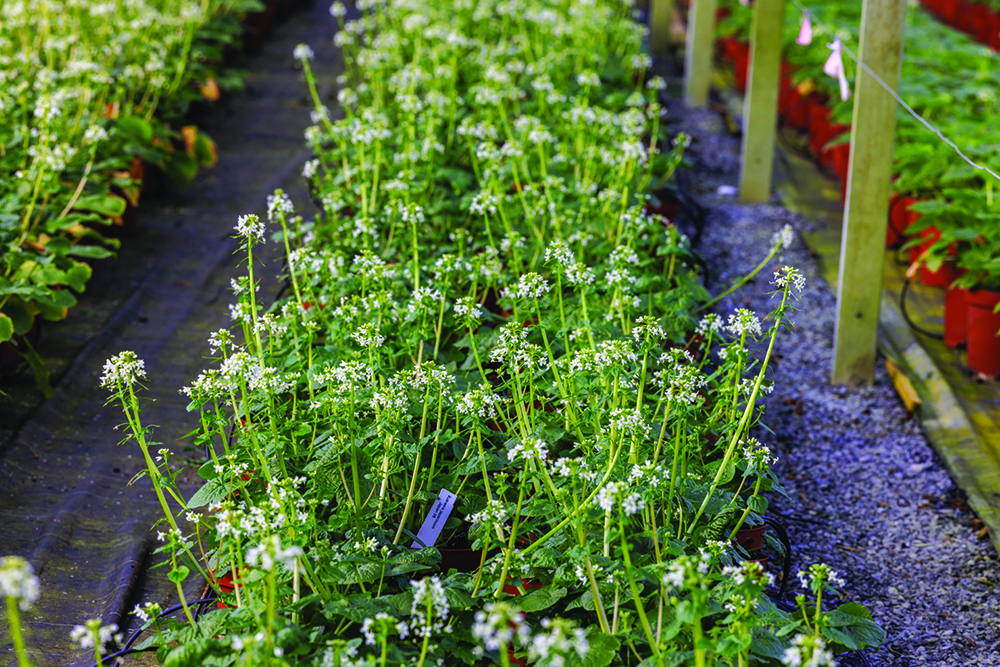
A bed of wasabi flowers, grown in controlled conditions at Beotanics, Ltd. Photo credit: Teagasc/Beotanics, Ltd
Researchers at Teagasc Moorepark are collaborating with Irish ag-tech company Beotanics, Ltd. to study several varieties of wasabi grown on-site in Kilkenny. This partnership highlights innovative, under-used crops in Ireland and their potential to support human health – in this case, their effects on gut health.
Beotanics is a pioneering Irish ag-tech company, founded by Pat FitzGerald, specialising in the cultivation of niche crops such as wasabi, yácon and more. Beotanics cultivate wasabi in a peat soil mixture within a polytunnel structure, using black mesh covering to provide shade and maintain cool growing conditions. During colder snaps and prolonged frost, the crop is covered with fleece. Wasabi plants are drip-fed through a connected irrigation system that supplies constant water and essential nutrients to the plants directly to the roots.
Historically healthy
Wasabi is a pungent plant native to Japan, commonly eaten as a paste alongside dishes such as sushi and sashimi. It grows naturally in cool, shaded areas with nutrient-rich soil and continuous flowing water. Nutritionally, wasabi is composed of carbohydrates, fibre, and small amounts of protein and fat. It also provides vitamins (particularly vitamin C), minerals such as potassium, calcium, and magnesium, and antioxidants.
Jane Lavin, a PhD Student at the Food Research Centre at Teagasc Moorepark, explains that wasabi is also known to contain a range of bioactive components called isothiocyanates.
“These components not only give wasabi its signature heat, but have also been linked to antimicrobial, anti-inflammatory and potentially anticancer effects. Historical sources suggest that wasabi may have been used to prevent food poisoning, especially from raw fish, as well as in other proposed health-promoting tonics.”
A healthy gut relies on a diverse and balanced microbiome, which supports digestion, nutrient absorption, immune function and overall wellbeing. By exploring the properties of niche crops like wasabi, researchers hope to uncover natural ways to promote gut health and overall wellbeing.
Root causes
To study the properties of wasabi in a lab setting, researchers first separated the wasabi rhizome (root) from its leaves and petioles and grated it using a traditional grater called an oroshigane, producing a fine and fluffy paste. Wasabi paste was digested using the globally harmonised INFOGEST protocol, a standardised method that simulates the oral, gastric and intestinal phases of digestion.
“The end-product was placed in a membrane submerged in water, allowing small molecules to pass through, similar to how nutrients are absorbed from the small intestine into the bloodstream,” explains Jane.
“Next, the digested wasabi was added to a small-scale model of the human distal colon. This consisted of several bioreactors that maintain key gut conditions, including temperature, acidity, and oxygen-free conditions.”
To mimic a gut microbiome, stool samples from healthy donors were collected and combined with a nutrient-rich medium. This medium was freshly made containing nutrients and growth factors to support the growth of microorganisms. The stool and medium mixture were combined with wasabi and allowed to ferment for 72 hours in an oxygen-free environment.
Samples were collected immediately to understand the composition of the microorganisms present initially. Then samples were collected every 24 hours to observe how the microbial community changed as a consequence of utilising wasabi.
In addition to studying the microbial population, the faecal supernatant was collected from samples and analysed to identify a wide range of metabolites produced by the gut microbes upon utilisation of the wasabi rhizomes and to gain insights into how these metabolites affect the gut.
While some commercially available varieties of wasabi pastes exist on Irish shelves, many are produced primarily with horseradish due to its lower cost and wider availability. Both plants are members of the same plant family, Brassicaceae. To account for this, commercial wasabi controls were included to compare its effects with those of authentic wasabi.
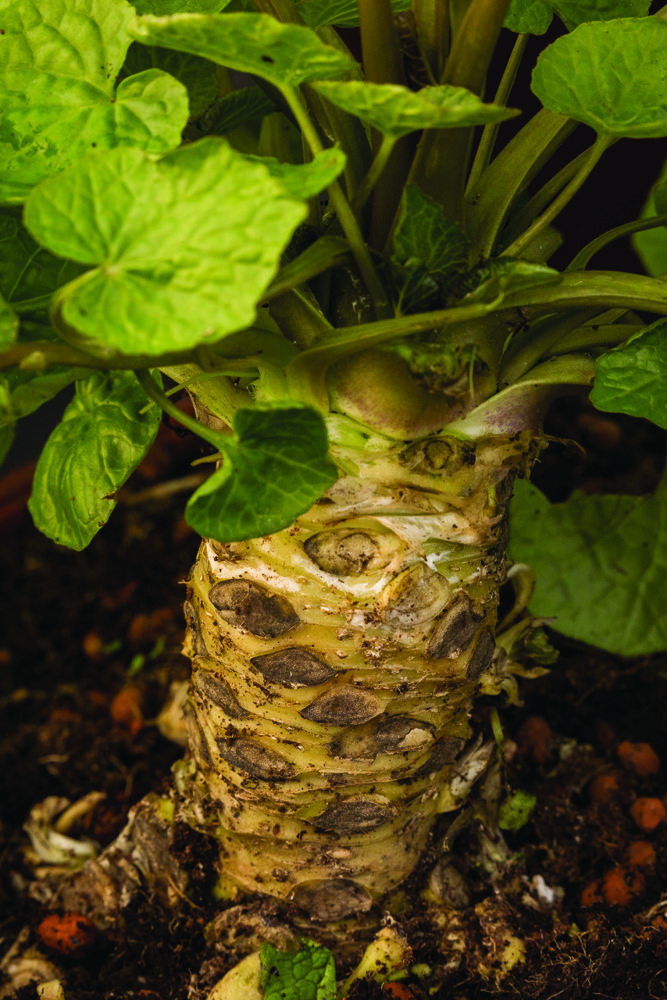
The wasabi rhizome, used to produce the traditional wasabi paste. Photo credit: Teagasc/Beotanics, Ltd
Compound interest
One of the most exciting aspects of wasabi is its isothiocyanates, examples of which include allyl-isothiocyanate and 6-(methylsulfinyl)hexyl isothiocyanate. These are natural compounds known to exert an antimicrobial effect on certain harmful bacteria, Jane adds.
“We hope that wasabi could show selective antimicrobial effects, targeting potentially harmful bacteria whilst concurrently supporting the growth of beneficial microorganisms. As part of our research, we are currently conducting bioinformatic analysis of sequencing data from the colon model experiments to precisely identify how wasabi rhizomes alter the composition and functionality of the gut microbiome.”
Over the next few months, this collaboration may shed light on how this traditional Japanese condiment might play a significant role in overall gut health.
Acknowledgements
The authors acknowledge the contributions towards this work by Arghya Mukherjee, Research Officer at Teagasc Moorepark, and Mark O’Brien, Senior Business Development Manager for Beotanics, Ltd.
Funding
This work was funded by a Grant in Aid Walsh Scholarship (2023006) and by Enterprise Ireland Innovation Voucher (IV20240231). Research in Harsh Mathur’s laboratory is supported by Enterprise Ireland and PepsiCo.
Contributors
Jane Lavin, PhD Walsh Scholar, Teagasc Moorepark
Richard FitzGerald, Research Project Manager, Beotanics, Ltd.
Pat FitzGerald, Founder/CEO, Beotanics, Ltd.
Harsh Mathur, Research Officer, Teagasc Moorepark
harsh.mathur[at]teagasc.ie