
Investigating the effects of crossbreeding
Work carried out at Teagasc Moorepark examined the crossbreeding of Holstein-Friesian cows with Jersey cows and how this might impact the composition, yield, or maturation characteristics of full-fat cheddar cheese.
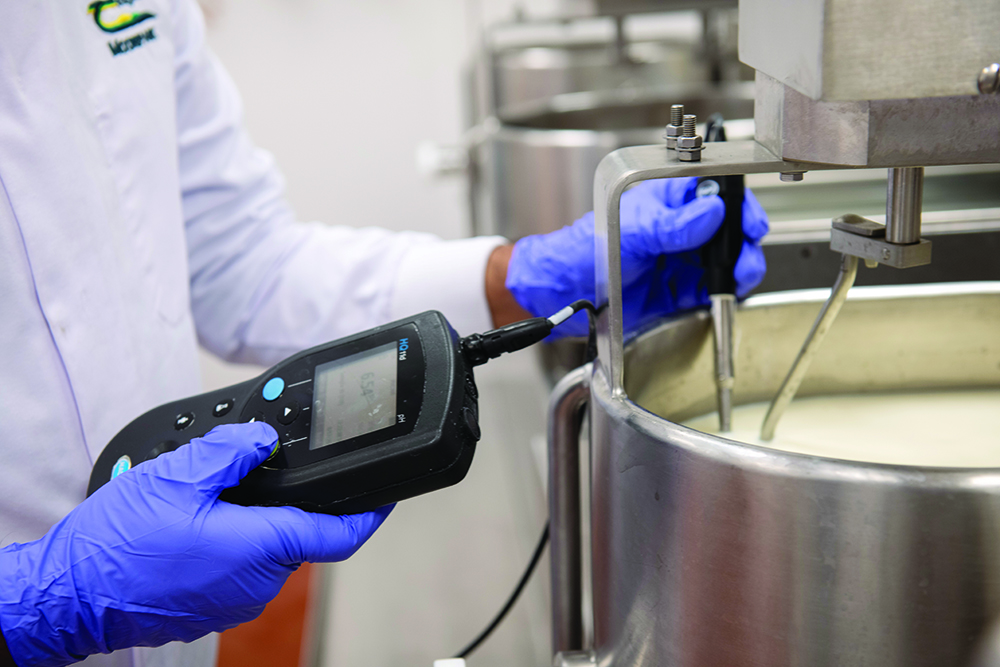
Choosing purebred vs crossbred cows milk for cheese production may potentially create an end-product more appealing to consumers. Photo credit: Andrew Downes
In Ireland, the national dairy herd is mainly comprised of Holstein-Friesian (HF) cows, a breed established through careful selective breeding of Holstein (HO) and Friesian (FR) cows.
The HF breed is highly specialised, producing high volumes of milk with sufficient levels of protein and fat to maximise total solids yields.
Dairy farmers in Ireland are paid based on the total protein and fat yielded with a penalty for milk volume, making milk fat plus protein more important than milk volume.
Brendan Horan, a Principal Research Officer in the Animal & Grassland Research and Innovation Centre, at Teagasc Moorepark, explains that European dairy systems have typically focused selective breeding efforts towards increased productivity and efficiency within the HF population.
“This approach has brought benefits, but a problematic consequence has been decreased rates of genetic diversity. Breeding strategies such as crossbreeding can offer a solution to improving fertility and overall herd health.”
In dairy herd management, a common strategy involves crossbreeding Jersey cows (JE) with HF, resulting in Jersey-Holstein-Friesian (JFX) cows, Brendan continues.
“Previous studies at Teagasc Moorepark have shown that JFX cows outperform pure HF cows due to improved fertility and overall herd productivity. However, limited research has been conducted on how crossbreeding affects dairy products.”
To address this gap, researchers at Teagasc Moorepark and the University College Cork investigated the effects of crossbreeding on the composition, yield, and maturation characteristics of full-fat cheddar cheese. Cheese is a key dairy product in Ireland, with approximately one-third of the country’s milk supply used for cheese production.
Cheese on trial
The study was completed in triplicate; mid-lactation milk was collected on three occasions in August 2022, from a grazing farm systems experiment at Teagasc Moorepark.
Cows had been divided into JFX and HF groups, each group consisting of 25 cows randomised for age, yield, and parity. All were grazed on a typical pasture diet of perennial ryegrass.
Using the milks derived from the JFX and HF groups, cheddar cheesemaking trials were completed, and the composition and yield of the resultant cheeses were determined. The ripening characteristics of these cheeses were then investigated over a six-month maturation period.
Fat chance
The research found that both the raw milk and the cheesemilk (i.e. milk standardised to a protein-to-fat ratio of 0.95) derived from JFX cows had significantly higher levels of protein and fat compared to milk derived from HF cows, notes Richard Page, a PhD Walsh Scholar.
“Despite this, no significant differences were found in the level of lactose, mineral composition and fatty acid profile between the two groups.”
In a similar vein, crossbreeding Holstein-Friesians and Jerseys was found to have no significant effect on the moisture, protein, fat, salt, minerals and total fatty acid profile of the cheese.
“Cheddar cheese made with milk from JFX cows resulted in an average ~5 min faster set-to-cut time and actual yield increase of ~3% than HF cows,” Richard points out.
“However, these differences were not statistically significant, but they could be worth further study.”
No significant differences were observed between HF and JFX cheddar cheeses in terms of texture, proteolysis, pH, volatile-organic-compounds and free fatty acid profile.
Shades of difference?
The major point of difference was that the JFX cheeses were significantly more yellow in colour compared to HF cheeses (see Figure 1).
This was confirmed through higher b* values, explains Richard.
“The b* value is an instrument measure of colour from blue to yellow, and the significantly higher b* values indicate that JFX cheeses are more yellow than HF cheeses.”
“From a due-diligence perspective, it was not evident from this study that JFX phenotypes cause practical negative impacts on the cheesemaking ability of milk or adversely influence final cheese quality.
“As noted, the most significant difference observed was that cheese derived from JFX milk was more yellow in colour. This could be interpreted as being indicative of preferable sensory quality – consumers may feel a more yellow cheddar seems more high-quality – but the nutritional values remain ostensibly the same.”

Figure 1. The effect of Holstein-Friesian (HF) and Jersey-Holstein-Friesian Crossbreeding (JFX) on the b* values of cheeses during ripening. Presented values are the means from 3 replicate cheese trials; error bars show standard deviations of the means
Funding
This work was funded through Teagasc core funding, Project: Futuremilk2025 (grant number: 1412).
Acknowledgements
The authors would like to thank Tom O’Callaghan (UCC) and Seamus O’Mahony (UCC) for their contribution to this research.
Contributors
Richard Page, PhD Walsh Scholar, Food Chemistry and Technology Department, Teagasc Moorepark.
John Tobin, Department Head, Food Chemistry and Technology Department, Teagasc Moorepark.
Brendan Horan, Principal Research Officer, Animal & Grassland, Research and Innovation Centre, Teagasc Moorepark.
Prabin Lamichhane, Research Officer, Food Chemistry and Technology Department, Teagasc Moorepark.
prabin.lamichhane[at]teagasc.ie