
Ryegrass fights back
Glyphosate-based herbicides have thus far been effective in controlling weeds across Irish tillage. However, industry and researchers must consider integrated weed management practices in the face of growing herbicide resistance.
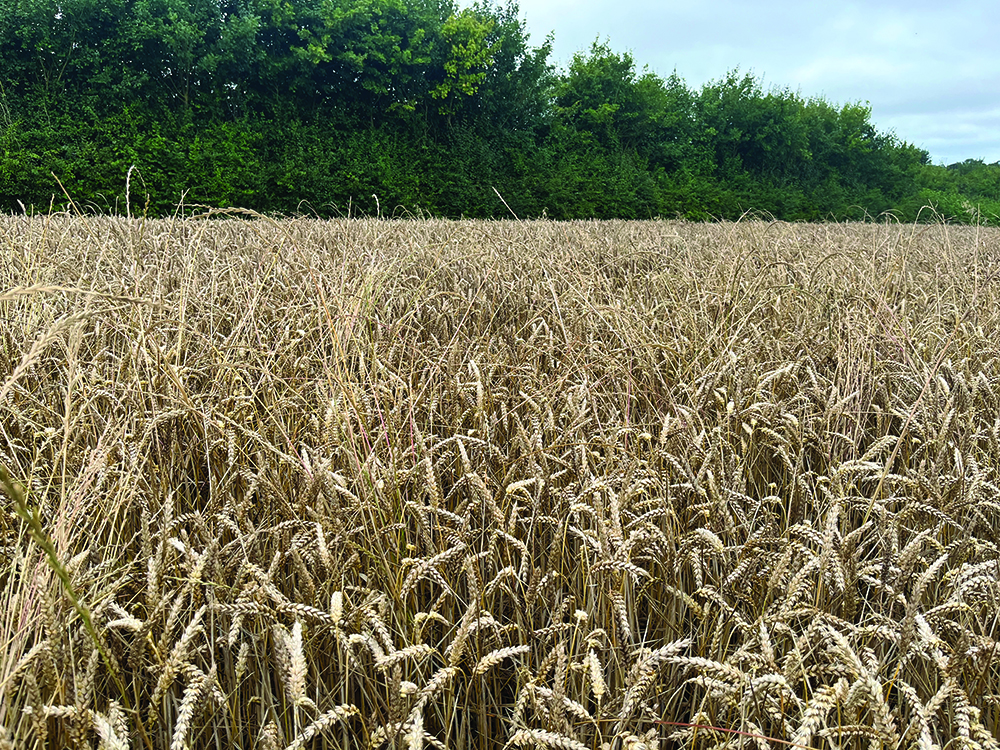
Photo credit: Teagasc
Lolium multiflorum, Italian ryegrass, is an increasingly herbicide-resistant grass weed that poses a serious threat to Irish tillage farms. To date, glyphosate-based herbicides have proven effective in controlling all grass-leaved weeds – as well as many broad-leaved weeds – across Ireland. However, if Italian ryegrass and similar weeds were to develop resistance to glyphosate, this would substantially impact weed management options.
Glyphosate resistance can develop through two primary routes. One is target-site resistance (TSR), which includes mutations in the EPSPS gene or gene amplification leading to an increased copy number of the EPSPS gene. The other is non-target-site resistance (NTSR), which includes mechanisms that reduce herbicide effectiveness without altering the target site, such as enhanced metabolism, reduced absorption, or vacuolar sequestration.
More than 50 weed species worldwide have developed glyphosate resistance, explains Vijaya Bhaskar A.V., a Research Officer in the Crop Science Department at Teagasc Oak Park.
“While such resistance occurs mainly in perennial crops like orchards and vineyards, it is less common in annual crops.” However, Vijaya warns, glyphosate resistance in Italian ryegrass has been found in cereal crops in Italy and in the UK.
“This signals a need for the agricultural sector to remain vigilant and to consider integrated weed management practices, which can help to reduce the selection pressures that drive resistance development.”
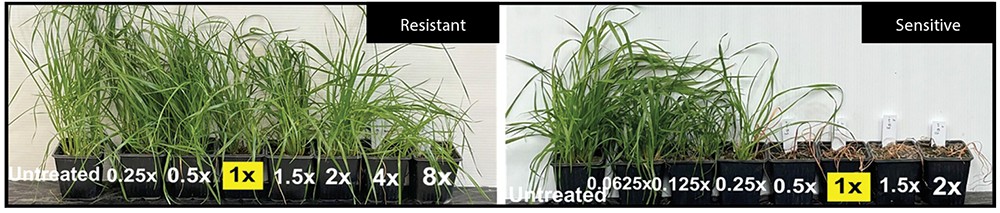
Figure 1: shows symptoms of resistant (left) and sensitive (right) populations of Italian ryegrass following application of glyphosate. The recommended rate (highlighted) of 540g/ha was used, which is the standard for use on young grass weeds in stubbles or pre-sowing. Dose rates ranged from 0.25 to 8 times the recommended rate for the resistant population and 0.0625 to 2 times for the sensitive population.
Assessing effectiveness
Ahead of the 2024 harvest, a suspected glyphosate-resistant Italian ryegrass population was submitted for testing.
A detailed dose-response study was done in glasshouse conditions, comparing the suspected glyphosate-resistant population alongside a known herbicide-sensitive population.
Plants at the two- to four-leaf stage were treated with glyphosate at rates ranging from 0.0625 times to eight times the recommended rate (540g/ha), the standard rate for controlling young grass weeds. Plant survival and above-ground shoot fresh weight were assessed 30 days post-treatment.
“We assessed herbicide effectiveness by calculating the effective dose causing 50% mortality (ED50) or 50% growth reduction (GR50), relative to untreated plants. We then extracted genomic DNA from leaf samples of resistance-suspect and herbicide-sensitive plants,” Vijaya explains.
“Genomic DNA was extracted from leaf samples of resistance-suspect and herbicide-sensitive plants, followed by PCR and pyrosequencing to detect any TSR mutations associated with resistance. In addition, the relative genomic copy number of EPSPS in both populations was assessed to determine if extra copies of this gene are present in the resistance-suspect population.”
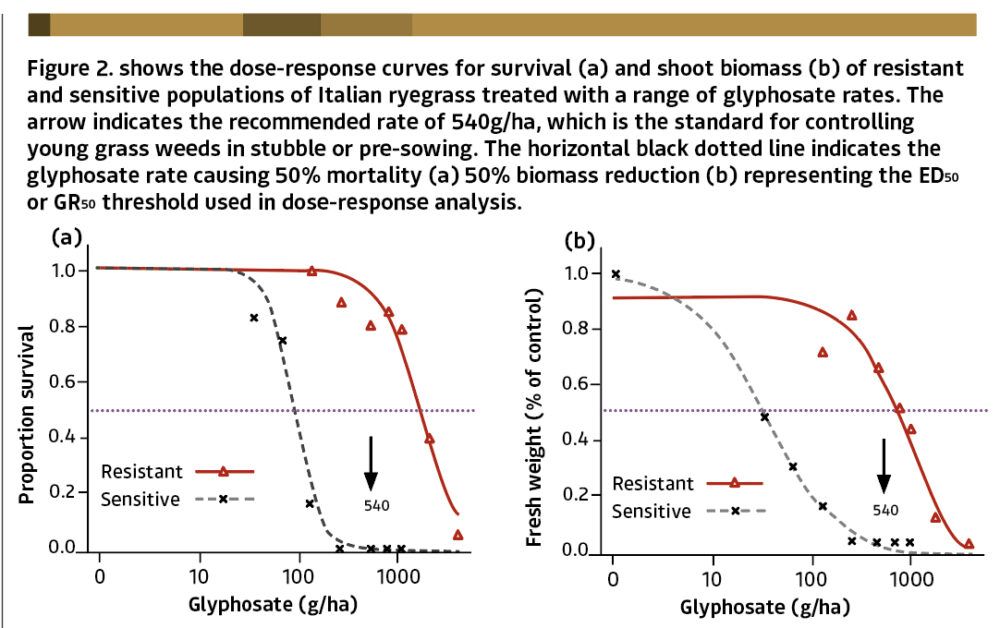
Figure 2 shows the dose-response curves for survival (a) and shoot biomass (b) of resistant and sensitive populations of Italian ryegrass treated with a range of glyphosate rates. The arrow indicates the recommended rate of 540g/ha, which is the standard for controlling young grass weeds in stubble or pre-sowing. The horizontal black dotted line indicates the glyphosate rate causing 50% mortality (a) 50% biomass reduction (b) representing the ED50 or GR50 threshold used in dose-response analysis.
Measuring resistance
The sensitive population was well-controlled at rates below the recommended rate of glyphosate treatment, with ED50 achieved at a value of 87.7g/ha and GR50 at a value of 33.2g/ha. By contrast, the resistant population showed high resistance; even at eight times the recommended rate of glyphosate treatment, incomplete control of Italian ryegrass was observed. In the resistant population, ED50 values were 1709.8g/ha and GR50 values were 1111.9g/ha.
The resistance index, which is the ratio of resistant ED50 values to sensitive ED50 values, indicated that the resistant population was approximately 20 times more resistant than the sensitive population. Molecular analysis identified a known TSR mutation at the Pro-106-Ser position of the EPSPS gene in the resistant population, along with an increased EPSPS gene copy number ranging from four- to eight-fold, both of which conferred high glyphosate resistance.
This is the first confirmed case of glyphosate resistance in Ireland, more than 50 years after its introduction. The message is clear, Vijaya underlines: no herbicide is immune to resistance evolving.
“This is an important wake-up call for the industry. Industry, growers and researchers all need to work together and stay vigilant against potential resistance issues in crops,” he concludes.
“This means being proactive in dealing with such potential issues, adopting biosecurity measures, and, in particular, to increase our focus on implementing cultural and non-chemical integrated weed management approaches. This latter point is crucial in order to help reduce the selection pressure that drives the development of herbicide resistance.”
Funding
The EVOLVE project (Evolving grass-weed challenges and their impact on the adoption of carbon smart-tillage systems, Grant No: 2021R528) is funded by the Department of Agriculture, Food and the Marine under the Research Stimulus Programme.
Contributors
Vijaya Bhaskar A.V., Research Officer, Crop Science Department, Teagasc Oak Park.
vijaya.bhaskar[at]teagasc.ie
Dermot Forristal, Principal Research Officer (retired), Crop Science Department, Teagasc Oak Park.