
Stripe Young Scientist and Technology Exhibition (SYSTE)
SYSTE 2026
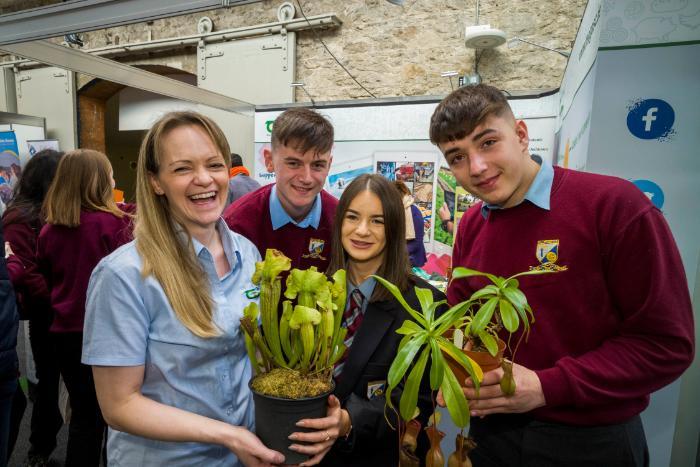
SYSTE 2026 will take place from 8-10 January. We invite visitors to visit the Teagasc stand at the Expo Hall 1 of the RDS Main areana, stand 112 where we had a range of hands-on displays throughout the exhibition covering a range of topics from across our Education, Advisory and Research directorates.
What to expect at the Teagasc stand
Forestry, climate and the environment
The Teagasc Forestry Development team – Áine Moran, Michael Somers, Pádraic O’Leary, Grace Jones, John Casey, Frances McHugh and Liam Kelly – will host interactive displays featuring trees and timber samples, highlighting the role of forests in carbon storage, biodiversity and sustainable land use.
Climate research will be explored with Karl Richards, Head of the Teagasc Climate Centre, who will discuss climate impacts and solutions, alongside Omobolanle Blessing Kalenikanse (Animal & Biosciences), who will explain research focused on reducing enteric emissions from livestock.
Crops, plants and biodiversity
Crop and plant scientists will demonstrate how research supports resilient, sustainable food systems. Activities include a plant–aphid board game exploring disease spread, integrated pest management demonstrations, and hands-on engagement with wildflowers and biodiversity.
Researchers involved include Marta Niedzicka, Sara Dunny Fox and Jack Perry (Crop Science), Hui Xing and Paul Fitters (Botanics), and Susanne Barth (Crops), who will also present the Biodiversity in Action school kit designed to link research with classroom learning.
Food, nutrition and health
Food biosciences research will highlight how Teagasc science supports healthier and more sustainable foods. Maria Hayes will present research on seaweeds, fisheries by-products and microalgae as sources of bioactive ingredients for use in functional foods, pharmaceuticals and topical applications.
Plant-based and gluten-free food research will be showcased by Pavithra Parthasarathy and Yueyue Chen, focusing on foods made from Irish-grown crops such as oats, fava beans, peas, quinoa and buckwheat. This work addresses challenges including coeliac disease, digestibility and healthy ageing using innovative laboratory models.
Animals, soils and ecosystems
Animal and environmental research will feature through hands-on activities. Francesca Johansen (Pig Research Department) will explore animal behaviour through interactive games, while Karla Burke (Environment, Soils and Land Use) will demonstrate soil microbiology, visual evaluation of soil structure and the underwear decomposition test to highlight the importance of soil health.
Innovation, data and education pathways
Spatial Analysis and Innovation researchers Rosie Giglia, Amy O’Leary and Lauren McGuinness will show how data, design thinking and engaged research inform decision-making, from plant protein value chains to public health challenges such as vitamin D deficiency.
Rónán mac an tSaoir (Ballyhaise College) and Dónall Flanagan (Horticulture) will speak with students about education pathways, ornamental plants and pollinators, including bees.
Karla Burke and Omobolanle Blessing Kalenikanse will also take part in an on-stage career discussion, sharing their experiences and how they are developing their careers through Teagasc’s Walsh Scholar Programme.
Teagasc Prize
Teagasc sponsors a special award at the event. The Teagasc prize is awarded to the project that best demonstrates a thorough understanding of the science of agricultural or food production, or the use of science to improve technologies available to agricultural or food production.
Previous winners
2020 – Herbal Leys – Milk Production for the Future