Artificial Nitrogen Fertilisers can be in either of three forms or indeed in combinations of more than one form:
Nitrate Nitrogen
Ammoniacal Nitrogen
Ureic Nitrogen.
Nitrate Nitrogen is the most readily available form of artificial nitrogen fertiliser for plant roots. The other types have to be converted to this form by soil acting bacteria before they can be utilised by crops. Nitrate N is very easily washed out of the soil. Because they are quick acting, fertilisers containing nitrate nitrogen are often used as top dressings on growing crops.
Calcium Ammonium Nitrate (C.A.N.) contains 26-27% nitrogen – half of it as nitrate nitrogen and half as ammoniacal nitrogen. This means that half the nitrogen is readily available while the other half is slow acting. This makes it a suitable fertiliser for grass, especially for spring grazing. It is suitable for any crop or soil and may be applied at sowing time or preferably as a top dressing.
Ammoniacal Nitrogen is a form of nitrogen based on ammonia, which is a nitrogen rich substance. It is slower acting than the nitrate form. It must be converted by soil acting bacteria to nitrate nitrogen before it can be absorbed by plant roots. It is not as easily lost from the soil by leaching.
NH4 ———-> NO3 ————–> Plants
(Ammonium) (Nitrate)
It can take from 3-5 weeks for the ammonium nitrogen to be converted to nitrate nitrogen by soil bacteria depending on soil moisture and temperature. Urea converts to nitrate N in 2 to 4 days depending on soil conditions.
Sulphate of Ammonia contains 21% nitrogen. Its nitrogen is in the ammonium form and hence is slower acting than C.A.N. It is useful in areas of low soil sulphur content.
Ammonium sulphate nitrate (ASN) contains 2^% N and 14% S. This is a mixture of ammonium nitrate and ammonium sulphate. The ammonium nitrate converts rapidly to nitrate N and the sulphur is also in a plant available form and immediately available to the plant.
Ureic Nitrogen is obtained from the substance called Urea which is also a nitrogen rich compound. In order to be absorbed by plant roots this form must be converted firstly into the ammonium form and then to the nitrate form by soil acting bacteria. For this reason it is slow acting and can be affected by low soil temperatures and dry soil surface conditions. Water must be added to Ureic Nitrogen to convert it to Ammonium Nitrogen. This can only occur in moist soils. This explains why urea is used early in the season and is not used during the dry summer months.
Urea contains 46% nitrogen. It is commercially used on grassland and as a cereal top dressing. It is not safe to combine with seed as it can severely inhibit germination. It needs to be applied on moist soil to be fully effective. It also gives best results when used in warm conditions. Urea should not be applied to soils which have been recently limed.
Urea is a cheap form of nitrogen. It is often found to be as good as C.A.N. but in some cases is found to be less efficient. Urea, like nitrate fertilisers, is easily leached when first applied to the soil. This would be a big disadvantage if heavy rain were to follow application. After application, urea is rapidly converted to ammonium carbonate, this may lead to losses at or near the surface of the soil or do damage to young roots or germinating seeds. This is the reason for caution about including urea in compound fertilisers.
Protected Urea
This page contains information on protected urea fertilisers and their efficient use. Protected urea is the number one technology to reduce greehouse gas emissions on grassland farms and help achieve ammonia reduction targets.
Protected urea (protected with a urease inhibitor) is cheaper than CAN and standard urea
Protected urea is cheaper than CAN on a cost per kg of nitrogen basis, and, while it may appear slightly dearer than ordinary urea, it will give the same “effective N” for the plant as urea, at a 12.0% lower spreading rate.
Table 1 summarises the N lost from the three N fertiliser products as ammonia and nitrous oxide nitrogen gases. The EPA estimates that ammonia loss from urea is 15.5% on average. Both protected urea and CAN have lower rates of N loss (79% reduction for protected urea = 3.3% loss; 85% reduction for CAN = 2.3% loss). Published research has quantified direct N loss as nitrous oxide from urea (0.25%), protected urea (0.4%) and CAN (1.49%), when indirect loss through ammonia redeposition is included urea and protected urea are similar. In summary, protected urea curtails N losses by reducing (1) ammonia N emissions compared with standard urea, and (2) nitrous oxide N emissions compared to CAN. This would make protected urea more cost effective than both urea and CAN.
Table 1: Percentage N lost from three N fertiliser products through two loss pathways
N loss pathway
Urea
Protected Urea
CAN
%N lost
Ammonia
15.5
3.30
2.30
Nitrous oxide
0.25
0.40
1.49
While the cost per kg of nitrogen is cheapest for standard urea (Table 2), when the extra losses associated with standard urea are accounted for, protected urea is cheaper. See example 1 below.
Table 2:Relative Cost per kg N for Different Fertiliser Types
CAN
NBPT Protected Urea
Urea
kgN/tonne
270
460
460
€/tonne
750
1,000
950
€/kg N
2.78
2.17
2.06
Example 1
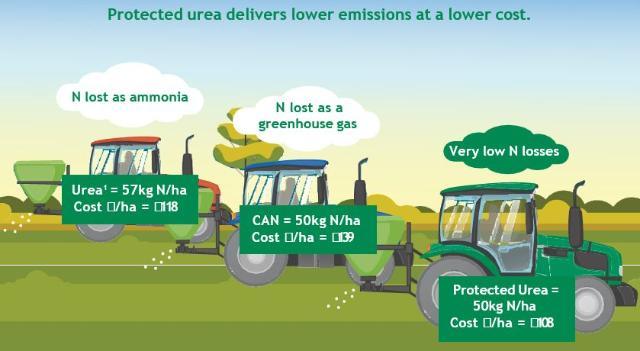
Assuming a rate of 50 kg of N spread as protected urea or 50 kg of N spread as CAN in March 2022. The equivalent quantity of N as standard urea that would need to be spread is 57kg to achieve the same plant available N, allowing for the extra losses with standard urea. If we assume costs of urea = €950/t, protected urea = €1,000/t, CAN = €750/t, Table 2 highlights the difference in cost with protected urea being the cheapest option.
Table 3: Relative cost of an application of N using different fertiliser types
CAN
NBPT Protected Urea
Urea
kg N spread
50
50
57
€/tonne
750
1,000
950
Cost of the application €
139
109
118
At these prices, the farmer will get better value for money by using protected urea (as opposed to urea). The example above, using current fertiliser prices, shows that the extra cost of the urease inhibitor more than covers its cost, if it saves 6 kg of N/ha. The value of retaining N that had previously been lost as ammonia has increased dramatically in line with the increased fertiliser cost. Also, in a situation where N application rate is limited, it makes sense to use less of a more effective product.
Protected urea grows more grass in the long term
While the quantity of grass grown by using CAN, protected urea and urea was similar across all fertiliser types in short-term Teagasc trials. In a long-term trial at Johnstown Castle, the grass grown by the fertiliser (i.e. net of the zero N control) for protected urea was greater than standard urea in 6 out of 7 years, 2018 being the exception due to drought when water was the limiting factor not nitrogen.
Protected urea grew 13% more grass on average compared to standard urea. The additional yield is similar in magnitude to the extra effective N level delivered to the plant by protected urea over standard urea. CAN yielded 9% more than standard urea.
Potential to reduce farm emissions
By switching to 100% protected urea on dairy farms, total farm emissions have the potential to be reduced by 7-8% at a spreading rate of between 200 to 250 kg N / ha.
The equivalent savings on total emissions on suckler farms is 1-2%, at a spreading rate of 60 to 80 kg N / ha.
Straight P and K fertilisers or blends such as 0-7-30 or 0-10-20 would be needed to achieve a 100% switch or alternatively use of a split or two of high P-K products such as 18-6-12 +S based on nutrient need opens the opportunity for more straight N slots where protected urea +/-S is a good fit.
Table 4: Benefits of using different fertiliser types
Protected Urea
CAN
Urea
Grass grown
x
x
Lowest ammonia emissions
x
x
Lowest GHG emissions
x
x
Lowest GHG and ammonia emissions
x
Lowest cost €/kg of nitrogen
x
Lowest cost €/kg of nitrogen
x
Unsure which product to use?
There are 20 protected urea products available from 6 companies. There are straight N options, N+S options as well as N+K+S options. If in doubt on which products to use check the list at https://www.teagasc.ie/crops/soil–soil-fertility/
Supply may be an issue in 2022 but get your order in early to help reduce farm and overall agricultural emissions.
Practicalities of using protected urea
Precise and ‘even’ spreading of fertiliser is essential. As protected urea is a high- N product, trial and error is not an option, it must be got right first time. Key points:
Even spreading depends on the fertiliser physical quality, the spreader, the bout width used, and the adjustment of the spreader.
All urea fertilisers are lower density than CAN, which makes them a little more challenging to spread wide, making bout width choice and machine setting vital. Urea from different sources varies in quality. Larger and stronger granules spread better.
Protected urea, will spread similarly to standard urea, provided it is treated and stored well. Choose a product that has larger and stronger particles. Excessive deposits on the spreading vanes indicates poor quality control in production or storage, impacting on even spreading.
Provided the correct settings and bout width are used, protected urea can be spread evenly with most spreaders.
To set the spreader, match the fertiliser’s quality to a product on the spreader manufacturer’s database (assessing size and strength). Use the manual or phone App or online resource to determine the bout width capability and the spreader settings (disc, vane, hopper height/angle etc) necessary for good spreading.
Use simple tray tests if guided by the manufacturer to verify the spread pattern.
NBPT Urea is urea that is treated with an active ingredient known as urease inhibitor. Urease inhibitor can be either coated onto the outside of the fertiliser granule or incorporated into the urea granule melt during the manufacturing process. Urease is the enzyme which catalyses the conversion of urea to ammonium. It is during this process that ammonia gas is lost from ordinary urea. The urease inhibitor acts as a blocker to the active site of the urease enzyme, moderating the rate at which urea converts to ammonium, and as a result, reducing ammonia losses and retaining more effective N to grow grass.
NBPT Urea can be spread throughout the growing season, at times when many farmers would otherwise spread calcium ammonium nitrate (CAN) or ordinary urea. Weather conditions are also an important factor to consider when applying any type of fertiliser N. During periods of drought, it is best to hold off on applying fertiliser N until rain is forecast and there is sufficient soil moisture for N uptake by the plant roots. This is due to the fact that if rain does not arrive to melt the fertiliser N into the soil, it will not be taken up by the plant and will remain in the soil until sufficient soil moisture is present.
Impact at Farm Level
NBPT Urea can have a positive impact at farm level in terms of financial benefits. NBPT urea is cheaper than CAN on a cost per kg of nitrogen basis. While it may appear slightly dearer than ordinary urea, it will give the same “effective N” for the plant as urea, at a 13.0% lower spreading rate due to more of the N retained.
NBPT Urea can also result in more grass being grown over a longer period of time, resulting in +0.5t DM/ha over ordinary urea. While the quantity of grass grown by using CAN, NBPT urea and urea was similar across all fertiliser types in the short-term. A long-term trial at Johnstown Castle Research Centre showed that the grass grown by the fertiliser, net of the zero N control, for NBPT urea was greater than standard urea in 6 out of 7 years. 2018 was an exception due to drought when water was the limiting factor not nitrogen. NBPT urea grew 13% more grass on average compared to ordinary urea. The additional yield is similar in magnitude to the extra effective N level delivered to the plant by NBPT urea over ordinary urea. CAN yielded 9% more than ordinary urea.
Another big advantage of NBPT urea is that farmers can use it throughout the permitted growing season. It will work as effectively as ordinary urea in spring in damp conditions and, due to the inclusion of the urease inhibitor, it releases N slower and more effectively than during the growing season. Trials at Johnstown Castle showed that weather conditions, for example, dry bare soils, conducive to loss of N were encountered in the springtime (March) of the year. Therefore, it is recommended to apply NBPT urea in springtime to reduce N losses. In addition, NBPT urea is a key technology for Ireland to reduce ammonia losses and is accounted for in the national inventory to reduce national ammonia emissons.
An example of NBPT Urea being used to great effect can be seen at Kildalton College’s farm.
Benefits to the Environment
Nitrous Oxide (N₂O)
There are several reasons why NBPT Urea is seen as beneficial, none more relevant than the environmental impact of using it. Nitrogen fertilisers release nitrous oxide (N₂O) which is a powerful greenhouse gas emitted from agriculture. Teagasc studies show that NBPT Urea has 71% lower N₂O emissions, this while also having comparable ammonia losses to CAN. NBPT urea can also be seen to reduce ammonia loss by up to 79% in comparison to ordinary urea. NBPT urea also consistently yields as well as CAN in Irish grasslands.
NBPT urea helps to reduce nitrate (NO₃) leaching. Nitrate leaching can occur during times of heavy or prolonged rainfall. Free draining soils are particularly susceptible to losses as nitrate is very mobile in soil and can be readily leached to groundwater. CAN is made up of 50% ammonium and 50% nitrate. After spreading CAN a large pool of nitrate is placed in the soil. It is open to being leached away if unfavourable conditions occur, such as heavy rainfall events.
NBPT urea converts to the ammonium form of nitrogen when applied to soil. Ammonium is more stable in soil than nitrate and less susceptible to leaching due to its positive charge. Soil microbes convert ammonium to nitrate almost like a steady conveyer belt; plants take up both nitrate and ammonium as required for growth and have access to a steady flow of available nitrogen as soon as the NBPT urea granules begin to melt.
Protected Urea delivers lower emissions at a lower cost.
What do farmers need to do?
Farmers are encouraged to switch from ordinary Urea and CAN to NBPT Urea. In order to do this, there are some considerations to make in terms of application preparation and where to purchase NBPT urea products. There are over 20 NBPT urea products available from at least six fertiliser blenders. There are standard N options, N plus sulphur (S) options, as well as N plus potassium (K) plus S options.
New farmers should also consider what compounds are required to use with NBPT Urea, with straight phosphorus (P) and K fertilisers or blends such as 0-7-30 or 0-10-20 needed to achieve a 100% switch. Alternatively, farmers would need to use an application or two of high P-K products such as 18-6-12 plus S based on farm fertiliser requirements. This opens the opportunity for more straight N slots where NBPT urea with or without S is a good fit. If in doubt, farmers can check utilise a variety of resources here.
In 2024, a new formulation of NBPT urea will include P in fertiliser blends for the first time. This ensures the stability of the NBPT inhibitor while delivering a reliable fertiliser option to reduce N₂O and ammonia emissions from fertiliser N.
Other Considerations
Other factors for farmers to consider when using NBPT Urea include:
Choosing a product that has larger and stronger particles.
Avoiding spreading on very windy days.
Ensuring the correct fertiliser settings/calibrations and bout width are used, which can be determined by using a spreader manual, phone app or online resources.
Using simple tray tests to verify the evenness of the spread pattern.
Where NBPT urea is being applied, trial work indicates that it is safe to apply to fields that have been limed recently.
Why use Protected Urea in the first or second round of fertiliser in the springtime?
It is low cost, reduces N losses, is a safer form of N in terms of leaching and denitrification, and is the number one technology to help Ireland reach national ammonia inventory targets.
Will it work as fast as CAN or standard urea?
Yes. It is a more stable and efficient form of N compared to other major N sources.
Will NBPT urea give the same performance as CAN fertiliser applied in dry conditions?
Yes, the Irish trial results show no significant yield or N recovery difference between CAN and NBPT (urease inhibitor).
Is NBPT urea more corrosive on fertiliser spreaders?
It is more hygroscopic than other fertilisers, causing it to draw moisture if the spreader is not washed out.
What’s the shelf life of NBPT urea?
Manufacturers recommend to use within six to 12 months depending on product type. Consult a fertiliser supplier for more information.
How stable is the NBPT Urea when mixed with other nutrients?
NBPT urea is most stable when bagged as a straight N product. Its stability in storage may differ when bagged with other nutrients as follows:
N with P: Stable. Currently a new NBPT formulation is available to protect the NBPT against the breakdown from P fertilisers
N with S: Stable but depends on the quality of the ammonium sulphate (if dusty)
N with K: stable/little impact on urease inhibitor.
Will NBPT urea affect soil microbes?
Trial work conducted at Johnstown Castle indicates no negative impact on soil microbes (grassland plots that have received protected urea for over eight years). Trials show positive impacts on soil biological communities compared to controls
Will NBPT urea affect water quality or get into waterways?
No, NBPT urea is less likely to be leached through soil compared with CAN, but farmers still need to adhere to good practice guidelines when applying fertilisers.
Is NBPT urea regulated?
NBPT urea is regulated by the EU and Irish regulatory bodies.
Is there a risk of the NBPT getting into the food chain?
Irish and international studies have demonstrated that no residues were found in the milk of cows grazing pastures fertilised with NBPT urea.
Testimonials
“It was probably one of the easiest fertilisers to calibrate in the spreader, and that is taking into account that my machine can be hard to get right. Also, I got a lot further with a full spreader. And it is also cheaper per unit of N than CAN.”
– Sam Pierce, Suckler Beef Farmer, Wexford.
“After hearing about NBPT urea at discussion group meetings, we decided to try it out and we have been happy with the results. NBPT urea, low-emission slurry spreading (LESS) and reducing chemical N use are the low-hanging fruit when it comes to GHG emissions. These tools are a great initial step in reducing our carbon footprint as an industry.”
– Cathal and Des McHugh, Dairy Farmers, Roscommon.
Manage Consent
To provide the best experiences, we use technologies like cookies to store and/or access device information. Consenting to these technologies will allow us to process data such as browsing behavior or unique IDs on this site. Not consenting or withdrawing consent, may adversely affect certain features and functions.
Functional
Always active
The technical storage or access is strictly necessary for the legitimate purpose of enabling the use of a specific service explicitly requested by the subscriber or user, or for the sole purpose of carrying out the transmission of a communication over an electronic communications network.
Preferences
The technical storage or access is necessary for the legitimate purpose of storing preferences that are not requested by the subscriber or user.
Statistics
The technical storage or access that is used exclusively for statistical purposes.The technical storage or access that is used exclusively for anonymous statistical purposes. Without a subpoena, voluntary compliance on the part of your Internet Service Provider, or additional records from a third party, information stored or retrieved for this purpose alone cannot usually be used to identify you.
Marketing
The technical storage or access is required to create user profiles to send advertising, or to track the user on a website or across several websites for similar marketing purposes.