Water Quality in Ireland
Water is a critical natural resource. Ensuring Ireland has water of good quality available across the country is essential from an economic and quality of life perspective. Our water is used for drinking, industry, energy generation and recreation. Water is also home to a wide variety of plants and animals.
Increasingly Ireland has to look at the impact of human activities on water quality on a global and local scale. Our activities can have a positive or negative influence. Activities impacting water quality are agriculture, hydromorphology (physical changes to waterbodies), urban and domestic waste water, forestry, peat extraction, industry and roads.
Climate change has resulted in more frequent storms and heavier rainfall or droughts. These impact water quality, putting increased strain on supplies and on Ireland’s ability to maintain and improve water quality.
To find out more, download the EPA Water Quality in Ireland 2019-2024 report here.
Water Policy and Targets
In Ireland, all water policy and management is guided by the EU Water Framework Directive (2000/60/EC). Under this directive, Ireland has been set a target of achieving at least ‘good status’ for all waters in the country, along with no deterioration. Despite a lot of good work over the last 20-30 years, we are falling short in achieving this target and water quality has declined in recent years.
Although overall water quality in Ireland compares favourably to the EU average, meeting objectives under the Water Framework Directive, whereby all waterbodies achieve good status by 2027, will be challenging. The latest Water Quality in Ireland report (Environmental Protection Agency, 2025), which refers to the period of 2019 – 2024, highlights that 52% of surface waterbodies are at good or high status. This is a decline from the 2016-2021 assessment when 54% of surface waterbodies where in good or high status.
The main causes of unsatisfactory water quality are:
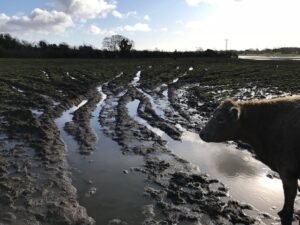
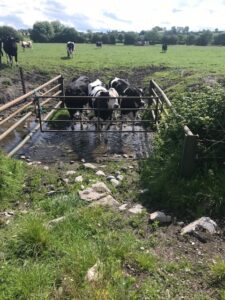
• Run-off of nutrients, sediment and pesticides from agricultural lands and farmyards;
• Activities such as land drainage, dredging and the presence of barriers such as dams, weirs or culverts in water courses;
• Discharges of poorly treated sewage from urban waste water treatment plants, domestic treatment systems and storm water overflows;
• Run-off from hard surfaces in urban environments of sediment and contaminant loaded water; and
• Run-off of nutrients and sediment from forestry operations.
Agriculture remains the main pressure on waterbodies, followed by hydromorphological changes and the forestry sector.
Improving water quality
As part of the second and third Irish River Basin Management Plans, Priority Areas for Action (PAAs) were created, within which actions are being targeted to improve water quality. These are implemented collaboratively by the Local Authorities Water Programme (LAWPRO), the Agricultural Sustainability Support and Advisory (ASSAP) Programme, local authorities and other stakeholders. In these PAAs, although ecological status has not yet improved, there is evidence of declines in phosphorus concentrations, which are a welcome first step. It is crucial that positive actions are maintained to continue this trajectory of progress.
You can find out more about current water quality in Ireland by visiting Catchments.ie.