
17 April 2025
Tillage advice: PGRs, fungicides and weed control
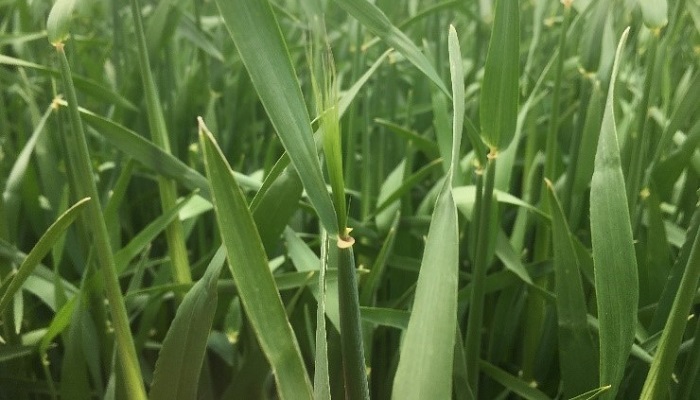
With most winter barley crops now at the flag leaf stage, Crops Specialist at Teagasc, Shay Phelan shares advice on plant growth regulator (PGR) and fungicide applications, along with outlining some of the key agronomic tasks for winter wheat, spring cereal, and bean and pea crops.
Winter barley
Most barley crops are at flag leaf stage now and, where needed, should get their final growth regulator application in the coming days.
Some farmers and agronomists are allergic to only putting one chemical into a tank to do a single job, and this is often the case when something like Terpal is being applied on winter barley. There seems to be a need to put something else in the tank to justify travelling through the crop but in this case, it is rarely warranted. Be aware that KWS Joyau is very forward and probably needs a PGR A.S.A.P as awns will probably be visible by the end of next week.
The final fungicide should be applied at the awns peeping stage. Repeated trials have shown that delaying for two weeks allows ramularia to infect the crop and will reduce yield by anything up to 0.4 t/ha. This will more than cover the cost of the fungicide and remember include folpet at full rate but only 50% rate of an azole/SDHI/Strob mix will be fine e.g. Macfare Expro, Siltra, Decoy/Comet.
Dr. Richie Hackett from Teagasc Oak Park joined Michael Hennessy on a recent episode of the Tillage Edge podcast to discuss the best use of plant growth regulators. Listen in below:
Winter wheat
Leaf 3 will have emerged on many of the early sown wheat crops next week. From the Teagasc monitor crops we have seen, there is low levels of septoria on lower leaves but this will start to spread with the recent rain. Graham does have some yellow rust so be on the watch out for that. Most crops this year have received a leaf 4 (T0) application. The table below gives options for growers at the leaf 3 application.
Table 1: Winter wheat disease control strategy – Leaf 3
| Disease | Leaf 4 | Leaf 3 |
|---|---|---|
|
Septoria High Disease Pressure Dawsum/Graham/Spearhead Sown at normal timing |
Thiopron 3.0L |
Folpet 1.5L + Revystar XL 1.5L or Ascra Xpro 1.5L |
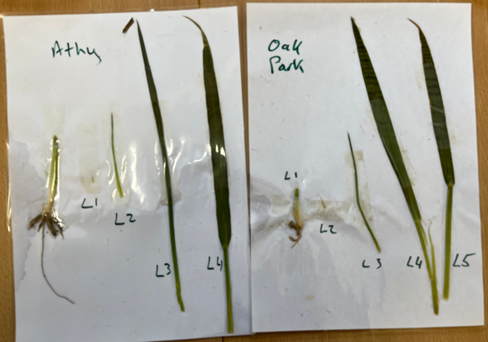
If you are unsure if leaf 3 is full emerged, dissect the plants and count the leaves starting with the flag leaf (leaf 1). The picture below shows the different leaves from two different crops in Athy and Oak Park.
Figure 1: Dissected winter wheat plants from Athy and Oak Park
Spring cereals
All spring cereal crops will have welcomed the recent rain, as many were starting to show signs of stress and trace element deficiencies. Next week might therefore be a good time to start controlling broadleaf weeds. You can also include trace elements to address whatever deficiencies that are showing. Generally speaking, most will use an SU herbicide e.g. Cameo Max, Ally Max etc with a mixer type product e.g. Galaxy, Hurler etc. to give the broadest spectrum of weed control. Wild oat control can then be completed in a few weeks’ time when we are sure they all have emerged.
Beans and peas
Crops have emerged well over the last few weeks and are growing nicely at the moment. However, in the last few days, there have been a number of reports of bean weevil damage on crops. Advice from PGRO is that sprays may be applied at the first sign of leaf damage and repeated after 7-10 days, if necessary. Once the plant reaches five pairs of leaves control should not be required. Increasingly we are seeing growers opt not to apply an insecticide, as many report to seeing damage on the new leaves after the application. Where you decide to spray, options for control include insecticides Karate Zeon, Decis Protech, etc. Check label for rates.
More from Teagasc Daily: First confirmed case of glyphosate-resistant grass weed in Irish cropping systems