
Having a gas
Measuring nitrous oxide emissions is notably complex, but innovation in “living labs” may transform Ireland’s ability to track and reduce greenhouse gas emissions.
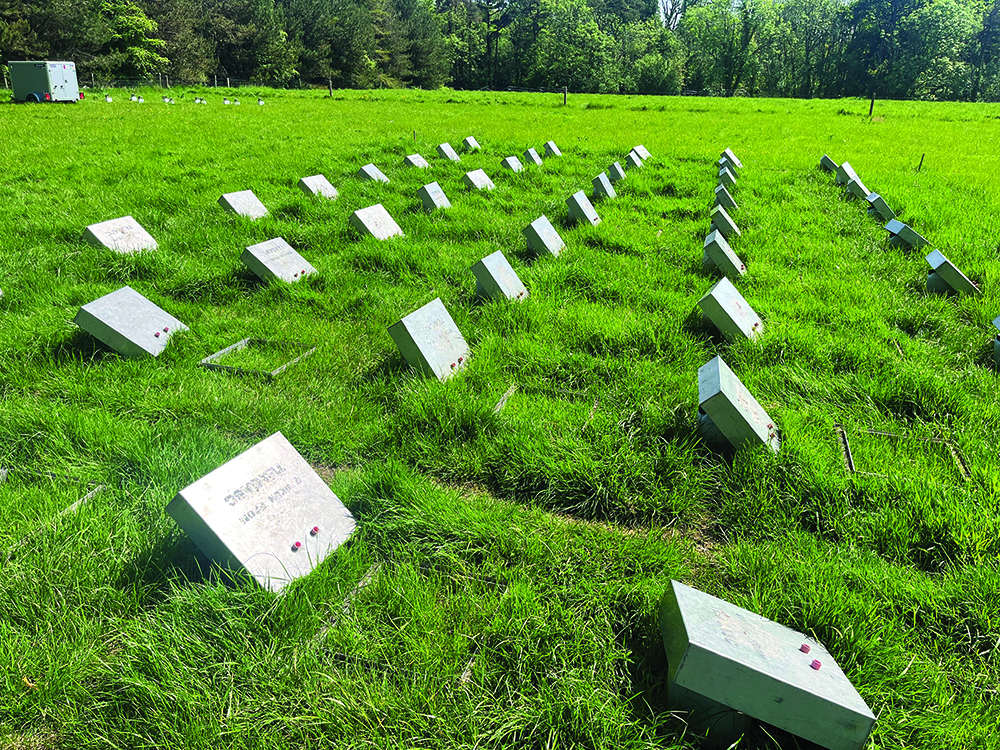
Traditional manual static chambers. Photo credit: Teagasc
Understanding greenhouse gas (GHG) emissions requires careful, regular measurement of data from gas fluxes – the rate at which a gas moves across the earth’s surface.
The most common approach to measuring gas fluxes is to use chambers, which are sealed over a soil surface and closed for a defined period, allowing gas exchange between the soil and the chamber headspace. Gas samples are then removed at set timepoints. However, manual retrieval of samples has the potential to overlook emissions ‘hot spots’. To tackle this issue, Teagasc has been researching the use of automated chamber measurement to provide more frequent, accurate GHG flux data.
Nitrous oxide (N2O) is a GHG with a global warming potential 298 times greater than CO2 over a 100-year horizon and is the single most ozone-depleting compound in the stratosphere. In Ireland, the agricultural sector is the largest contributor of natural GHG emissions and is responsible for 90% of the country’s N2O emissions; compared to other EU member states, Ireland has the highest percentage of emissions from agriculture.
Understanding emissions profiles
In Ireland, natural peatlands play an important role in climate regulation, owing to their natural capacity for sequestering carbon (C) – despite covering only around 3% of global land area, peatlands are estimated to store around 21% of the world’s total soil organic C stock. However, when peatlands are drained for agriculture, they can be transformed from C sinks into significant GHG sources. Wenxuan Shi, a Postdoctoral Researcher at Teagasc Johnstown Castle, explains further.
“Peatlands generally have variable N2O emissions, as the two key processes of N2O production – nitrification and denitrification – are limited within these ecosystems. By contrast, carbon dioxide and methane dominate the climatic feedback of these ecosystems, leading to them receiving more focus in studies of GHG emissions in peatlands.”
However, human management of peatlands can dramatically change their N2O emissions profiles, she continues.
“Drainage in nutrient-rich sites can significantly increase emissions. If drained soil is then used for grass-based agriculture, factors like ploughing, grazing and fertilisation can further enhance emissions.”
Hot moments and hot spots
Measuring and calculating N2O emissions from agriculture is complicated and highly uncertain, due to many interacting drivers that result in high temporal and spatial emission profiles. At 320 part per billions, atmospheric concentrations of N2O are about a thousand times lower than CO2, putting them outside the detection range of many analytical techniques.
In addition to this, N2O fluxes are subject to high temporal variability, as they respond dynamically to climatic and agronomic events, Wenxuan explains.
“N2O fluxes are characterised by so-called ‘hot moments’, lasting from a couple of days to several weeks. Characteristics of a given site can influence the dynamics of soil oxygen, temperature, moisture and nitrate concentrations, all of which contribute to hot moments. Despite their short duration, hot moments are a major driver of total N2O emissions annually.”
Spatial variability in N2O is even less understood, continues Wenxuan.
“Areas that are low-lying, were subject to previous land-use practices, or have notably high resource availability may all be important locations for high emissions potential – so-called hot spots. Hot spots could be characterised by consistently high GHG emissions from a single locale or set of locales, such as a drainage ditch or furrow.”
Varied frequencies
Chambers are the most common approach for measuring gas fluxes from the soil surface, where gases of interest accumulate in a known chamber volume over a specific area of soil. The chamber is sealed over the soil surface using a soil collar system and closed for a defined period to allow gas exchange between the soil and the chamber headspace. During the sample period, gas samples are removed at set timepoints to determine the change of gas concentration over time, and these concentrations are translated into a flux.
Static chambers are widely used to measure N2O emissions worldwide, but they are subject to limitations, Wenxuan explains.
“Most N2O flux measurements are conducted intermittently, with sampling frequency varying from daily to monthly, using traditional manual static chambers. However, sparse sampling intervals could potentially overlook hot moments of N2O emission. Depending on the deployment layout of the chambers, there’s a further risk of hot spots being missed.”
Automated chamber measurement is one approach to obtain high temporal frequency soil GHG flux data. The analysers can provide real-time emission data every second. The basic requirements of chamber design and the need to minimise soil, plant, and environmental disturbance are identical to those for static chambers. Automation ensures the capture of emissions associated with unforeseen episodic events, such as significant rainfall after a dry period.
This approach also allows gas measurements to be taken at high temporal frequencies and define the shape of the N2O response curve to N fertilisation, irrigation, or other management interventions or disturbances. This is especially the case at sites where manual chambers would be difficult to access when significant emission events are occurring – e.g. heavy clay soils after rain, dense or tall closed canopies, variability in the water table or water-filled pore space, or freeze–thaw events.
Towards a continuous system
Automation also allows for detailed assessments in remote locations using generators or solar power, where labour and travel costs for episodic manual sampling might be uneconomical, Wenxuan says.
“In our research study, different N amendments were applied at two agricultural grass-based peatlands. The LI-COR automated soil GHG flux system (LI-8100A) were used to collect and analyse N2O flux at high temporal resolution after fertiliser application in real time in the field.”

LI-COR long-term automated chambers. Photo credit: Teagasc
The LI-8100A system is a fully automated chamber network including a multiplexer, laser-based gas analyser, automated long-term chambers and flux calculation software. The chambers are opened and closed through a pneumatic system in sequence, with measurement times for each chamber set at five-minute intervals and each chamber taking 15-16 measurements per day. Continuous system running will allow each chamber to take samples every hour.
“These research activities can help minimise uncertainty in soil N2O emission measurement and provide data to refine and develop the use of emissions factors for N2O emissions associated with Irish agricultural peatland,” Wenxuan concludes.
“The outputs of this work will directly contribute to Ireland’s National Inventory Reporting and provide insight for climate mitigation and peatland rehabilitation activities.”
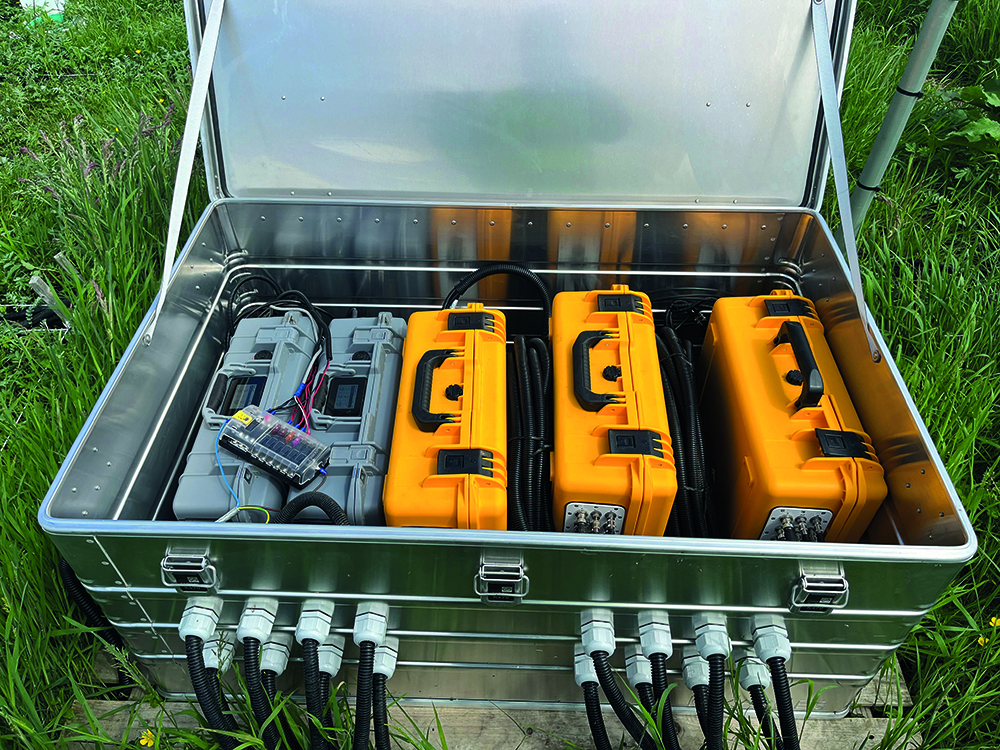
The multiplexer and two gas analysers were used in the LI-COR automated soil flux system (LI-8100A). Photo credit: Teagasc
Acknowledgments
The authors acknowledge research from the following colleagues: James Rambaud, Kate Devereux, Martin Donoghue, Christy Maddock, Luis Sangil-Lopez, Christopher Udusalu, Karl Richards, and the Irish Research Council.
Funding
The ASPEN project (Assessing Peatlands Emissions of Nitrous Oxide) is funded by the EPA (2022-CE-1167).
Contributors
Wenxuan Shi, Postdoctoral Researcher, Teagasc Johnstown Castle.
wenxuan.shi[at]teagasc.ie
Owen Fenton, Principal Research Officer, Teagasc Johnstown Castle.
Matthew Saunders, Assistant Professor, Trinity College Dublin.