
11 March 2025
Getting the timing right when applying nutrients
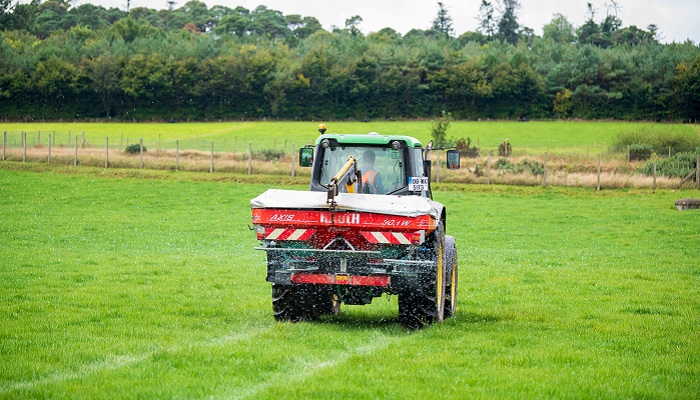
Results of soil tests analysed by Teagasc shows there’s a clear need to focus on soil fertility on dairy farms. In this article, Signpost Programme Advisor, Liam Quinn explains why the timing of nutrient applications is important to maximise grass growth.
Throughout 2024, Teagasc analysed 21,093 soil samples from dairy farms across the country. Of these, only 24% of soils were optimal for pH, Phosphorus (P) and Potassium (K). 61% of soils had a pH >6.2, while 37% of soils had a P index 1 & 2 and 38% of soils had K Index 1 & 2. This highlights the need for more focus on soil fertility.
Optimised soil fertility is crucial in maintaining grass growth but also in increasing nitrogen efficiency. It is important that every kilogram of nitrogen applied is effective in growing grass, and the best way to ensure this is by having optimum soil fertility.
Nutrient management planning
It is important that each farm has up to date soil samples and a Nutrient Management Plan completed annually, in order to know the Nitrogen (N) and P allowances and the lime requirements.
The first step in improving soil fertility is by applying lime. Although generally applied in autumn, lime can be spread at any time of year where it is required, and should be applied to low grass covers. Leave three months between applying lime and cutting silage to ensure no lime enters the bales or pit.
Appropriate applications
We are now entering an important time of year where N, P and K are required (Figure 1) to maximise and maintain grass growth throughout the summer. Remember slurry is a valuable source of N, P and K available on farm. Every 1,000 gallons of cattle slurry (6% Dry Matter) applied per acre is the equivalent of a bag of 9-5-30 when applied using Low Emission Slurry Spreading. It is also worth €28 per 1,000 gallons so use this to your advantage. Target low index soils where slurry will be most effective.
Figure 1: Timing of nutrients
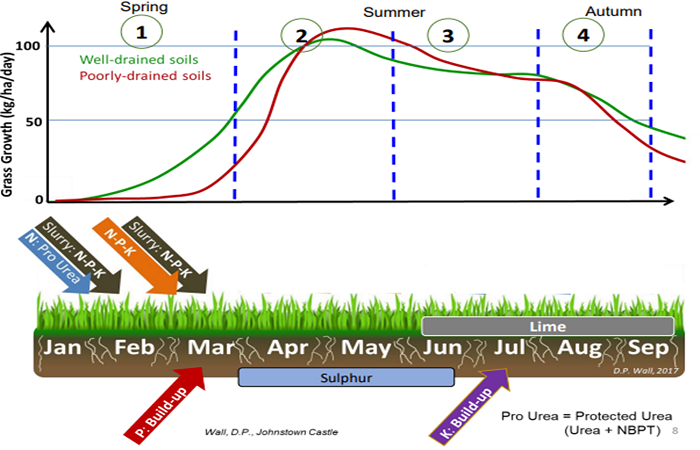
Teagasc research shows that Sulphur has a major role to play in increasing nitrogen use efficiency (NUE), grass nitrogen uptake, and grass yield while reducing N leaching. Trials show up to a 2.5t/ha yield response to sulphur applications between March and July, so target sulphur during the main grazing season. Sulphur level recommendations are 20kg/ha per year on grazing ground and 20kg/ha/cut on silage ground.
K application is usually targeted towards the later part of the year from August onwards as growth is slowing and the risk of grass tetany is reducing. Building index 1 and 2 soils up to index 3 can yield an extra tonne of dry matter per hectare. One bag of 0-0-50 (Muriate of Potash) to the acre has the potential to build one full index, which has huge potential on farm.
In summary, time your nutrient application where it will maximise grass growth. When applying nutrients, always keep in mind: using the right product, in the right place, at the right rate, at the right time.