
11 November 2024
The importance of a good foot bathing routine
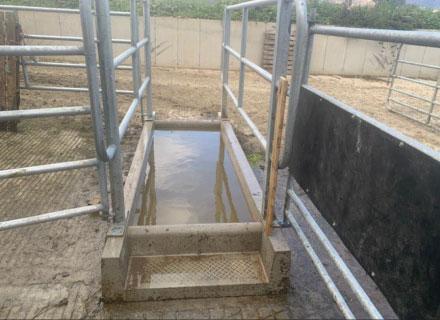
As cows return indoors, Dairy Specialist at Teagasc, Patrick Gowing looks at the causes of lameness and offers tips for best practice foot bathing and foot bath design.
Along with causing stress for the animals and the farmer, lameness in herds can have a large economic cost. Generally there are two main types of lameness: physical damage to the foot, like white line disease; and infectious damage to the cow’s hoof.
While getting the hoof trimmer is a routine part of maintaining herd hoof health, reducing the number of cows that require treatment is the long-term goal for any farmer.
Physical damage to the cow’s hoof is normally caused on roadways, holding yards, cow exits and sheds. These will need to be rectified if creating a lot of issues. For infectious damage, it can be characterised by hygiene on the farm, in particular the sheds and scraper passages. If infectious disease is an issue for your herd, a good foot bathing routine is essential to help control the problem.
Foot bath design
Having a properly designed foot bath is a necessity for every farm and in particular as stock move into the sheds for the winter.
- Foot baths should be no longer than 3m, as a bath longer than this can be contaminated by the cows as they walk through.
- Pre-wash baths are no longer recommended for the same reason, as the cows will then tend to soil the bath with the solution in it as the cows walk through them.
- Too short of a bath is not suitable, as the cows may not drop all their feet in the solution or some feet may only drop in the solution once.
- The floor of the footbath should be level with the exit race the cows are exiting on. This will improve the cow flow through the footbath.
An appropriate solution
On many farms, footbaths are in use but they do not get the results they were looking for. The main reasons for this can be a poorly designed bath or the solution used in the bath is not appropriate.
The rule of thumb is to have 1L of solution for each cow pass. So a 200L footbath will allow 200 cows through it before it has to be refreshed. Additional passes of the cows above this may actually help spread infectious disease, as the solution is no longer effective and the foot bath can be soiled from the previous cow passes. For the majority farmers this would mean refreshing the solution between each milking. Some farms with larger herds may have to wash out and refresh the solution during milking.
Foot bath size
Each footbath requires 1L of solution per cow. The depth of the solution in the bath should be between 10cm and 15cm. To calculate the size of your footbath, you multiply to length x width x the depth in centimetres and divide by 1,000 to convert to litres.
Automatic foot baths
Some farmers are now using automatic footbaths. These foot baths are programmable for different chemical rates and can count the number of cows that pass through them and automatically empty, wash out and refill with solution when the pre-set numbers of cows pass though. They normally have two options for different chemical that can be added and are safer for the operator if dangerous chemicals such as formalin are being used on the farm.
To install and automatic foot bath, the farmer will be required to have a power supply, air supply and water from a wash down hose close to where the footbath will be installed.
Also read: Simple steps can help support a positive start to spring 2025
Also read: Grazing advice: Setting up the farm for profitable milk production next spring