
11 November 2024
Feeding the freshly-calved cow this winter
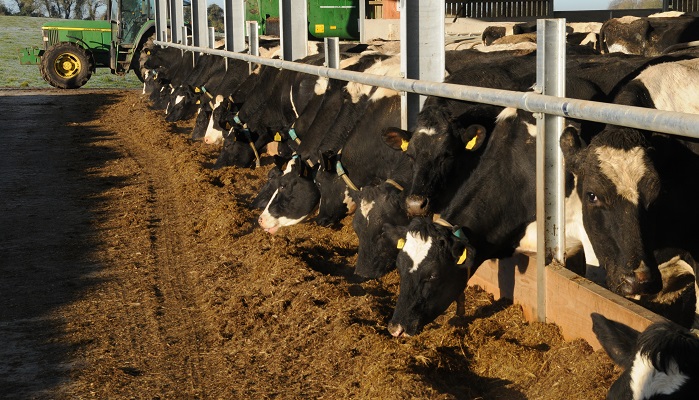
Aisling Claffey, Nutritionist at Teagasc, discusses feeding programmes for liquid milk cows, highlighting the importance of striking a balance between performance and profit.
On liquid milk producing herds, the focus in recent weeks will have switched to those freshly-calved cows entering the herd and achieving a balanced diet to support milk production from these animals. A significant proportion of the herd will be in late lactation, which must be factored into feed plans.
Feed cost is the single biggest contributor to the higher cost of production associated with producing milk over the winter months. There has already been a lot of extra cost incurred on farms year to date as a result of reduced grass growth, so it is important that setting up a winter diet does not further compound this.
The first port of call for setting up your winter diet is to analyse forage quality. Nationally, mean silage quality remains stagnant at 68 DMD year on year. For winter herds, this needs to be closer to 75DMD to have any realistic chance of building a profitable milking diet.
The benefits of higher DMD silage are well proven; improved forage intake, more milk solids and milk from forage, better rumen health and lower concentrate feeding levels. A high quality forage source will also simplify the diet as it allows the majority of supplementary feeding to be done in-parlour. This will minimise the amount of excess concentrate fed to late lactation animals at the feed barrier, where all animals are being run in one group.
Table 1. Concentrate requirements at varying levels of silage quality and milk yield to meet UFL requirements of the cow
| Milk yield | 65DMD silage | 70 DMD silage | 75 DMD silage |
|---|---|---|---|
| 0.72UFL | 0.79UFL | 0.85UFL | |
| 20 litres | 5.5kg | 4.0kg | 3.0kg |
| 25 litres | 8.0kg | 6.5kg | 5.5kg |
| 30 litres | 10.0kg | 8.5kg | 7.5kg |
| 35 litres | 12.5kg | 11.0kg | 10.0kg |
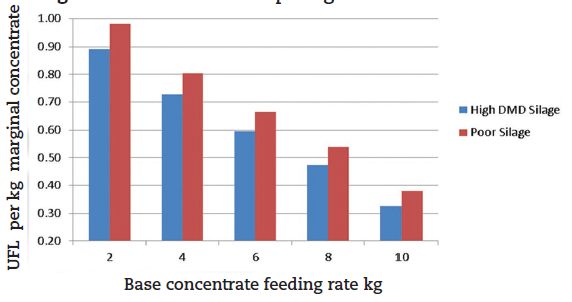
As the DMD of forage decreases, it will contribute less energy to the diet, but it will also restrict total dry matter intake due to its slower passage rate. The high levels of concentrate required to support production from poorer quality forages will also reduce the efficiency of fibre digestion. This is why we see a declining milk response for each additional kg of concentrate fed.
It is important to compare the milk response to the increasing cost of the diet to determine the breakeven point for your herd. While there will be a better response to concentrate feeding on poor quality silage, it will increase the total feed cost per litre of milk produced. If forage quality is consistently an issue on your farm, it is important that you assess soil fertility, sward make up (level of perennial rye grass) and cutting date, and ensure reseeding continues to be an integral part of your programme to improve this.
Figure 1: Total UFL increase per kg of extra concentrate fed in addition to high quality or poor quality grass silage
There is often a lot of debate around the role of straw in winter milk diets, however, it will reduce the energy density of the diet (UFL/kg DM) and the fibrous nature of straw will also restrict total DMI, having a knock-on effect on milk yield. The dairy cow typically requires 35% NDF in the diet, with 24-28% of this coming from forage to support rumen health and function. Good quality silage will typically supply 40-45% NDF. If forage intake is limited, it is important that concentrate feeds contain sources of digestible fibre such as beet pulp (1.14 UFL/kg DM, 55% NDF), soya hulls (1.05 UFL/kg DM, 70% NDF) and maize distillers (1.16 UFL/kg DM, 34 % NDF), in addition to cereals and high-quality protein sources.
Protein is often considered a driving factor of milk production, but energy intake is far more important, with milk protein concentration declining in response to insufficient energy. Milk recording will be paramount to identifying issues with the winter milk diet as changes in solids will be masked by late lactation animals, and a potential dip in their protein also, as they move to a silage based diet as grass availability declines on farm.
Focus on achieving a high level of UFL/kg DM through forage and concentrate quality, whilst achieving a balanced PDI supply. Typically a ratio of 100-105g of PDIE per UFL will supply sufficient protein, with PDI balance being more important than overall crude protein (CP) % of the diet, as can be seen in the reduction of the CP of the Johnstown winter milk herd diet from 17.5 to 15.5 % in recent years with no impact on performance.
Table 2. The Johnstown Winter milk herd diet nutrients and ingredients to achieve this
| Metric | Measure | Ingredients kg DM |
|---|---|---|
| Dry matter percentage | 34 | Grass silage – 9kg |
| DMI kg | 21-22 | Mazie silage – 4.5kg |
| UFL | 0.94 | |
| Crude protein % | 15.5 | |
| PDIN/PDIE g | 95/96 |
23% blend – 3.0kg DM (maize meal, beet pulp, soya, distillers) |
| NDF % | 36 | |
| Starch + sugar % | 19 | |
| Conc. as % DM | 34 |
High energy 18% nut – 5.5kg DM average (fed in parlour incl. minerals) |
| Milk kg supported | 32 |
The above article was first published in the Irish Farmers Journal as part of its Liquid Milk Focus.
Also read: Why some winter milk farms achieve better financial performance than other