
27 December 2023
Managing out blocks to ensure overall farm performance
Growing and utilising high-quality, home-produced feed rather than depending on purchased in concentrates or bought in feed remains the most cost effective option for dairy farms.
Over the last number of years, feed costs have increased by approximately 30% on farms. Fertiliser, contractor, spray costs and land charges have all increased.
Parallel to this, the level of out blocks being utilised on dairy farms has increased. Across the country, leased land costs can vary; but in all cases, land is now more expensive to lease.
Feed cost analysis
The ‘Grange Feed Cost Model’ was used to determine the cost of commonly-grown feeds in October 2023. Some of the assumptions made are listed in Table 1 below.
Slurry was applied to all crops to reduce nitrogen (N) input and lower N requirements. Land cost was assumed at €865/ha (€350/ac). Grazed grass is the cheapest feed resource, with white clover inclusion reducing costs further.
Purchased concentrate, such as rolled barley, remains an expensive feed resource, compared to grass and other feeds. Within this analysis, grass clover is least expensive compared to grazed grass, while zero-grazed grass is the most expensive of the fresh grass options.
First-cut silage and red clover grass silage remain the most competitive of the conserved feeds, followed by baled silage and maize silage – the most expensive conserved feed.
The most important aspect of farm growth rate and stocking rate is that the farm needs to be stocked to the farm grass growth capacity, not its potential. Figure 1 shows the mean grass demand across the year on PastureBase Ireland farms, compared to the mean grass growth from 2021 to 2023.
Figure 1: Grass growth compared to grass demand on PastureBase Ireland farms (2021, 2022, 2023)
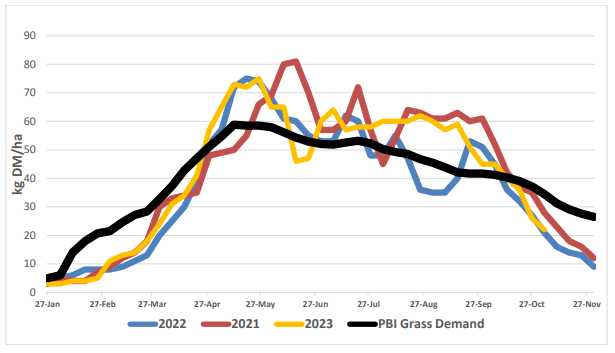
This figure shows that on average, on many weeks over the past three years (especially 2022), cows have had to be supplemented to satisfy their feed demand. Grazing platform dry matter (DM) production averaged 12.8t DM (estimated) in 2023, 12.7t in 2022, 12.2t in 2021 and 12.9t in 2020. On many farms, this level of DM performance did not satisfy the feed demand of the grazing platform and required very high preforming out blocks to complement the lower DM performance.
Table 1: Feed assumptions and estimated costs (€) to produced feed in October 2023
| Grazed grass | Grass + White clover | Zero-grazed grass – all year | First and second-cut pit silage | First and second-cut baled silage | 3-cut red clover silage | Maize silage | |
|---|---|---|---|---|---|---|---|
| DM yield (t/ha) | 13.0 | 13.0 | 13.0 | 6+4 | 6+4 | 6+4+3 | 13 |
| DM % | 17.4 | 17.4 | 17.4 | 21.7 | 32.4 | 30 | 30 |
| UFL/kg | 1.03 | 1.02 | 1.03 | 0.82 | 0.82 | 0.82 | 0.8 |
| Inorganic fertiliser N (kg/ha) | 225 | 100 | 225 | 87+69 | 87+69 | 112 | |
| Total fertiliser N (kg/ha) | 250 | 125 | 250 | 115+82 | 115+82 | 145 | |
| Total cost/ha (including land charge) | €1,427 | €1,283 | €2,785 | €2,161 | €2,431 | €2,823 | €3,135 |
| Total cost/ha (excluding land charge) | €563 | €418 | €1,921 | €1,577 | €1,848 | €2,071 | €2,271 |
| Total cost t DM/ha grown (including land charge) | €110 | €99 | €214 | €216 | €243 | €215 | €245 |
| Total cost t DM/ha grown (excluding land charge) | €43 | €32 | €148 | €158 | €185 | €158 | €177 |
Assumptions: Zero-grazing does not include the cost of handling extra slurry vs. grazing. First- and second-cut silage were assumed to be cut on 29 May and 17 July, respectively. Slurry + the cost 0-7-30 for the remainder of K requirements, does not include grazings in the back end of the year. 6 year persistence for red clover. Land charge of (€865/ha) €350/acre. Protected urea = €550/t
Out block DM production performance needs to be at least at the same or higher level of DM production than the grazing platform, to ensure that the farm is able to be feed self-sufficient. On many farms, the total land base is underperforming and has to be complemented with additional silage and concentrate purchases.
Table 2 shows the level of stocking rate and concentrate inclusion to ensure high grass utilisation. In recent years on many farms, both grazing platform and out blocks have under preformed. For example in Table 2, if the farm is not growing 14t DM/ha (which can sustain 2.5 cows/ha), then higher levels of concentrate will need to be supplemented or additional feed purchased.
Table 2: Stocking rate that optimises profit on farms growing different amounts of pasture and feeding different amounts of concentrate/cow
| Concentrate (t DM/cow) | Grass grown (t DM/ha) | |||
|---|---|---|---|---|
| 10 | 12 | 14 | 16 | |
| 0.00 | 1.5 | 2.0 | 2.3 | 2.6 |
| 0.25 | 1.7 | 2.1 | 2.4 | 2.8 |
| 0.50 | 1.8 | 2.2 | 2.5 | 3.0 |
| 0.75 | 1.9 | 2.3 | 2.7 | 3.1 |
| 1.00 | 2.0 | 2.4 | 2.9 | 3.2 |
| 1.25 | 2.1 | 2.5 | 3.0 | 3.4 |
| 1.50 | 2.2 | 2.6 | 3.1 | 3.5 |
Conclusion
The performance of dairy out blocks does not attract the same emphasis as the grazing platform. Reduced DM production performance of the out blocks generally leads to additional feed purchases to sustain the farm system. Even though silage produced on out blocks is more expensive than grazed grass, highly productive out blocks can still play a role in efficient grazing systems by providing sufficient high-quality winter feed. Excessive levels of outside blocks in a farm system will lead to reduction in grazing season length and an increase in the overall production costs.
This article first appeared as a paper by Michael O’Donovan, James Dunne, Pat Moylan and Donal Patton from the Teagasc National Dairy Conference. To find out more about the 2023 Teagasc National Dairy Conference, click here.