
30 October 2023
C.O.W – culling the right cows for you
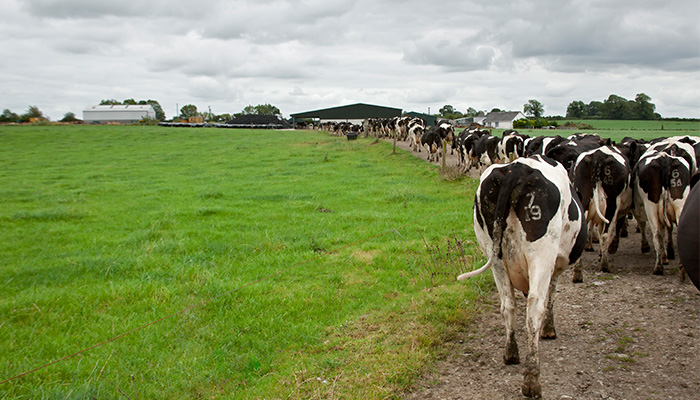
The opportunity to voluntary cull cows has markedly increased in recent years due to improved reproductive performance. Since the removal of quotas, 6-week calving rate has improved by nine percentage units to 66% in 2022, reducing the need to involuntary cull empty or late calving cows.
Almost half of all dairy herds have expanded by more than 5% in the last two years, with over 1,300 of these herds expanding by >25% during this period. Because of either physical or regulatory limitations on stocking rates, many herds are likely to cease expansion or even contract in the years ahead. Interestingly, 23% of herds have reduced in size by >5% between the years 2020 and 2022.
The C.O.W Index
There has also been a significant increase in the number of herds milk recording in recent years; up 38% in 2022 compared with 2020. As a result, more herds can get access to their Cow’s Own Worth (C.O.W.) decision support tool, available on HerdPlus, to make more informed culling decisions.
C.O.W. ranks dairy females, within a given herd, based on each cow’s excepted remaining lifetime profitability considering factors such as milk production, age, level of heterosis (i.e., crossbreeding effect), and calving date as well as the genetic merit of both the female herself and her future expected female progeny.
How C.O.W works
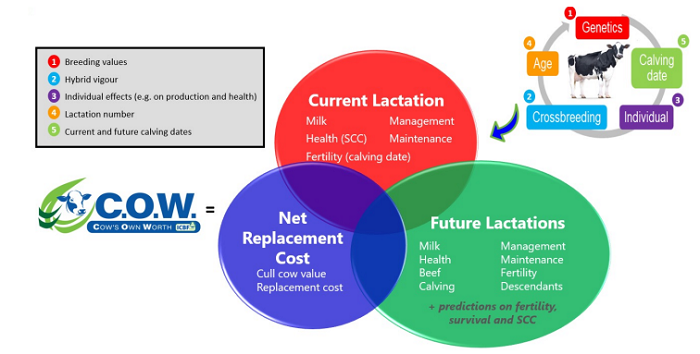
Milk-recorded, spring-calving herds can access C.O.W. on their HerdPlus profile. The application instantaneously gathers all information to rank cows from expected most profitable to least profitable. The profit potential is calculated as 1) expected profit from the current lactation, 2) expected profit from future lactations, and 3) net profit from culling (including the replacement cost) for each dairy cow (see Figure 1).
Figure 1: C.O.W components – expect profit for remaining lifetime
Future lactations
This module considers the expected profit generated by a cow in future lactations. The module includes the same animal attributes as the current lactation module as well as three additional components considering future profit from calving performance, progeny beef performance and future replacement merit accounting for the transmission of genetics to future generations. One of the key strengths of the C.O.W. is the inclusion of predicted probabilities of the expected future number of lactations, future calving patterns and likelihood of udder health issues in subsequent lactations.
Net profit from culling
This component deducts the average cost of a replacement heifer from the expected value of the cow to be culled based on her genetic merit for carcass weight.
When to use C.O.W
C.O.W. uses live data directly extracted from the ICBF database; therefore, keeping herd and cow records up to date is essential to generate accurate C.O.W. values for the herd.
The C.O.W. can be run at any time of the year; most farmers run the decision support tool in late autumn (i.e. before drying off) and again before breeding. For the former, ensure all breeding records (such as inseminations and pregnancy diagnoses) and health events are up to date before making culling decisions.
The advantage of running the C.O.W. before breeding is that cows identified for culling removes additional costs of breeding. It is still important to use the EBI to make all breeding decisions for the herd. Use sire advice to assist in mating decisions; cows marked for culling using C.O.W. will appear in sire advice as marked as a cull candidate.
Conclusions
The ability to identify cows with the greatest predicted future profit potential has a substantial impact on herd profitability. C.O.W. provides a decision support service to herdowners to assist in their routine culling management and is particularly useful where voluntary culling options have increased on farms.
Farmers might also need to consider reducing cow numbers to comply with stocking rate regulation changes introduced this year. Removing obvious candidates for culling as well as the more difficult to identify “passenger” cows can improve herd profitability while assisting in compliance.
This article from Margaret Kelleher, ICBF, and Donagh Berry, Teagasc, first appeared in the 2023 Moorepark open day book. Access the full publication here.