
09 July 2023
Finding the optimum stocking rate for your farm
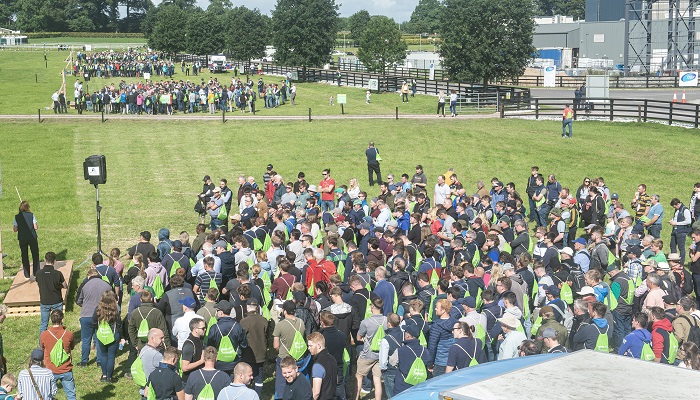
Farmers attending the Moorepark Dairy Open Day on July 4th were reminded of the importance of matching milking platform stocking rate to grass growth levels in order to optimise profitability.
Having the correct stocking rate has always been a cornerstone of efficient and profitable grazing systems. And despite the overall stocking rate on Irish dairy farms only increasingly modestly (1.9LU/ha versus 2.1LU/ha) over the past decade, some focus appears to have been lost in terms of the optimum stocking rate for milking platforms.
Based on available national statistics, the milking platform stocking rate has increased significantly from 2.0LU/ha to 2.7LU/ha over the last decade. Padraig French, Teagasc Head of Livestock Systems Department, explained that this has occurred as farms have become increasingly specialised in dairy cows and other stock have been moved to outside land parcels or, in some cases, to contract rearers.
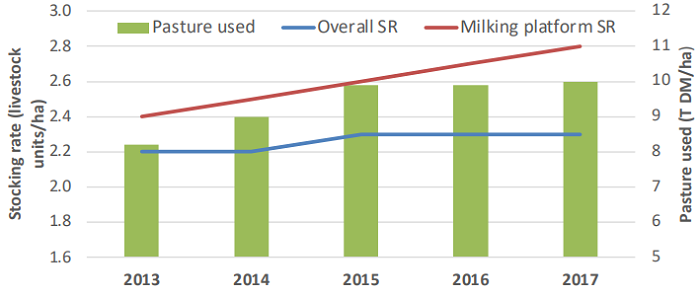
To illustrate the point of the importance of matching stocking rate to grass growth, data from a matched sample of dairy farms that completed Teagasc eProfit Monitors and used PastureBase Ireland during the period from 2013 to 2017 were presented. Similar to the national data, only a modest increase in overall stocking rate was observed on these farms (2.2LU/ha to 2.3LU/ha). However, the stocking rate on the milking platform increased substantially from 2.4LU/ha to 2.8LU/ha.
Despite the increase in milking platform stocking rate on this farms (Figure 1), there was no significant increase in pasture utilisation between 2015 and 2017, indicating that on many farms the milking platform stocking rate increased to levels beyond that required to maximise pasture utilisation.
Figure 1: Trends in overall and milking platform stocking rate and pasture utilisation (t DM/ha, green bars) on Irish dairy farms (2013-2017; Ramsbottom et al., 2020)
As a result, there are additional cows on these platforms that are effectively increasing total purchased feed requirements, labour and capital costs, and reducing the duration of the grazing season for the entire herd.
In addition, where stocking on the available area exceeds the pasture production capability of that area, this results in an increase in total costs that correspond to approximately 1.6 times the increase in feed costs alone.
Optimum milk platform stocking rate
In defining the optimum stocking rate, it must first be acknowledged that farms differ in terms of land quality and usability, cow type/size, milking platform area, availability of outside land blocks, etc.
Nonetheless, Padraig explained, pasture production, pasture utilisation and concentrate supplementation levels are the primary considerations that define the optimum stocking to allow both high animal performance and high pasture utilisation to be achieved.
In Table 1, the optimum whole farm SR for farms that produce different amounts of grass and feed different amounts of supplement are defined within self-sufficient forage systems.
Table 1: Optimum overall stocking rate* for grazing dairy farms growing different amounts of pasture and feeding various levels of supplement/cow
| Grass grown (t Dm/ha) | ||||
|---|---|---|---|---|
| Tonnes supplement (DM/cow) | 10 | 12 | 14 | 16 |
| 0.00 | 1.5 | 2.0 | 2.3 | 2.6 |
| 0.50 | 1.8 | 2.2 | 2.5 | 3.0 |
| 1.00 | 2.0 | 2.4 | 2.9 | 3.1 |
For the milking platform, the specific stocking can be increased to improve grazed pasture utilisation, while the additional winter feed requirements can be provided on an area away from the platform.
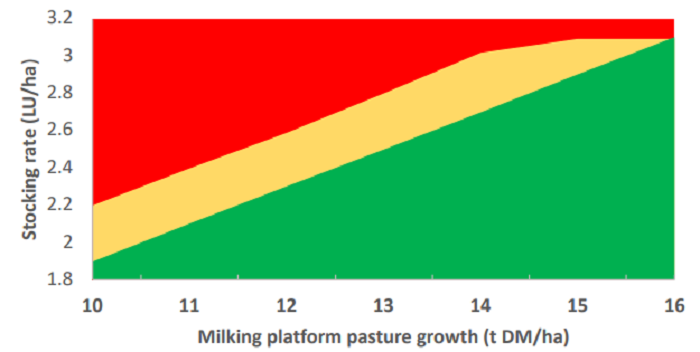
In this situation, the additional cows on the milking platform are considered ‘marginal cows’, as the system is no longer forage self-sufficient and part of the diet is supplied by feeds (both concentrate and silages) from outside the milking platform. The marginal cow milking platform stocking rate to maximise pasture utilisation for farms growing various levels of pasture is outlined in Figure 2.
Figure 2: Overall (green area) and milking platform (yellow area) stocking rate (SR) for farms growing various levels of pasture on the milking platform (t DM/ha). The red area reflects SR in excess of marginal levels where no additional pasture is utilised and the entire requirements of the additional animals are supplied from outside the system
Milking platform stocking rate guidelines
As evidenced by Figure 2, milking platform stocking rate can be higher than the overall stocking rate to yield a finite additional pasture utilisation on the milking platform, but should never exceed the shaded yellow area as this corresponds to a complete supplementary feed (equivalent to a total mixed ration (TMR)) diet for these additional animals.
On this, Padraig explained: “By bringing in about 50% of the winter diet from outside blocks – about 0.5t DM/cow – will allow you to lift the stocking rate by about 0.3 cows/ha to 2.8 cows/ha and you will still be able to maintain the percentage of grazed grass in the diet when growing 13t DM/ha.
“Once you go above that, these extra cows above what the milking platform can carry are predominantly eating silage and concentrates. That’s a low margin business.
“There is extra work and there is extra capital involved in putting them there for very little extra margin. From an economic sustainability point of view, these cows above that stocking rate shouldn’t be on our farms.”
In addition, farmers should exercise caution with marginal stocking rate increases as additional pasture utilisation is not guaranteed (depending on growing conditions) and the overall economic benefit is heavily dependent on favourable economic conditions (milk price and input costs, capital and labour requirements).
For these reasons, previous studies in pasture-based systems in Ireland and New Zealand have reported a linear decline in profitability with increasing feed importation. In addition, many studies also indicate that where increased stocking is associated with increased chemical fertiliser and supplementary feed importation, nutrient-use efficiency is reduced, resulting in increased nutrient losses to the general environment.
More from Moorepark 23
Also read: Massive numbers of dairy farmers attend Teagasc Moorepark’23 Open Day
Also read: Current and future technologies to meet sustainability challenges
Also read: Results from the cow-calf contact systems study
Also read: New grass and clover genetic improvement programme launched
Also read: Precision nitrogen management – what is it and why is it required?
Also read: Becoming the 50-hour farmer – reducing workload on dairy farms
Also read: Refocus on financials – protecting the margin for 2023
Also read: AgNav – a sustainable digital platform to support farmers
Also read: Work Organisation for Farmer Health and Safety Video launched
Also read: This is Dairying Photo Competition captures generational bond