
11 June 2023
Safety with bulls during breeding
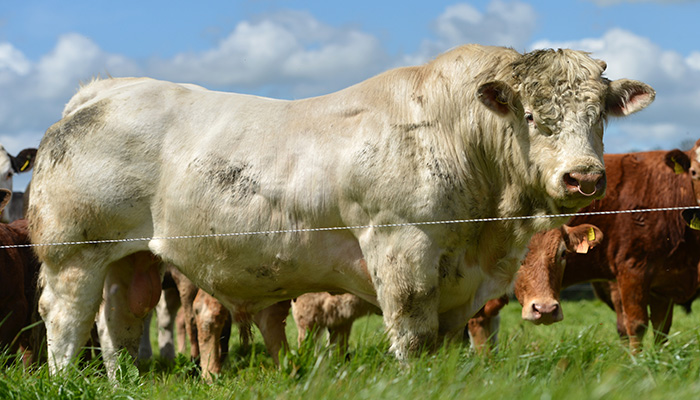
Health and Safety Authority (HSA) statistics show that from 2012 to 2021 bulls were the cause of 16% of farm workplace deaths.
Ciaran Kinahan, Teagasc Walsh Scholar, John McNamara and Francis Bligh, Health and Safety Specialists, tell us how to stay safe around bulls.
The use of a bull may be based on reducing labour or due to the observations of heat and/or the difficulty of gathering cows for artificial insemination (AI). Bulls are dangerous and need to be treated with the utmost respect, especially during mating season, as the danger increases during this period. It is important that tasks with animals are properly planned and organised.
Artificial insemination
The use of AI reduces the risk posed by a bull on the farm. The use of AI is not possible in all situations, but it should be an option which the farmer has considered.
Precautions
When checking livestock in the fields, never allow a dog or pets to accompany you. When bringing cows into the yard for milking or walking through the fields with livestock always carry a stick. It is vital when entering a field with a bull to keep sight of him at all times and never turn your back on him. As a bull gets older he can go through different stages, such as playful aggression as a yearling, to defensive, territorial aggression as a two to three year old.
When handling a bull a farmer should always have help. Inexperienced livestock handlers should not interact with a bull. People under the age of 18 should never be in close contact with a bull.
Legislation for ringing
Breeding bulls must have a ring fitted before they are 10 months old. This is a legal requirement. Ideally, the owner should not fit the ring. It is a challenging activity that should only be carried out in a crush where the animal is appropriately restrained. A chain is also advised when the bull is in the pasture to provide a means of control in the event of an attack.
Bull management
It’s crucial that the bull becomes accustomed to people and associates people with positive experiences like meal feeding. It is also crucial to keep a safe distance at all times and to control close contact with the use of appropriate animal handling equipment.
Culling
If a bull shows signs of aggression he should be sent for slaughter. Bulls of all breeds have the capacity to turn hostile.
Refuge
HSA statistics tell us that many accidents with bulls take place in the open field during the mating season. Bulls are guardians of the herd and can perceive people as a threat. Keep the bull in your line of sight at all times, and prepare an escape route or means of defence. When entering the field with a bull it is important to herd the animals with a tractor or other suitable farm vehicle as they can be used as a safe refuge. If cornered by a bull, spread your arms wide, face the bull and try to slowly move out of the bull’s proximity. Turning and running from the bull can cause it to chase.
Signs
When a bull is grazing with the main herd, make the maximum use of fields that the public don’t have access to. At the entrance of fields, there should be a warning sign that says “Beware of bull”. The fields need to be fenced appropriately, with gates and fences maintained regularly.
Cows
Heifers and cows are both capable of becoming aggressive and can attack. They are capable of showing extreme vigilance when it comes to protecting their offspring, and the danger is increased during stressful events like calving, dehorning, and weaning. Never turn your back on cows or heifers, always maintain a physical barrier when handling, and when issues are found, cull the animals.
Plan for emergencies
When working with a bull, follow these safety tips:
- keep a mobile phone in your pocket so you can call for help if needed
- someone should be aware of where you are and when you expect to return
- keep your first aid box well
In this clip, we look at some top tips for livestock safety for farmers
In this clip, hear how Ann Doherty was attacked by a bull and the serious injuries that were inflicted
This article first appeared as a Teagasc Advisory newsletter.