
25 May 2025
Better silage pays off for the Dodgers
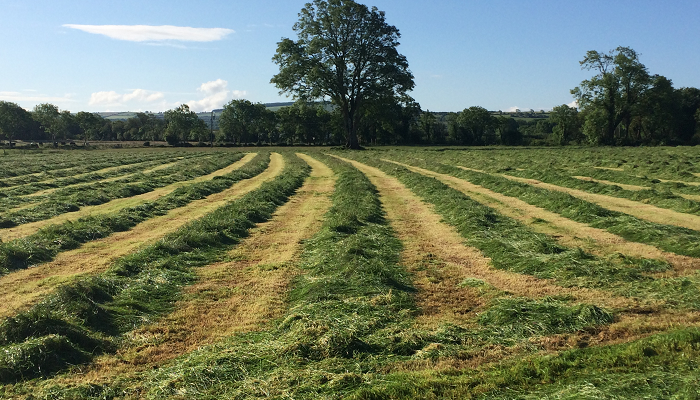
A Monaghan drystock Knowledge Transfer (KT) discussion group focused on making quality silage in 2024 and reaped the benefits, Teagasc B&T Drystock Advisor, Eimear Tobin writes.
Last year it cost €42.12, on average, to make a bale of silage. Two-thirds, €26.77, was for harvesting and there’s no charge for land included. Silage is clearly a major cost on drystock farms.
The Dodgers drystock Knowledge Transfer (KT) discussion group met recently on Fred McKeever’s farm near Donaghmoyne to review their experience making silage in 2024 and plan their silage strategy for this year. A feature of any KT group is a one-to-one advisory session. Most of the group used their session to focus on soil fertility management, which is fundamental to growing grass.
“Talking about fertility and getting soil tests done meant we knew where we were starting from,” said Michael Agnew, who farms near Castleblayney. “We targeted fields that needed lime, P or K and avoided wasting money on fields that were already at Index three or four.”
Fertiliser plan
Michael created a fertiliser plan for the year based on his soil test results. It’s worth noting that all farms stocked at over 130kg N per hectare must take soil samples if they wish to spread chemical Phosphorus or import slurry.
Another group member, Mickey McCague, is a big advocate of raising soil pH. “Applying lime is not exactly a new idea but we saw a big response in grass growth from it.”
Closing for silage
The group discussed that paddocks that were closed off on time and received the correct nutrients will be ready to cut by the middle/end of May. Aiming for bulk will reduce the quality of the first cut and the yield of the second cut.
Cutting dates
In 2024, the group members had a range of cutting dates. Some members of the group were still making their first cut in late June/July. One group member had cut his silage in the middle of June in 2023, and in 2024, made the first cut a few weeks earlier on the June bank holiday weekend. When asked about the quality of the silage, he said he has better looking cattle and was able to reduce the total concentrates bought for the year, acknowledging that weather might have also played a role. Next year, he said, he will aim to take his first cut in mid-May.
Cut at the right growth stage
The harvest date is the most important factor that affects silage Dry Matter Digestibility (DMD). One issue the group discussed was whether or not they should graze the silage ground in the spring. Research shows that if you have grazed once in early February or March that will reduce first cut silage yield by 0.5 to 1.2 tonnes of DM Per ha, but it will increase total forage yield per hectare per year.
Testing for nitrogen and sugars
High nitrogen levels in the crop will make it harder for the pH to drop in the bale or pit, reducing the quality of the silage. As a general rule, grass uses two units of nitrogen per day. If, for example, 100 units of Nitrogen was applied per acre, the nitrogen will be used up in 50 days. However, there are a number of factors that affect this, such as the weather, the age of the sward, or the soil health in general.
Sugars in the grass are extremely important for fermentation and have a direct impact on crop preservation. To ensure sugars are at their highest, mow the crop in the evening, where possible.
If there is dry weather approaching, and you are unsure of the nitrogen and sugar content in the grass, you can get the grass tested in your local Teagasc office. If the nitrate level is slightly high, wilting the grass for 1-2 days will usually resolve the problem. If the sugar levels are below 3%, additives such as the traditional molasses will help. Adding 10-15 litres per tonne of grass will improve preservation.
Group member, Jason Hughes, who farms just outside Castleblayney, got his grass tested at his Teagasc office for the first time this year.
“I was anxious about the nitrogen level as weather conditions had delayed us getting fertiliser out.”
The nitrogen levels were slightly high, but he was able to wilt the grass for 24 hours.
“I was able to cut a few weeks earlier than I would have if I didn’t get the grass tested, and it made all the difference for the second cut.”
Host farmer Fred McKeever is convinced of the savings coming from quality silage particularly for his fattening cattle.
“With higher quality silage they’ll finish sooner and even if it’s only a couple of weeks that’s a saving on concentrates. As a group, we are definitely making silage earlier than we did in the past and we are seeing the benefits,” Fred concluded.
The impact of silage quality
Grass silage accounts for up to 30% of total feed on beef farms. A higher quality silage will reduce the amount of concentrates needed. For example, in terms of weanlings, with a target daily weight gain of 0.6kg/head/day, being fed silage of 66% dry matter digestibility (DMD), they would need to be supplemented with 3kg of meal per day. However, if they were being fed 70% DMD silage, they would need just 2kg of meal. And if the weanlings were on excellent quality silage, for example 74% DMD, they only require 1kg of meal per day to achieve the target.
Silage targets
The target DMD required varies from farm-to-farm and depends on the stock on the farm. A dry suckler cow will get by on 66% DMD silage; a suckler cow with a calf at foot requires a higher DMD silage of 70%, as she uses more energy to produce milk. Growing cattle need a silage DMD of 72%, and finishing cattle require silage with a DMD of 74%.
How much silage do you need?
This is an approximate pit silage requirement* per animal per month:
- Dairy cows: 1.6 tonnes
- Suckler cows: 1.4 tonnes
- 0-1 year old: 0.7 tonnes
- 1-2 year old: 1.3 tonnes
- 2+ year old: 1.3 tonnes
- Ewes: 0.15 tonnes
*If you are using bales, multiply the tonnage required by 1.1.
It is good practice to include a minimum of four weeks extra in your calculations as a reserve to allow for unexpected circumstances, such as poor weather. A winter fodder budget is an effective tool used to assessing the silage requirements on your farm. Contact your local Teagasc advisor for more information.
The above article first appeared in the May/June edition of Today’s Farm. Access the full issue of Today’s Farm here (PDF).
More from Teagasc Daily: Silage cutting: Wilting, nitrogen and sugar levels
More from Teagasc Daily: Making quality silage – be brilliant at the basics