
17 May 2025
Breeding a better suckler herd with Future Beef farmer, John Dunne
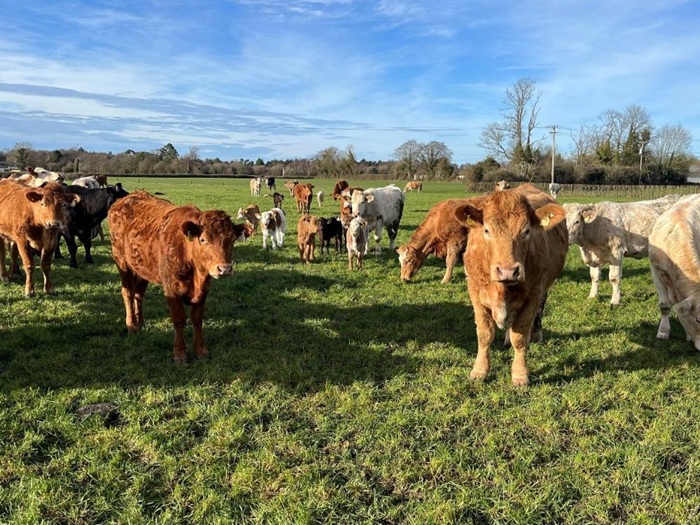
John Dunne, a participant in the Teagasc Future Beef Programme, runs a 128ha beef and dairy beef enterprise across two blocks near Portarlington, Co. Offaly. Carrying a herd of 85 spring-calving suckler cows, breeding is one of the main focus areas over the month of May.
After experiencing setbacks with infertile and sub-fertile stock bulls, John focused on rebuilding his suckler cow numbers. He has reached a point where he no longer needs to buy in replacements and can now breed from his own maternal line. However, he has identified a drop in milk production, which he aims to correct through a targeted artificial insemination (AI) programme.
This spring, John selected 50 of his best maternal cows, all over 35 days calved, for a synchronised AI breeding programme. His goal is to produce high-milk, fertile replacements using three high-performance Simmental AI bulls: Lisnacrann Fifty Cent (SI2469), for cows with carcass weight >20kg; Rubyjen Here’s Johnny (SI4350), for lower carcass cows (<20kg); and, Coose Kingston PP (SI6226), for cows with average carcass weight.
The following criteria were used when selecting these sires:
- ≥9kg daughter milk,
- ≥14kg carcass weight,
- ≤8% calving difficulty (at >85% reliability),
- €150+ on the Eurostar index.
To allow for a more compact calving next spring and to aid pull back the calving date, John has used a synchronisation programme (as outlined below). To maximise conception rates, only cows over 35 days calves were synchronised.
AI synchronisation timetable:
- Saturday, April 19 – progesterone device (P4) inserted plus GnRH injection,
- Saturday, April 26 – P4 device removed and prostaglandin and ecG injection administered,
- Tuesday, April 29 – fixed time AI.
For further insights on John Dunne’s farming system, watch the below video: