
06 May 2025
An April of weather ups and downs

Teagasc Signpost Programme participant, Gareth Peoples brings us up to date with the latest happenings on his dairy calf to beef farm in Co. Donegal, where an April of weather up and downs resulted in some cattle being re-housed over the Easter weekend.
Mid-April’s persistent rain really took its toll on ground conditions and that, along with low grass covers, forced me to house 30 steers over the Easter weekend.
Grass growth up to then had been relatively poor but utilisation was high and stock were content, so I was happy to continue grazing. However, as over 50mm of rain fell over a short period on the Friday and Saturday of Easter, some cattle were housed until ground conditions improved and growth rates picked up.
Calf rearing
Rearing is ongoing with my group of 35 spring-born calves. Overall, they are progressing well with the plans to have them fully off milk from the middle of May.
At that stage, I will be more than confident they will be consuming at least 2kg of concentrates per head per day and this is something I feel is hugely important to prevent any growth check post weaning.
Weather depending, I hope to get calves out as soon as they are off milk replacer, and I will continue meal feeding at a rate of ~2kg a day at grass for the first few weeks post turnout to ensure performance is maintained.
Autumn-born calves are out well over a month at this stage. They are still getting around 1.5kg of concentrates per head to maintain performance but also due to a grass shortage. Weather conditions and grass availability will dictate when I stop supplementation. I plan to faecal sample them in the next few days to monitor for worm burdens. In previous years, we had worm burdens rather quickly in this group of stock and I don’t want such an issue occurring again.
Plans for silage and grazing
Closed in early April, all my silage ground received slurry and 90 units of chemical nitrogen per acre – a mix of both protected urea with sulphur and 18-6-12. This crop was slow to get going, which I put down to the weather. While the weather we had earlier in the month was good, there was still too many cold nights for growth to really kick on.
Growth rates on the grazing ground have been even slower. The first application was over 25 units of nitrogen in the form of protected urea in early March, followed by a bag and a half of 18-6-12 per acre in April, so I am confident when growth does kick in grass will power on.
Teagasc Signpost May Climate Actions
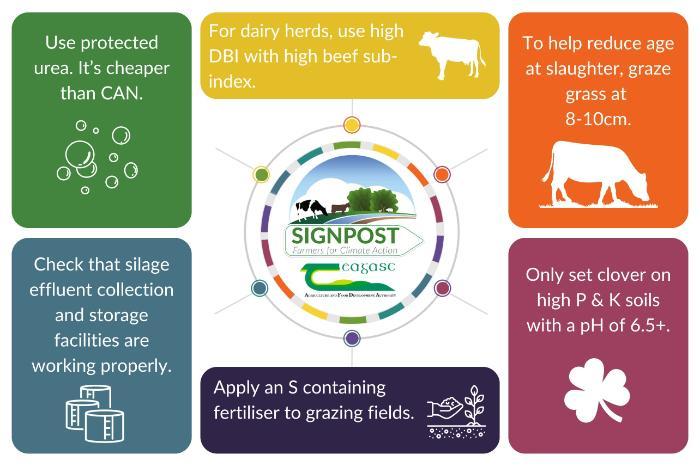
Each month, the Teagasc Signpost Programme share key Climate Actions for the month ahead. For May, the actions include:
- Use protected urea. It’s cheaper than CAN;
- For dairy herds, use high DBI sires with high beef sub-index values;
- To help reduce age at slaughter, graze grass at 8-10cm;
- Only set clover on high P & K soils with a pH of 6.5+;
- Apply a fertiliser containing sulphur to grazing fields;
- Check that silage effluent collection and storage facilities are working properly.
Gareth Peoples is a participant in the Teagasc Signpost Programme and Teagasc DairyBeef 500 Campaign.
The above article first appeared in the Farming Independent.