
08 April 2025
Early born heifers make better ‘Future’ replacements
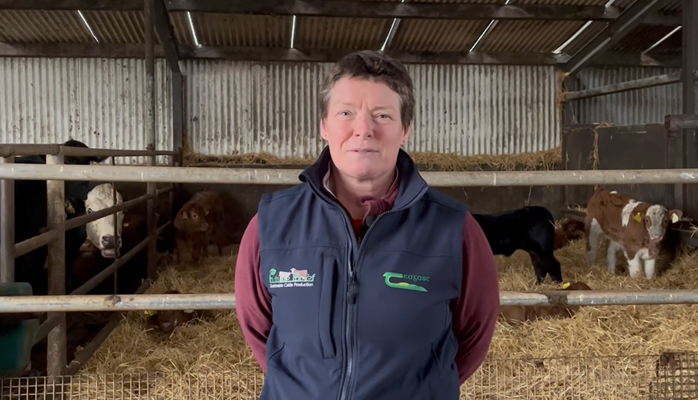
‘There is no point picking an April-born calf to breed the following May or June.’
This was a key message shared by Olivia Hynes, a suckler and sheep farmer from Four Roads, Co. Roscommon, who delved into the benefits she’s seeing from following a breeding programme based on 100% AI, what she wants in future replacement heifers and how calving at 24 months of age is working for her system.
Joining industry experts as part of the Teagasc Future Beef Programme’s Pre-Breeding Essentials Webinar, Olivia’s contribution was prefaced by Future Beef Programme Advisor, James Mullane who said: “Over 70% of suckler heifers calve at 36 months of age rather than 24 months. Beef farmers are losing very serious money as a result.
“The benefits of earlier calving, both financially and environmentally, are proven by Teagasc researchers and the farmers who calve heifers at 24 months of age.”
Olivia, an advocate for calving heifers at 24 months, followed: “We have no problem with heifers calving at 24 months of age. If they are suitable for breeding or AI, it doesn’t stunt them.”
But how?
A critical target for achieving this – ensuring heifers are 60% of their mature body weight at the time of breeding. Olivia’s replacement strategy – after moving away from purchasing in-calf heifers – preferences heifers born early in the spring calving season, from docile dams with plenty of milk.
On the why, Oliva explained: “We have some fantastic cows, producing fantastic calves and weanlings. In-calf heifers are quite expensive to buy, so we changed completely over to AI two years ago, so why not produce our own replacements?
“It saves me a lot of money. Rather than going out and spending €2,500-3,000 on in-calf heifers, I can produce my own from my own top cows, select bulls that are easy calving and feed the heifers appropriately and have nice quite cows when calved down,” Olivia added.
With the aim of calving heifers in February or early March, Olivia has to be realistic on which heifers make the grade for breeding, adding: “There is no point picking an April-born calf to breed the following May or June”.
There’s also science, and even a large-scale study, to back this statement up, as was discussed by Dr. Colin Byrne, NutriBio and formerly of Teagasc Grange, who said: “If a heifer was born in the first 21 days of the calving season, she has a 25% greater chance of lasting to her fourth lactation and beyond.
“The heifer has more time to grow before she’s required to cycle. If she goes in calf early for the first time and calves down early, she has a greater recovery period before she is expected to go back in calf and that cycle continues on. They are in a better metabolic state and hence why they have a greater chance of making it.”
Along with examining the figures and breeding for docility and milk, Olivia wants a “good square cow with a good frame”. Often times a Limousin or Simmental – or a criss-cross of both – achieves this billing, with the ultimate aim of breeding to a Charolais sire to produce a nice, coloured weanling.
Often times farmers shy away from calving heifers at 24 months of age due to the perceived calving difficulty risks, Olivia’s solution to this is two-fold – ensure the heifer hits the target weights pre-breeding and only use proven easy calving bulls.
“The bull team consists of a mix of Belgian Blue, Simmentals for replacements, Charolais for weanlings and all of the replacement heifers are bred to Limousin,” Olivia explained, before responding to the question does she think the work involved in AI is worth it?
“There is a bit more work, but I have more choice. It’s hard work for six or eight weeks, but it is worth doing.”
For further insights on Olivia’s farming system, watch a recording of the Pre-Breeding Essentials Webinar below, which also featured Donal Lynch, Tullamore Vet Clinic, who detailed both stock and teaser bull management:
Future Beef webinar series
The Future Beef team hosted a series of webinars, which focused on a farmers’ guide to suckler breeding over recent weeks.