
19 February 2025
Making spring grass count at Newford
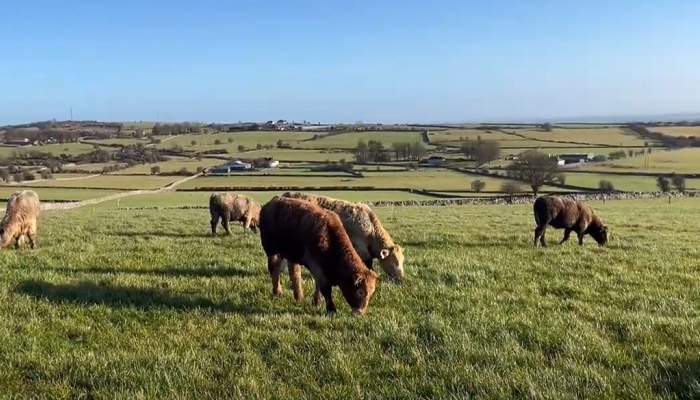
Maximising weight gain from grass is a priority at Newford Farm. Michael Fagan tells us how this starts with early turnout and making the best use of spring grass.
2025 marks the second spring since our move to Roscommon, and we’ve taken advantage of suitable grazing conditions to commence our grazing year. Yes, spring grazing can be a challenge and the mindset to get cattle out is required, but you have to take the opportunities when they arise and graze when you can.
Our grazing year commenced on February 1 with the turnout of 39 yearling heifers to grass. These animals had been overwintered on a diet of 76 DMD silage and 2kg of concentrate/head/day. On this diet, they achieved an average daily gain of 0.74kg/head/day since housing on December 5, leaving them at a turnout weight of 376kg. All heifers received their clostridial booster vaccination prior to turnout.
At the time of writing, these heifers have been at grass fulltime for a total of 18 days, meaning we’ve saved the equivalent of 19 bales of silage and ~1.5 tonne of concentrates. Our hope is to keep these animals at grass until the point of sale next September, but like everything – it will depend on the weather.
There is no denying that you need infrastructure to make the best use of spring grass, and we’ve subdivided paddocks to allocate 24 hour grazing blocks. This ensures the animals are offered fresh grass daily while also limiting the potential for damage. Additionally, when first turned out, animals were grazed on 700-800kg DM/ha covers, but as they have acclimatised to grazing and settled, we’ve moved this up to 1,300kg DM/ha.
We are also following the spring rotation planner on PastureBase Ireland to set the farm up for the second rotation and to ensure we have enough grass for when cow and calf pairs and yearling steers move to grass fulltime. We’re pretty much on track to achieve this and are aiming to have 21% of the farm grazed by February 21. To boost grass growth on the grazed paddocks, we’re also applying cattle slurry at 2,000 gallons/ac after grazing using LESS, which will supply the equivalent of 18 units of nitrogen per acre.
Overall, our aim is to draft the heifers off grass next September at +300kg carcasses at 18-19 months. Getting early gains from spring grass will help us hit this target, along with making considerable savings on silage and concentrate costs.
Also read: A glimpse inside Newford’s busy February
Find out more about the Newford Herd here.
The Newford Farm is enrolled in the Teagasc Future Beef Programme. Find out more about the Future Beef Programme here.