
17 February 2025
Farm-to-farm sourcing a must for this Meath dairy-beef producer
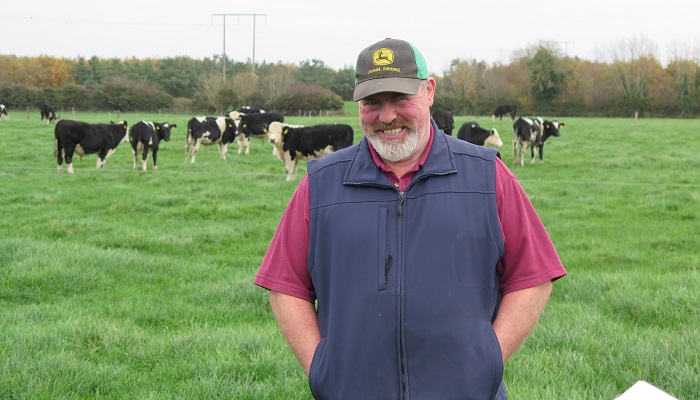
Animal performance on Aidan Maguire’s DairyBeef 500 farm in Co. Meath starts on day one, the day on which he purchases his calves.
In this article, Dr. Siobhán Kavanagh, Signpost Programme Communications and Engagement Specialist, and Fergal Maguire, Advisor on the Teagasc DairyBeef 500 Campaign, share some of the standout measures being implemented on the farm located on the outskirts of Navan, Co. Meath that led to Aidan being crowned the winner of the Dairy Beef Category of the Teagasc FBD Environmental Sustainability Awards last autumn.
The 2025 Teagasc FBD Environmental Sustainability Awards are currently open for entries.
The farm
Farming approximately 65ha, comprising mainly of grassland and to a lesser extent forestry, Aidan, who farms in partnership with his son Luke, carries a calf to beef enterprise of approximately 300 cattle. In the region of 170 calves are purchased annually – a mix of autumn and spring-born calves.
A standout for the judging panel of the 2024 Teagasc FBD Environmental Sustainability Awards was the attention Aidan pays to calf sourcing, particularly the focus placed on building relationships with dairy farmers locally. Over the last 15 years, Aidan has endeavoured to build such relationships to not only ensure the calves he is buying a healthy every year, but to also maximise the calves’ genetic potential to allow them to thrive on his farm.
Building a relationship with dairy farmers
Aidan currently purchases all his calves from five local dairy farmers. Over the years, he has been selective and prioritised sourcing from herds that can consistently deliver a healthy calf; all the current source farms know that Aidan will not buy a calf if it is less than three weeks old, appears thin or looks anyway off form.
Often the fear for dairy farmers is that beef farmers will let calves build up on the dairy farm until there is enough calves to fill a trailer, resulting in calves that are fit for sale being held on the dairy farm for an extra week or two longer.
However, Aidan reckons that good collaboration works both ways, as dairy farmers need to move calves in a timely manner during the busy spring. Aidan will often come and collect calves two or three times a week off the same farmer once they turn three weeks. There is also a cost to feeding these calves for longer on the dairy farm, and Aidan feels that if you don’t offer some flexibility in terms of collecting calves as they become ready, the trust between both farms will end up breaking down.
Animal health
The mortality rate of these calves on Aidan’s farm is just 2%, and Aidan maintains that the main reason for this is that he is very fussy when purchasing calves. The three week age limit stems from Aidan’s desire to avoid costly scour outbreaks. At 21 days, the calf is over the danger period for Rotavirus and Coronavirus scour. If the calf subsequently gets a touch of crypto scour, it is strong enough to overcome it.
Arrival on farm
On the evening of arrival, calves are offered 3 litres of milk and are gradually introduced to the farm’s milk feeding programme in the days that follow. Weaning takes place at approximately 65 days old, once the calf is consuming adequate quantities of concentrate and its rumen is sufficiently developed to maintain performance post weaning.
Two days after the calves arrive on the farm, calves are vaccinated for pneumonia and will get an IBR intranasal vaccine. Waiting the two days allows calves to settle into their new environs and maximises vaccination effectiveness. The booster for pneumonia will be administered a month later.
Genetic potential of the calves
While sourcing a healthy animal is a fundamental aspect of a successful dairy calf to beef enterprise, just as crucial an area is sourcing a calf that has the genetic potential to perform well from birth right through to finish.
Aidan is a big believer in the old saying ‘an ounce of breeding is worth a tonne of feeding’. More emphasis is now placed on selecting calves from farms with the genetics for good beef traits. Central to this is the use of the Commercial Beef Value (CBV), a tool employed by Aidan and Luke to make informed decisions on what calves to purchase. They can check out the CBV of the calves they buy on herd owner’ HerdPlus profile.
In 2024, with the help of his Teagasc advisor, Aidan has curated a list of bulls suitable for improving the genetics of the calves he is purchasing. All these bulls had a beef-sub index of at least €100 and a carcass weight of +10kg. The trust built up between Aidan and the dairy farmers gives Aidan the confidence that the calves he is buying will deliver in terms of animal performance and the dairy farmer is securing a market for his/her calves.
All the beef x dairy calves will need to have a high beef genetic merit and be ranked in the top 40% on CBV, which means Angus and Herford calves will have a CBV greater than €80. Aidan will continue to purchase Friesian bull calves, as he still feels they are value for money. However, he plans that the Friesian bull calves that he purchases will have a CBV greater than €1.
For more insights from Aidan’s farm, watch the below video:
Age at Slaughter
Aidan has reduced his age at finishing from 24 months to 22.5-23 months. This has been achieved by a combination of:
- Buying healthy calves and calves of high CBV
- Good grassland management, achieved through getting soil fertility right, having a good reseeding programme, having good grazing infrastructure and measuring grass.
- Using high-quality silage for winter feeding. Last winter, Aidan used red clover silage of 76% DMD.
- Having a good herd health plan.
Teagasc FBD Environmental Sustainability Awards 2025
The Teagasc FBD Environmental Sustainability Awards aims to promote environmentally sustainable farming. The awards highlight the progress farmers are making to lighten the load of farming on the environment, while continuing to produce high quality, nutritious food, in a profitable manner.