
26 December 2024
Careful planning pays off for new finishing shed
A new finishing shed constructed on Charlie Smyth’s DairyBeef 500 farm is ticking a lot of boxes for labour efficiency, animal performance, nutrient storage and location. DairyBeef 500 Advisor to the farm, Fergal Maguire tells us more.
Charlie Smyth and his father Charles have operated a dairy calf to beef system on their farm since 2019. Now equipped with a plan to bring all animals to finish between 21 and 26 months, 107 calves were purchased in 2024.
The farm is approximately 60 hectares in size and is situated just outside Virginia, Co. Cavan. The soil type is a mixture of relatively free-draining soil to heavy drumlin soil type. The farm is fragmented. There are five separate blocks of ground, which significantly increases the workload. Alongside the beef farm, they also operate a poultry unit.
Additional space
As the number of calves arriving on the farm have increased over the last five years, winter housing and in particular slurry storage had become tight.
As there is no standalone calf shed on the farm, Charlie had relied on getting weanlings out early in the spring in order to free up a shed to purchase calves. If ground conditions were not suitable to graze, Charlie had to stock weanling pens densely in order to get by.
This lead to increased workload and stress during an already busy period in the spring, with Charlie explaining: “A lot of time is spent working with the hens. I wanted to streamline the calf to beef enterprise during the winter/spring period and have it in a way that I could do the jobs morning and evening in a stress-free and in a timely fashion.”
Choosing a site
Charlie designed the shed in conjunction with his local Teagasc Advisor Roslyn Fay. He outlined that a lot of planning went into designing the shed in order to get the spec that he was satisfied with.
“Our main requirements for the shed was good ventilation, safety, animal comfort and a bright shed that you would enjoy working in. After some time mulling over different designs, I finally settled on a shed that I felt ticked all those boxes.”
Charlie also felt that finding the correct location for the shed was an important decision to make. There are a lot of factors that come into play when locating a finishing shed. These include: ease of feeding; movement of cattle; and access for a lorry when loading cattle for sale.
“The reason I picked this site is because it is close to the silage pit and meal bins. I can easily move cattle on my own and cattle can be loaded on a lorry without any issue from this shed,” Charlie added.
Shed design and size
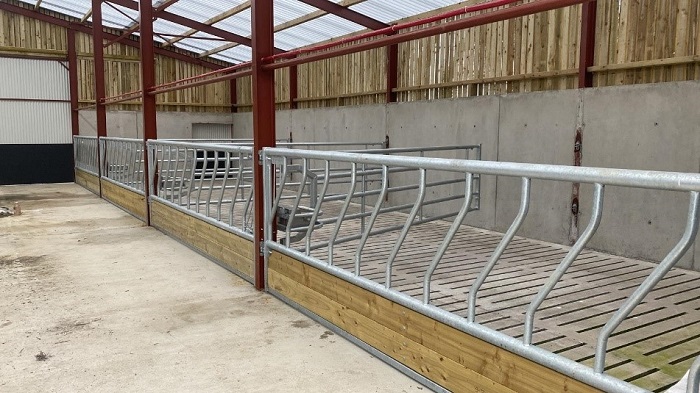
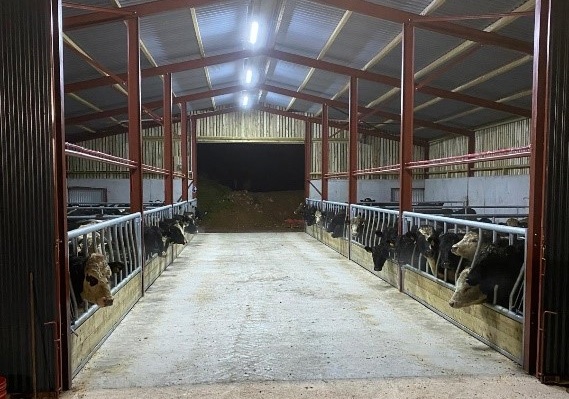
The shed itself is a straightforward design. The shed has the capacity to hold 64 finishing cattle at ease; although, it can handle a few more if a diet feeder was used. The shed is 6.2m high at the apex. It is 19.4m long and 15.2m wide. The concrete walls of the shed stand at 2.4m. There are four main sliding doors located at either end of the unit, and also four smaller access doors to the pens at the corners of the shed. The feed passage is 4.9m wide which, in the future, will allow Charlie to use a diet feeder if he so wishes.
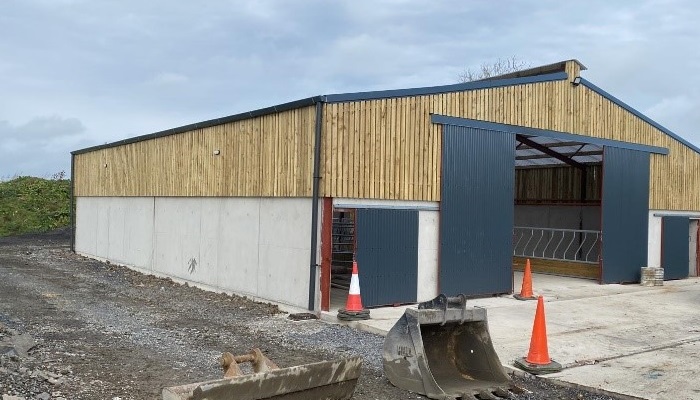
Each bay is the standard 4.8m wide and 4.9m deep, which will easily accommodate nine finishing cattle of approximately 550kg. However, each pen is limited to eight cattle due to feeding space.
“I did think of incorporating concrete feed troughs, instead of the concrete walls, on both sides of each pen to maximise capacity. As it stands, the shed easily accommodates what cattle I can stock on the farm. In the future, if I do go up in numbers, I would strongly consider a diet feeder,” Charlie explained.
Another nice feature in the shed is that the dividing gates are hung on both sides, so they can be opened from either side when moving cattle.
Water
Cattle on high concentrate diets require unrestricted access to clean water, allowing for higher intakes and the efficient conversion of feed into weight gain. In order to ensure cattle have clean water at all times, Charlie installed tip over drinkers at the front of each pen.
“The main reason I installed the drinkers at the front of each pen was that I knew if the drinkers were at the back of the pen, I would rarely go and check them. When they’re at the front of the pen, I can check them any time I’m in the shed,” Charlie added.
Light and ventilation
The first thing you notice when you walk into the shed is how bright and airy it is. Polycarbonate clear sheeting was installed on the roof instead of typical galvanised sheeting, and Yorkshire boarding was used on all four sides of the shed.
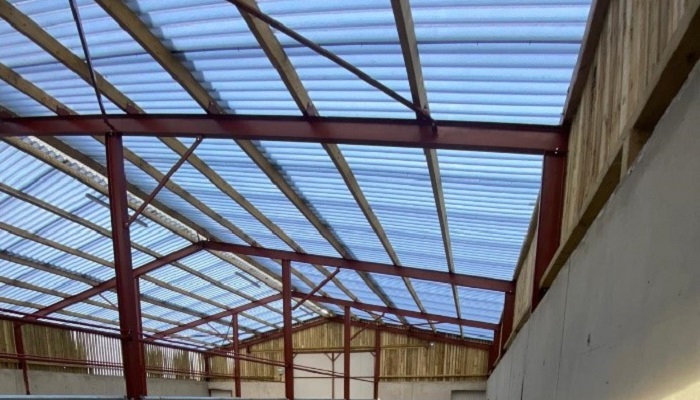
“I wanted to create an environment in the shed that the cattle are comfortable in, as I firmly believe that a happy animal is a thriving animal,” Charlie added.
Additional slurry storage
The tanks themselves are 4.6m wide and 2.4m deep with an internal length of 21.9m. Each tank has two external agitation points at either end. On account of the additional storage provided, Charlie reckons he will now be able to go out with slurry when the ground conditions are good rather than having to go out when the slurry dates allow just because the tanks are full – allowing him to make better use of the organic nutrients on his farm.
Concluding comment
After finishing the shed and putting it to work, Charlie said: “Overall I am extremely happy with how cattle are performing in the shed. I sold my first batch of heifers to the factory last month and these heifers done a great thrive compared to what I would have seen in the older shed.”