
16 April 2024
Making a start at grazing – small numbers, large areas
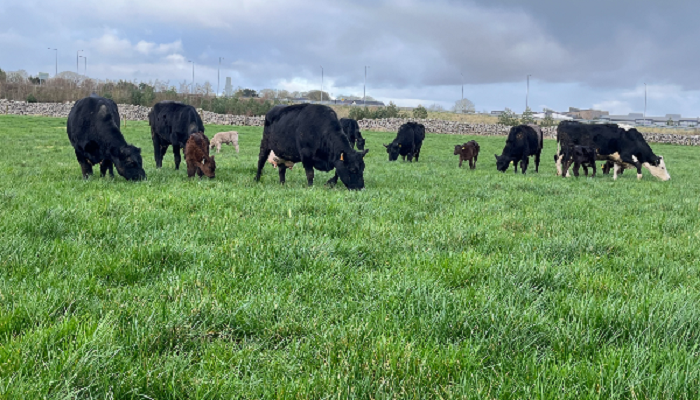
Turnout has been delayed on many beef farms across the country. With a turnaround in the weather forecast, Martina Harrington, Future Beef Programme Manager, provides some key tips on managing the transition back to grass.
Martina explained: “A wet spring has limited grazing on beef farms, causing additional workload pressures with foddering and bedding, a tightening of silage stocks and a large bank of grass being created on some farms.
“Although some farmers on drier ground have been able to get stock out for short periods to alleviate pressure, this hasn’t been the case on all farms and cattle have remained indoors since turned in last winter
“Now that the weather finally looks to be turning in our favour, how farms with very little or no grazing done so far manage turnout will not only have an impact on the workload within the farmyard, but also the quality of grass for the remainder of the grazing season and the fodder reserves to hand at housing next winter.”
Turning stock out to grass
Fully aware that grazing conditions may remain challenging for a period of time for farmers operating on heavier soil types, Martina explained that – at this stage – farmers should take every opportunity to commence the grazing year.
“Firstly, you should walk your farm and identify areas where grazing can start. With longer days and high pressure building, you could be surprised at how suitable some fields are for grazing.
“Where possible, make a start by turning out some cattle – even the lighter animals on farm – to graze over large areas to prevent damage. There’s no need to force animals to graze out initially and move them on once they start to damage.”
Along with targeting the drier areas of the farm, Martina said that starting on the lightest grass covers is preferred, as this has the combined benefits of settling animals back into grazing, while allowing you to move through larger areas to get grass re-growing.
“Once animals are settled and ground conditions are better, you can move onto heavier covers. From this point, you will get better graze outs and animals will move slower through the paddocks.
“Keep grazing until the first two or three paddocks grazed have enough grass to start the second rotation and, at that point, jump back to these paddocks and take the remainder out as surplus bales to build fodder reserves for next winter,” she said.
Where turnout is underway, Martina also reminded farmers to ensure magnesium is provided to prevent issues with grass tetany arising.
Preparing for breeding
Martina also touched on the importance of monitoring cow body condition score ahead of the upcoming breeding season, noting: “Body condition is key to getting cows back cycling. Cows have been housed for a long period and are possibly on poorer quality silage now.
“If your cows are still in, start to feed 2kg/day of meal to ensure they are not losing condition and get them to grass as soon as possible, prioritising first-calvers, old cows and thinner cows first.”
She also explained that breaking the cow’s bond with the calf – often called restricted suckling – can help cows start to cycle. This may be achieved – where possible – by turning older calves out to grass and retaining the cows indoors until conditions allow full turnout.
Fertiliser applications
As a result of the wet spring, many farmers are behind on fertiliser applications, with Martina noting that should be prioritised when conditions allow. For farmers who have yet to order fertiliser, she advised them to order it and have it ready in the yard for when fields are travelable. Additionally, the fertiliser spreader should be serviced and ready to go before starting to spread.
On fertiliser recommendations, she said: “Aim to spread 30 units/ac of nitrogen. If you have an allowance for phosphorous, use 1.5 bags/ac (75kg/ac) of 18-6-12 + sulphur. The phosphorous (P), potassium and sulphur contained within will boost growth and help the roots if damage was caused during grazing.
“If you don’t have an allowance for P, protected urea is the safest form of nitrogen and you can cover more ground with a full spinner. To provide the 30 units/ac of N, you will be looking at 0.6 of a bag/ac (30kg/ac) of 46% protected urea or 0.8 of a bag/ac (40kg/ac) of 38% protected urea.”
On where to spread, she said: “Cover all ground – even the heavier covers – as this will help recovery once grazed. If you are unable to graze them before the first paddock grazed reaches grazing height, you can take the paddock out for silage.
“The one caveat here would be areas you cannot cut for silage – try graze them earlier. If this is not possible, maybe you should wait until grazed before applying fertiliser, but the preference is to graze these paddocks early.”
After approximately 3-4 weeks after the first application of nitrogen, she advised farmers to apply a further 20 units/ac of nitrogen as: “You cannot grow too much grass this year. Be prepared to take out paddocks to build feed supplies ahead of next winter.”
To aid farmers through this challenging time, Martina has compiled a document outlining six tips to deal with current conditions. This document focuses on grazing, fertiliser spreading, silage production, fodder budgeting, health issues in calves and strategies for the breeding season in 2024. It provides practical advice for managing livestock in challenging conditions.
The document can be accessed here.
For more information on the Future Beef Programme, click here.