
20 February 2024
The importance of colostrum to suckler calves
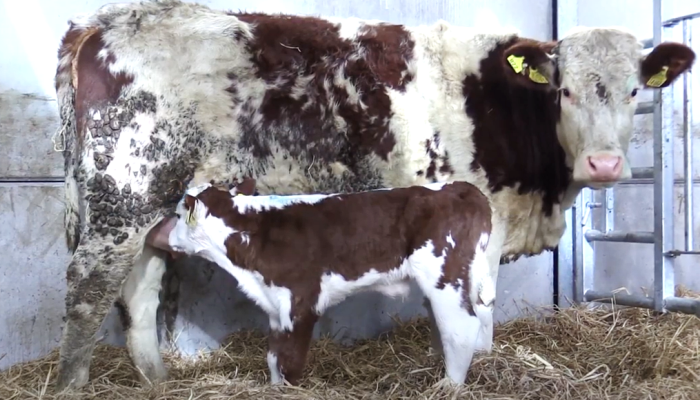
As a means to protect the early-life health of calves, suckler farmers have been encouraged to prioritise the feeding of colostrum to their calves this spring.
This message came from John Donlon, a Teagasc vet working in the area of beef herd health, who joined Catherine Egan on a recent episode of the Teagasc Beef Edge podcast, where he offered advice and tips for caring for the newborn calf.
“The most vital part of a calf’s early life is colostrum management,” John explained. “When born, calves have no antibodies in their bloodstream. They have never really been exposed to any pathogens or any bugs. They’re completely naive to the world and what cows do to help protect their calves in that early lifetime is they produce colostrum,” John explained.
John encouraged farmers to feed antibody-rich colostrum to their calves as soon as possible after birth and when it’s safe to do so, as “the calf’s gut is in a very unique kind of stage in that early life, where it is able to actually absorb those antibodies into the bloodstream to give the calf immunity.
“We call it passive immunity and if you feed the calf within the first two hours of life, that’s when that gut is the most open and that’s when you’ll get the best transfer.”
Although all calves should be provided with colostrum, John reminded farmers to keep a careful eye on calves that may have experienced a hard calving or those which are slow to stand, and to ensure these are supplied with colostrum as soon as possible after birth.
On which colostrum to feed calves, he said: “You want it to be the first milk from a cow. Ideally it would be from the calf’s mother herself. If you can’t get that, colostrum from another cow [in the herd] is the next best thing.”
He also advised caution on the use of colostrum replacers; these should only be used in exception circumstances as “natural colostrum from a cow on the farm is the best thing for the calf”.
Although 3L of colostrum is often quoted for a dairy scenario, John advised farmers to feed calves with as much colostrum as it will drink in the first two hours. Achieving the 3L mark maybe difficult, however, as suckler cows tend to produce a more concentrated colostrum than their dairy counterparts.
Navel dipping
Along with colostrum management, John advised farmers to disinfect the navels of their calves early. Speaking from his experiences – both as a practicing vet and in research – he noted that navel ill is an issue that often gets missed on farms. After birth, the navel is essentially a pathway for pathogens to enter the calf’s body. By using products such as iodine or chlorhexidine, this avenue to infection can be closed, with John having a preference for dipping the navel with either solution.
For more tips from John on managing the newborn calf, including best practice when stomach tubing, listen to the Beef Edge podcast below: