
09 November 2023
Changes in multi-species swards
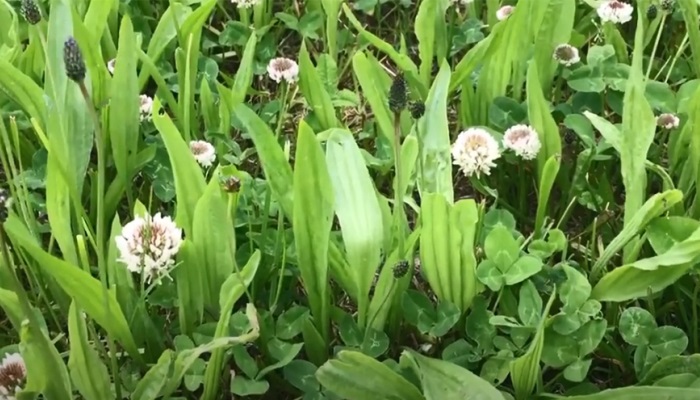
Sarah Burke, Mark McGee, Paul Crosson and Edward O’Riordan examined multi-species swards: annual changes in botanical composition under rotational grazing at Teagasc Animal & Grassland Research and Innovation Centre, Grange, Co. Meath.
Perennial ryegrass (PRG) is the most commonly sown species in Ireland due to its ability to produce high dry matter yields. Previous research at Teagasc Grange has shown that including white clover in PRG pastures reduced the reliance on chemical nitrogen (N) fertiliser application.
Furthermore, cattle grazing grass-clover compared to PRG-only swards tended to have improved liveweight gain. Recently, there has been growing interest in multi-species swards to further exploit complementarity between plant species. A beef cattle grazing systems experiment commenced at Grange in April 2022 comparing grass-clover and multi-species swards sown the
previous year. The grass-clover swards consisted of PRG and white clover, while the multi-species swards comprised PRG, legumes (white and red clover) and herbs (chicory and plantain). No chemical N was applied to the grazing area. The botanical composition (dry matter basis) of the swards was determined over the 2022 and 2023 grazing seasons. The weed burden of both pasture types was negligible. The percentage of white clover in the grass-clover sward peaked in August, at 41% and 27% in 2022 and 2023, respectively. The botanical composition of the multi-species sward changed substantially over the two grazing seasons (Figure 1). Red clover was more dominant than white, particularly in August, during both years. The percentage of herbs, especially chicory, declined as the grazing season of 2022 progressed, and failed to recover during 2023. The herbs were mainly ‘replaced’ with PRG.
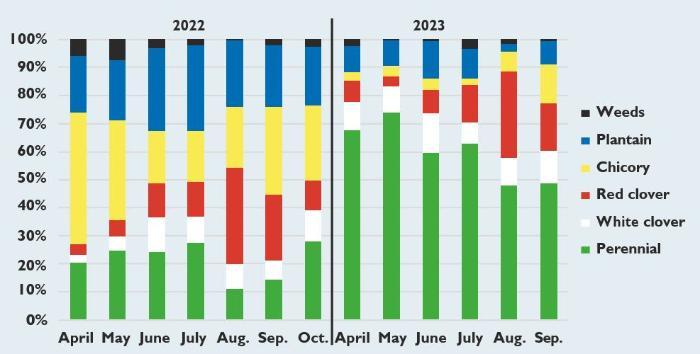
Changes in the botanical composition of multi-species swards over the 2022 and 2023 grazing seasons.
Read more from the Teagasc Beef Newsletter November 2023