
18 June 2023
Research update: Forage or concentrate?
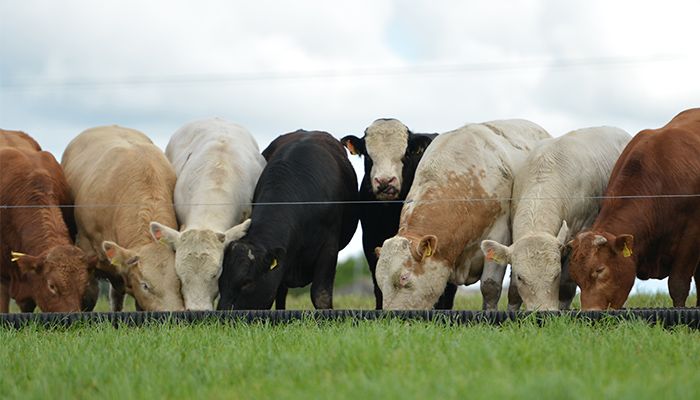
Researchers from Teagasc Grange Research Centre report on the effect of forage or concentrate beef production systems on farm profit, carbon footprint, land use and meat nutritional value.
The effect of contrasting suckler weanling-to-beef production systems on steer performance, land use, farm economics and greenhouse gas (GHG) emissions was evaluated. Post-weaning, eight-month-old, spring-born, Limousin and Charolais steers (333kg) were assigned to one of three systems:
1. Grass silage plus 1.2kg concentrate dry matter (DM) over the first winter (148 days), followed by pasture until August (123 days), then finished indoors on ad-libitum concentrates for 120 days and slaughtered at 21 months of age in December (GRAIN);
2. As in 1. above but remained at pasture until October (196 days), then finished indoors on grass silage ad-libitum plus 3.5kg concentrate DM for 124 days and slaughtered at 24 months of age in March (SILAGE+GRAIN);
3. Grass silage-only over the first winter (148 days), remained at pasture until October (196 days), silage-only over the second winter (140 days) and finished on pasture in June (97 days) and slaughtered at 28 months of age (FORAGE).
The mean target carcass weight was 390kg for each system. Total concentrate DM intake was 1,187, 606 and 0kg/head for the GRAIN, SILAGE+GRAIN and FORAGE systems, respectively. Profitability was greatest for the FORAGE-only system and it did not differ between the GRAIN and SILAGE+GRAIN systems. The FORAGE-only system required the greatest land area and the meat produced had the highest concentration of desirable omega-3 poly-unsaturated fatty acids. The GRAIN-finished system had the lowest GHG emissions per animal and per kg of carcass weight, and required the least area of land.
In conclusion, there were inverse relationships between profitability, land use and GHG emissions intensity among different steer production systems, with each system having distinct advantages and disadvantages.
Peter Doyle, Edward O’Riordan, Mark McGee, Paul Crossan and Aidan Moloney