03 March 2023
Ger McSweeney – Make hay while the sun shines
17 yearling heifers were turned out to grass on 1st February this year, a record on Gers farm. They started grazing paddocks with lower covers beside the farmyard, this allowed them to settle and not walk grass into the ground and it also allowed Ger to keep a close eye on them.
Ger is not new to letting cattle out early and he has the confidence to so this as he follows a spring rotation planner. The plan allows Ger to take advantage of good ground conditions this spring and gives the first grazed paddocks time to recover before the second rotation starts in April.
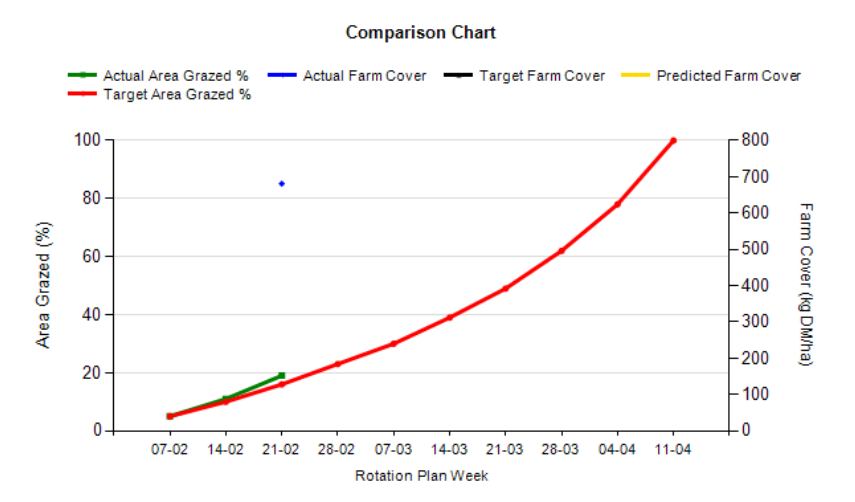
In total Ger has 23.59ha available to graze, his targets are to have 30% (7ha) grazed by 7th March, 60% grazed by 1st April (14.2ha) and have 100% grazed by 11th April. He is now heading into heavier covers and grass is starting to grow, the heifers alone won’t meet these targets so cows and calves are being turned out, but how many?
In Ger’s case he measured grass on the farm and knows that there is a cover of 793 kg DM/ha and that 80% of this should be utilised. His target until 7th March is to graze around 0.2ha per day.
- Multiplying 793 kg DM x 0.8 x 0.2ha = 127 kg DM/day to be eaten (0.6 of a silage bale).
- The heifers are approximately 380kg and will eat 2% of their body weight per day, or 7.6 kg DM.
- Dividing 127 kg DM by 7.6 kg DM means that 17 heifers can be turned out to grass.
As cattle progress through grass on the farm and the daily growth rates increase, more cattle in the form of calved cows and calves can be let out to meet the targets. If Ger is behind target, he can graze lower covers and if he is ahead of target he can house the cows and calves by night or reduce the numbers that are out.
He can easily monitor this on Pasturebase Ireland by entering graze dates of each paddock. However, it does not come without challenges and he regularly watches the weather so that he can plan ahead for housing cattle by night or moving them to more sheltered paddocks if bad weather is forecast.
28 cows are now calved on the farm. One heifer needed assistance as she did not loosen up enough to allow the calf to be born and the calf was dead on arrival. However a newly purchased calf is being fostered on to her. One other calf was dead at birth and is a suspected neospora abortion, but one twin calf was fostered on to her for rearing. Other than that, Ger is very happy with how the calving season is progressing and has the earliest born calves out at grass full time with the cows. 11 more cows are due to calve between now and 17th March.
Ger has been selecting AI bulls for breeding this spring. As he has an automated heat detection system in place on the farm he is keen to use some sexed semen for breeding replacement heifers. 13 potential cows have been selected for one serve to a sexed semen straw from SI4147. Ger chose this bull out of the options available as he is well balanced for maternal traits (+8.7kg daughter milk, -6.93 days calving interval) and carcass traits (+33.5kg carcass weight, +1.84 carcass conformation). The calving difficulty for beef cows is 7.2% at 99% reliability. However he is unsuitable for heifers at 14.7% beef heifer calving difficulty.
As SI4147 is unsuitable for heifers, Ger must carefully select the cows for breeding to the sexed semen straws. He has used the following criteria when choosing them;
- 5 star replacement cows
- Good maternal traits – good mothers, docile, milky, fertile
- Calved in the first half of the calving season this year
- Held in calf to the first serve in 2022
- Negative for neospora
- Have cycled twice before breeding
Furthermore, he will be able to monitor the ‘heat index’, or the quality of each breeding animal’s heat through the automated heat detection system on his farm. If the heat index is high, he knows that there will be better conception rates to the serve whereas if it is low he would be better to use a conventional straw instead. He will also be able to monitor the heat window which will show the best time for inseminating the cow.