
21 February 2023
LESS gives more for James Skehan, Future Beef Farmer
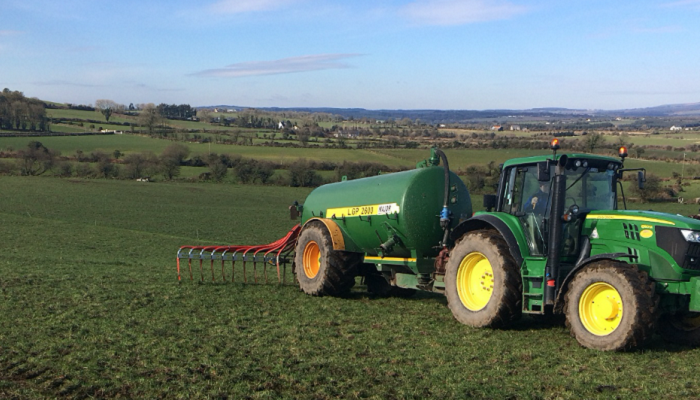
James Skehan, a participant in Teagasc’s Future Beef Programme, began spreading slurry with a dribble bar instead of a splash plate for the first time in 2022.
From a practical point of view, James finds the dribble bar is far superior to the splash plate. In terms of flexibility, it can spread on heavy covers, fields with lower phosphorous (P) and potassium (K) indexes can be targeted, cattle will graze three weeks later and the odours produced are reduced.
Financial
James knew the use of low emission slurry spreading (LESS) would save an extra three units of nitrogen (N) for every 1,000 gallons spread, worth €3.27. Last year, he took a sample of the slurry from the weanling tank and the results showed that it contained nine units of N, six units of P, and 31 units of K per 1,000 gallons. He used this information to balance up the chemical fertiliser applications for silage last year. He spread 3,000 gallons/ac when weather conditions allowed and he plans to do the same this year. It will then be topped up with 58 units/acre of N plus sulphur, which will be spread in the form of protected urea, amounting to 85 units of N, 18 units of P, 93 units of K and 10.5 units of sulphur per acre. This will be sufficient to replace the nutrient offtakes from first-cut silage.
James has two slatted tanks available in the cattle shed for slurry storage. The weanlings and store cattle are housed on one tank, with the cows and calves housed on the other. The shed has five bays that measure 15ft7’ and the cows are on 14ft6’ slats, with the weanlings on 16ft6’ slats. Both tanks have a depth of 8ft. In total, they have a storage capacity of 112,000 gallons of slurry. However, the housed cattle do not fill the tanks over winter, as he has more slurry storage available than what he requires. It is estimated that approximately 65,000 gallons of slurry are produced over the winter period.
This year, 1,000 gallons of slurry is worth €50 per 1,000 gallons. By switching his slurry spreading method from the splash plate to the dribble bar, James is retaining three units of nitrogen for every 1,000 gallons spread, which is worth €3.27 per 1,000 gallons. Multiplying this across the 65,000 gallons of slurry produced will save James €212.55 this year alone.
Legislation
In accordance with legislation, any farm that is stocked greater than 150kg N/ha from grazing livestock, before exports, is required to spread slurry by low emissions slurry methods, i.e. the dribble bar, trailing shoe or injection system from 1st January 2023. This will become a requirement for farms stocked greater than 130kg N/ha from 1st January 2024 and from farms stocked over 100kg N/ha from 1st January 2025. All pig slurry is also to be spread by low emission equipment since 1st January 2023. James is stocked <130 kg N/ha and would legally have to spread slurry using low emission equipment from 1st January 2025 anyway, but is very happy with his decision to change methods ahead of this. He employs a contractor to spread slurry for him but TAMS grants have been available for farmers at rates of 40% to 60% to purchase their own.
For more information on the Future Beef Programme, click here. If you are interested in similar articles like this, subscribe to the Future Beef Programme newsletter, which offers monthly updates from the participating farmers and relevant, timely advice.