05 February 2023
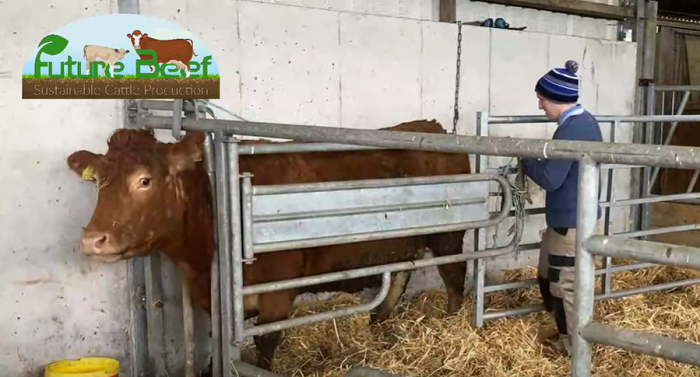
Calving facilities with Aonghusa Fahy, Future Beef farmer
Aonghusa Fahy farms with his wife Olivia and two young children in Ardrahan, Co. Galway. He is part-time farming and is working full-time off farm as a secondary school teacher.
The farm, consisting of 58ha, is split in two blocks – 22ha are in Ardrahan and the remainder are 36km away in Tulla, Co. Clare. The farm in Ardrahan is mostly free-draining soil; one section contains a large proportion of low-lying, heavy-natured land that is prone to flooding. Much of the land in Tulla is free-draining soil, with the exception of 2ha of historically reclaimed bog and 4ha of shallow land, with some surface rock.
Operating a spring-calving system with 30 cows, with progeny brought to store/finish, the suckler herd and calves are kept on the home farm and the followers are moved onto the out farm for the second season at grass. Calving starts in early February. Aonghusa uses AI with a stock bull to mop up. As he is working off-farm, Moo-Heat is used to aid detection along with some family labour.
Aonghusa has prioritised and put in place an excellent paddock system on the home farm in Ardrahan. This part of the farm is stocked at over 2LU/ha, so growing and utilising grass is a major focus throughout the year. Weekly grass measures are taken and PastureBase Ireland is used to help make management decisions. The grazing infrastructure in Tulla will be improved over the next couple of years. Overall, the soil fertility is very good with no lime requirement and 65% of the farm is at phosphorous (P) index 3 or 4. On the potassium (K) side, 87% of the farm is at index 3 or 4.
Main focus areas:
- Improving the overall breeding performance;
- Calving interval of 8-10 weeks;
- Calving all heifers at two years of age;
- High maternal replacements;
- Increasing the output of the farm;
- Finish all progeny to slaughter;
- Incorporation of clover to reduce the fertiliser bill;
- Improving grazing infrastructure by splitting large fields in Tulla.
Turnout to grass
Aonghusa has a dry farm with a good average farm cover (AFC) of 750kg DM/ha; he is planning to get some cattle out in the first week of February. There are risks in letting stock out this early, but the benefits in terms of increased livestock performance and saving on expensive silage and meal makes the decision easy.
Slurry and fertiliser
Slurry is a very valuable nutrient resource on every farm and Aonghusa is determined to use his wisely this year, spreading the right amount to the right areas in the right conditions using a low emission slurry spreader. Protected urea will be the fertiliser of choice when the four main application conditions are met.
Health and safety
Like most farms, February and March are pressure points in Aonghusa’s calendar. He has been busy getting his calving essentials ready. He has also invested in very good handling facilities to ensure his own safety when giving assistance to a cow at calving. See Aonghusa’s facilities below.
Future Beef Newsletter
Aonghusa is one of 22 farmers enrolled in the Teagasc Future Beef Programme. A Future Beef Newsletter will be issued on a regular basis throughout the year. The newsletter will have revelant time critical information and advice. If you would like to receive the newsletter register your interest at the link below.