
20 February 2024
Controlling liver fluke – test don’t guess
The highly pathogenic nature of liver fluke, along with its complicated life-cycle and its ability to thrive in warm and wet summers, makes liver fluke a threat to sheep and cattle of all ages.
That was a key message delivered by Dr Philip Skuce, Principal Scientist at the Moredun Research Institute, Scotland, at the recent Teagasc National Hill Sheep Conference.
Describing the environs in which liver fluke thrive, Dr Skuce said open, wet, unsheltered areas with bare mud provide the perfect mud snail habitat – the intermediate host of the liver fluke parasite. Such areas include: depressions caused by tractor tyre ruts; poached areas; natural landscape features; cleared ditches and drains; banks on the sides of streams or ponds; and soft ground around leaking water taps or pipes.
He also touched on the factors that contribute to liver fluke infections. Such elements include: changing weather patterns – leading to warmer, wetter summers and milder winters – thus resulting in both longer grazing and parasite seasons; animal movements without effective quarantine treatment on arrival; the development of drug resistance, especially in the case of triclabendazole; and agri-environmental schemes in Scotland that facilitate wetland/peatland restoration for wader species.
On the topic of resistance, he presented work completed in Argyll, on the west coast of Scotland – an area where triclabendazole resistance was first identified in the 1980s. 10 farms in this area were part of the study, using composite faecal egg count (FEC) monitoring to inform the timing of treatment. However, in February 2019, it was confirmed that triclabendazole resistance was present on all 10 farms.
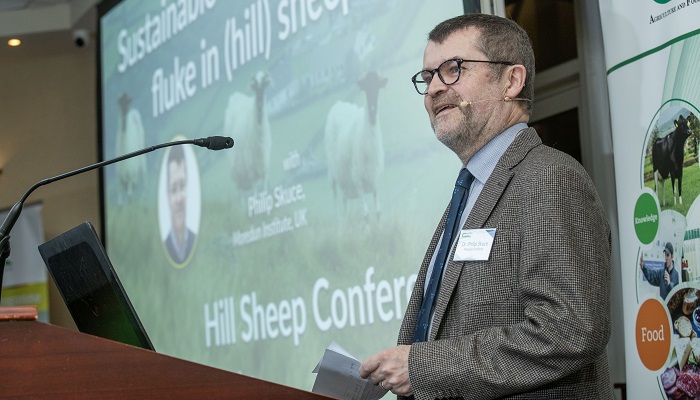
Dr Philip Skuce, pcitured above, addressed the Teagasc National Hill Sheep Conference.
Clinical signs of liver fluke and diagnosis
Dr Skuce also touched on the clinical signs of liver fluke, these include:
- Sudden death of previously healthy animals – worth investigating fallen stock;
- Severe abdominal pain, liver liable to rupture, animals recumbent and unwilling/unable to move;
- ‘Bottle jaw’, anaemia e.g. pale gums and eyes;
- General ill-thrift, poor performance, weight loss, poor body condition etc.
These clinical signs, in combination with post-mortem/liver inspections, may be used as a fluke diagnostic option. However, they often occur too late. Instead, Dr Skuce spoke on the other diagnostic tools available, including: ELISA (blood testing) for anti-fluke antibodies, which gives the earliest indication at ~2 weeks post infection, and is used in invasive scenarios; faecal egg count (FEC) tests, which detect the presence of adult fluke only, 10-12 weeks after infection; and coproantigen test (cELISA), which identifies late immature-adult fluke, >6-8 weeks post infection.
Blood testing, he said, is a “very useful indicator of early infection in young, first-season grazing animals – both sheep and cattle. However, it is less useful in older animals as antibodies can persist, even after successful treatment”.
As part of fluke diagnostic plan, he recommended using blood testing on a small number (n=6) of sentinel animals from mid-summer to indicate when and where they’ve encountered fluke, and inform treatment, timing and product choice.
Both FEC and cELISA, he noted, can be used to monitor infection and to assess treatment efficacy in sheep and cattle. FEC sampling ~10 animals should be completed monthly from late summer to monitor egg appearance, and inform treatment, time and product choice. Alternatively, the use of individual FEC or cELISA should be used to test efficacy of treatment, with the timing informed by composite FEC testing.
Flukicides – important points to note
Delegates in attendance were also reminded of the 5Rs of liver fluke control – using the right product, at the right dose rate, on the right animal, at the right time and in the right way. This is critical, Dr Skuce said, as flukicides are at the “frontline for fluke control”, with not many products to choose from and no new products in the pipeline.
Additional considerations highlighted by Dr Skuce include:
- Drugs that kill ‘worms’ tend not to kill fluke, e.g. the ‘mectins’. Most flukicides don’t kill all stages of fluke;
- Combination fluke and worm products – fluke drugs not persistent, even in combination with a wormer which is;
- Constant risk of reinfection if grazing outside, no natural immunity and no such thing as a ‘preventative treatment’;
- Some of our frontline flukicides (and wormers) have potentially detrimental impact on important dung, soil and aquatic life. If you do need to treat, use ‘as little as possible but as much as necessary’ and dispose of unused chemical and containers carefully!
Take-home messages
Concluding his presentation, Dr Skuce gave farmers the following take-home messages:
- Have a working knowledge of the fluke life-cycle and be able to risk assess a field/farm for fluke;
- Understand what diagnostic tests are available and what they tell you about fluke infection;
- Know the liver fluke status of your animals and farm – test, don’t guess;
- Know which products work on your farm and which don’t – test, don’t guess.
For more from Dr Skuce’s presentation from the Teagasc National Hill Sheep Conference, click here.
Also read: Liver fluke at ‘worrying’ levels in the North West
Also read: Tackling the fluke challenge this winter