
06 June 2023
An update from Tomas O’Leary – BETTER Sheep Farm participant
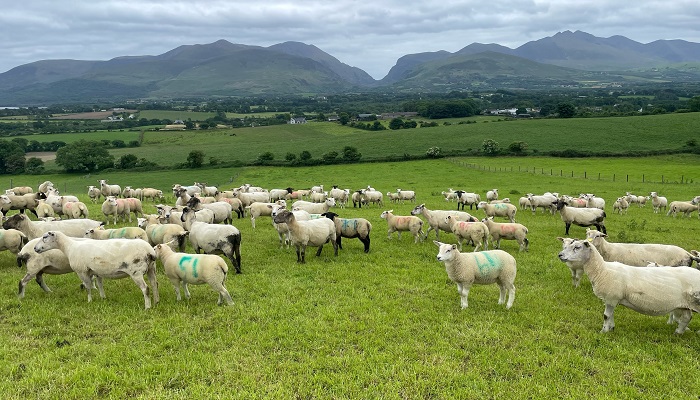
Tomas O’ Leary, his wife Eileen and children Míchéal, Yvonne and Sinead farm approximately 40ha (adj.) in two blocks of land in Kerry.
The farm currently operates a flock of approximately 250 ewes (181 mature ewes and 69 ewe lambs mated), plus a contract dairy heifer rearing enterprise of 90 Friesian/Jersey cross heifers. The farm is split into two blocks, which are 27km apart. Below, Michael Gottstein gives an update from the farm.
Lambing
Lambing commenced in early March on the O’Leary farm. Mature ewes scanned 2.1, whereas the ewe lambs scanned 1.5 with 69 out of the 70 ewe lambs mated being pregnant. Overall lambing went well and lamb mortality currently stands st around 8%.
While lambing went well and ewes and lambs in first weeks of lambing were turned out to grass quickly, the very wet and poor weather in March created major problems. Tomas had to hold ewes and lambs in and lost some lambs due to adverse weather. Another weather related issue was a much higher than normal incidence of mastitis, with eight ewes having being identified as developing mastitis of which two died. This has resulted in a higher number of lambs being reared artificially, as Tomas had to bring in lambs from the field as a result of ewes getting mastitis.
Lamb performance
Current lamb performance is quite good. Seven week weights are slightly back on 2022, but still roughly on a par with the average of the last five years (Table 1).
Table 1: Lamb performance on Tomas O’Leary’s farm
| Litter size | Birth weight (kg) | Seven week weight (kg) | ADG 0-7 weeks (g/day) |
|---|---|---|---|
| 1 | 5.9 | 23.31 | 353 |
| 2 | 4.9 | 19.0 | 286 |
| 3 | 4.1 | 18.4 | 288 |
Grassland management
Grass supply has been marginally behind 2022 (3.8t DM/ha versus 4t Dm/ha in 2022). Poor weather delayed turnout of the dairy heifers by two weeks this spring (turn out early April). Currently there is plenty of grass on the farm and Tomas has cut three paddocks for silage, with a further paddock (1.2ha) burned off for reseeding with grass/clover. The first-cut main silage crop should be ready for harvest the end of May. Last year this silage came in at 79% DMD, resulting in very little concentrate supplementation being fed to stock over the winter.
Over half of the slurry produced over the winter has already been applied using a trailing shoe spreader and it is anticipated that most of the remaining slurry will be applied to the paddocks from which silage has been harvested.
Flock health
All lambs have received their first drench for Nematodirus and Coccidia. The anthelmintic used for Nematodirus control was a white drench (benzimidazole), as there is no known resistance to nematodirus to benzimidazole-based wormers in Ireland. The white drench will however not be used later on in the year (June onwards) due to resistance strains of strongyle parasites being present on the farm.
All lambs have also received their first vaccination for clostridia and pasteurella pneumonia. Lambs are being foot bathed regularly to keep on top of lameness. Shearing will also take place this week as Tomas has had a lot of ewes going on their backs in recent weeks. This is an annual problem for Tomas and results in a number of ewes being lost each year.
Dairy heifers
The 90 diary heifers performed very well over the winter. These were synchronised and artificially inseminated using sexed female dairy sires in late April. Any heifers that repeat will be AId using Aberdeen Angus semen. Once this round of repeats has been inseminated, three stock bulls will be left run with the heifers to mop up any further repeats. In general, the number of heifers that are not in calf is low, generally no more than three or four at the end of the breeding season. The heifers are co-grazed with the lambs post weaning, resulting in improved performance for both sheep and cattle and reducing parasite burdens in the lambs.
Signpost Sheep Farmer
Tomas is one of the demonstration farmers in the Signpost Programme. His farm is involved in adopting practices to reduce gaseous emissions and nutrient losses, manage and enhance biodiversity and reduce costs.