
04 April 2023
Tackling infectious lameness
With the majority of flocks experiencing cases each year, it’s unsurprising that infectious lameness is among the top health and welfare concerns for sheep farmers.
Infectious lameness negatively impacts pregnancy rate, ewe body condition score (BCS) and lamb growth rate. Setbacks in any of these can result in significant financial losses. However, Frank Campion and Jack Delaney, Teagasc Athenry, explain why we should be careful not to brand infectious lameness as exclusively a production problem.
The stress and discomfort of affected animals, for potentially prolonged periods of time, means infectious lameness should be considered a welfare-reducing disease and closely monitored and treated accordingly.
There are three types of infectious lameness: interdigital dermatitis (scald); footrot; and contagious ovine digital dermatitis (CODD). Interdigital dermatitis and footrot are the most prevalent types of infectious lameness in Ireland. CODD is already present in approximately half of all UK sheep flocks and anecdotal evidence suggests that CODD is an emerging issue in Irish flocks. It is an issue that may come to the fore when controlling, treating and preventing infectious lameness outbreaks.
Lambing is under way, or has just been completed, on many farms with sheep being turned out to pasture. Milder weather, coupled with increased grass growth rates, creates the perfect storm for the emergence of scald within the flock, particularly in lambs. The condition can spread rapidly throughout the flock. If left untreated, scald can lead to a more severe condition. Research from the UK has concluded that scald and footrot are part of the same disease spectrum and that scald should be considered as early-onset footrot, which if left untreated will progress in time to full footrot. Footrot can potentially lead to cases of CODD also, where CODD or its causative agents are already present on farm. Therefore, prompt and effective treatment of scald is essential to limiting and preventing cases of infectious lameness.
If a high proportion of your flock is getting lame at any one time, or you are struggling to control lameness, then consider consulting with your advisor and veterinarian to develop and implement a lameness control plan for your farm. Observing sheep at pasture is generally the best method for identifying the number of lame animals. It is important to remember that one in three sheep with foot lesions may not present as lame on visual inspection. For this reason, particular attention should be paid to sheep once they have left the footbath. Any exposed lesions present on the hoof may have become irritated by the foot bathing solution. As a result, the sheep may display an uneven gait and should be separated for closer inspection and further treatment, if necessary.
Footbathing, coupled with an aerosol antibiotic spray post-footbathing, has been shown to be an effective treatment method for scald. More severe conditions such as footrot and CODD may require an antibiotic injection which should be given in conjunction with veterinary advice. This is particularly the case for CODD-based infections where foot bathing has been shown to have a low efficacy.
Prompt treatment is essential to minimise the impact on the animal’s welfare and prevent the spread of the disease to other sheep. Ideally, once lame sheep are identified (not always easy where ewes have lambs at foot) they should be isolated in a separate field to the main flock but close to the handling yard. There they can be easily re-examined and re-treated if the condition fails to improve.
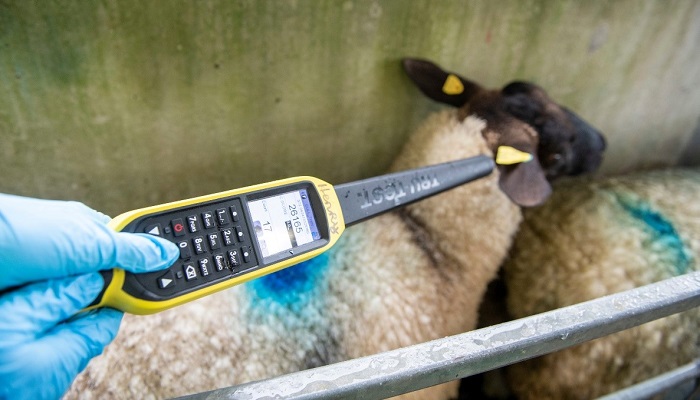
Footbathing is most effective when sheep remain in the footbath for 15-20 minutes when using a zinc or copper sulphate-based solution, followed by at least 30-60 minutes where the sheep are standing on a dry, hard stand to allow the solution to dry. A batch footbath allows for the treatment of many animals without stalling/slowing the handling process or increasing labour hours. Persistently lame ewes or rams that are not responding to treatment can act as a ‘disease well’ for the remainder of the flock. These repeat offenders should be culled to avoid the spread of disease within the flock. The use of EID technology or a simple recording book or app can help when monitoring sheep for lameness. It will help track repeat offenders and any antibiotic treatments administered.
Research project
A research project being undertaken by Teagasc and University College Dublin (UCD) is seeking to quantify the production and economic losses associated with infectious lameness in Irish sheep flocks. It aims to develop tailored, evidence-based control, treatments and prevention protocols which farmers can readily employ. One key element of this research project is a nationwide survey on lameness.
This survey is available to complete online and aims to investigate the following factors:
- The methods farmers are employing to treat lame sheep;
- What bio-security protocols farmers implement on farms;
- Where farmers source their information on lameness control and treatment;
- The on-farm prevalence of the different types of lameness and the times of year during which they are most prevalent.
By completing the survey, farmers will help us to determine the on-farm factors that are associated with increased/decreased levels of lameness. Establishing the levels at which infectious lameness is prevalent on farms and during which periods throughout the year is key. In particular, we are interested in how different areas/soil types are affected.
In order to assess the production and economic impacts caused by infectious lameness, another element of this study will be conducted on the Teagasc BETTER sheep farms. Lame sheep will be compared to their non-lame counterparts in achieving production goals such as seven, 14 and 21-week weights and time taken to reach slaughter weight, along with the BCS and weight of ewes versus non-lame ewes at various stages of the year.
This data will allow us to place a monetary figure on production losses and therefore enable us to estimate the cost to each individual farm of an outbreak of infectious lameness. Access the survey here. If you would prefer to complete a paper based copy of the survey detailed above, please contact 091-845 827 so that one can be sent to you.
This article first appeared in the March/April edition of Today’s Farm.