
25 March 2023
Watch: ‘Feed costs are very high so you need to be feeding accurately’
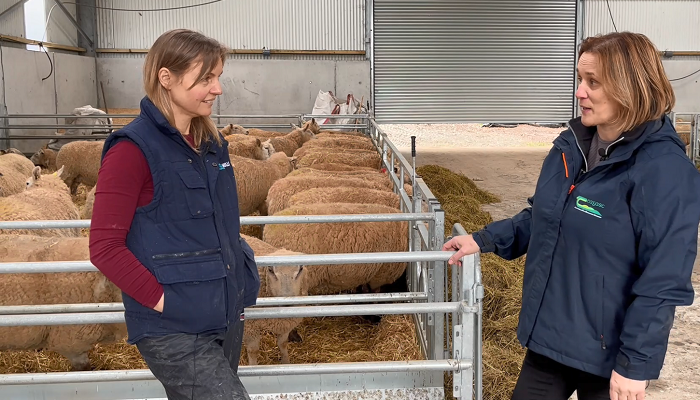
Farming organically since 2015, Amy Jackson farms in partnership with her husband Ross on their 50.5ha sheep and tillage farm in north Tipperary.
They keep approximately 150 ewes that lamb in March / early April each year, with many of their lambs sold direct to customers under their brand ‘Lacka organic lamb’. Elaine Leavy, Teagasc Organic Specialist, caught up with Amy as part of a recent Let’s Talk Organics webinar to get an overview of the farming system and how they feed the ewe pre and post lambing.
Ewes scanned at 1.68 lambs/ewe this year. Breeds include mainly Texel crosses, Charollais crosses, New Zealand Suffolk, Belclares and Rouge. All ewes and lambs are out-wintered on cover crops and multi-species swards until February before housing, which occurred in the second week of February.
Ewes were housed in accordance with litter size and lambing date. Triplet ewes were started on 0.3kg/head/day of concentrate nine weeks prior to lambing, which is slowly built up to 0.9kg/head/day. Concentrate feeding is introduced to triplets six weeks prior to the start of lambing, at a feeding rate again of 0.3kg/head/day, which is increased to 0.6kg/head/day. Singles are only fed for the final two weeks prior to lambing at 0.3kg/head/day. The levels of meal offered is depends on the silage quality, with red clover silage, at 16% crude protein, and grass silage with a DMD of 70-75% DMD used.
On purchasing a concentrate suited to an organic system, Amy said: “The first year that we were in organic I was a little bit apprehensive I suppose about mixing our own ration. So we used a bought-in nut, it was in small bags. It was lovely to use, very convenient, easy to handle and everything, and no mess and no dust or anything like that. But that was very expensive. So we moved away from that the second year and we mixed straights that year. But there was quite a lot of work in the mixing and it was dusty enough.”
Up until this year, a bought-in ration had been used, but higher concentrate costs has meant other alternatives had to be assessed, she added: “That’s fairly expensive this year so we looked at other alternatives and we have a supply of our own organic oats from the farm. So we’re going to use those and buy in organic soya and organic peas. And I’ve worked out the two different mixes, like an oats and soya mix and an oats and pea mix.” This process is saving the farm €800 when compared to purchasing a ready-made organic certified ration.
Offering advice to other sheep farmers who may have entered the organic conversion process this year, Amy said: “Feed costs are very high so you want to be feeding accurately, so you want to scan your ewes definitely and that’s going to help reduce problems at lambing time as well.
“If you’re feeding your ewes adequately then you’re going to help reduce the chances of twin lamb disease, you’re going to have better quality colostrum, you’ll have less illness in your lambs and all of that means less treatments.”
She added: “If you’re looking to save as much money as possible on the feed, have the best quality silage as you can. If you can have red clover silage, that’s getting additional protein into them early on. And then we all know grass is the cheapest feed, so good quality silage and that reduces slightly the amount of meal you’d have to supplement with.” She also advised farmers, if possible, to consider mixing their own rations.
Also read: Producing lamb on an organic farm in Co. Tipperary