
24 March 2023
Watch: Pre-lambing nutrition in the first year of organic conversion
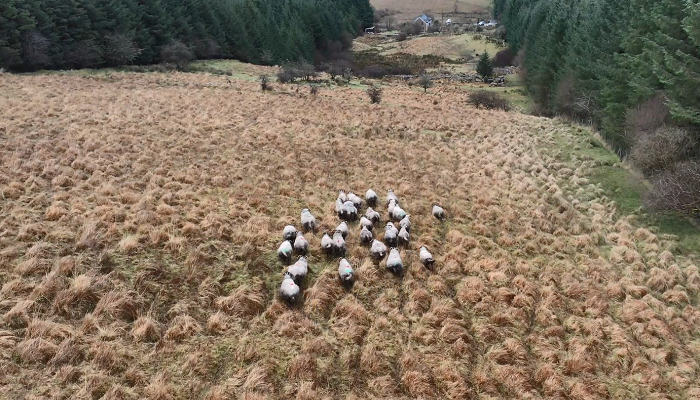
Barry O’Hagan, a sheep farmer from Manorhamilton, Co. Leitrim, entered the organic conversion process earlier this year. Featuring in a recent Let’s Talk Organics webinar, he detailed how he is managing the nutritional needs of his ewes prior to lambing, which is set to commence in late March.
Farming 56ha of heavy clay and peat soils, including some commonage in north Leitrim, he runs approximately 158 ewes which are predominantly Lanark Blackfaces. The ewe lambs have been typically sold as breeding ewe lambs through a producer group and ram lambs have been finished on farm. The ewes are fed for 6-8 weeks pre lambing depending on the scanning rate. Scanning took place in late January, achieving a scan of 1.75 lambs per ewe joined.
Barry explained that ewes are started on silage and a small amount of concentrates, with a 16% crude protein organic ration sourced; additional protein will be provided through the supplementation of approximately 100g/lamb/ewe/day (depending on litter size) in the build up to lambing. On concentrate feeding levels, Barry explained: “The singles are getting 0.2kg/head and the twins and triplets are getting 0.5kg/head.”
Prior to lambing, ewes will be moved to closed ground, where grass was allowed to build, on March 24-25th, adding: “We won’t be feeding them silage or hay and we’ll be increasing the feed at that stage, mainly for the twins and triplets. We’ll be moving from 0.5kg/head to 0.6kg/head or 0.7kg/head, but we’ll also be adding some soya into that, about 100 grams per lamb.”
Hard feeding will be offered to ewes six to eight weeks pre lambing and, depending on the weather, it might be continued for three to four weeks post lambing.
On meal feeding and the addition of soya bean meal prior to lambing, Barry said: “I think it’s very important because it’s for the development of the lamb and to keep the condition of the ewe up, because you’ll end up with nothing if you don’t feed concentrates. You just have to for lamb development, it’s very important.”
Also read: TAMS for organic farming
For more information on the Let’s Talk Organics webinars, click here.