
13 December 2022
Know the feed value of silage for ewe flock
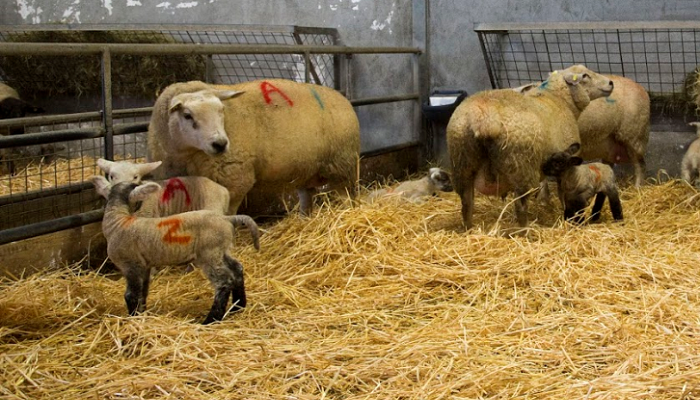
Damian Costello, Sheep Specialist, Teagasc Athenry, tells us that for the majority of ewe flocks that are housed during mid and late pregnancy, grass silage is the most common forage offered.
The cornerstone of any feeding plan should be maximising the use of high quality silage. Dry matter digestibility (DMD) is the key factor influencing silage feed value. High DMD silage has a high metabolisable energy (ME) concentration along with high intake characteristics. Ewes eating high DMD silage will have a high ME intake which results in high animal performance. In studies conducted at Teagasc Athenry, feeding high DMD silage to housed ewes was found to have a positive impact on ewe body condition at lambing and lamb birth weight. Each 5% rise in silage digestibility improved ewe bodyweight immediately after lambing by 6.5kg and lamb birth weight increased by 0.25kg which in turn resulted in lambs being on average almost 1kg heavier at weaning time (Keady & Hanrahan 2011, 2012). The potential savings on concentrate supplementation with high feed value silage at a number of different concentrate prices are summarised in Table 1 below.
Table 1: Estimated cost of pre-lambing concentrates for 70-75kg twin bearing ewes at different price points over a range of baled silage feed values
| Big bale silage | Silage DMD % | |||
| 79 | 72 | 65 | 60 | |
| Concentrate required (kg/ewe) | 12 | 24 | 34 | 40 |
| Cost/ewe if price @ €400/ton | €4.80 | €9.60 | €13.60 | €16.00 |
| Cost/ewe if price @ €450/ton | €5.40 | €10.80 | €15.30 | €18.00 |
| Cost/ewe if price @ €500/ton | €6.00 | €12.00 | €17.00 | €20.00 |
| Cost/ewe if price @ €550/ton | €6.60 | €13.20 | €18.70 | €22.00 |
Taking representative samples
The first step is to get your silage analysed to establish the feed value and target feeding the best quality silage available to ewes in late pregnancy. Any silage analysis report is only as good as the sample taken and in the case of pit silage it should be taken from multiple sites on the surface or face of the pit. On many sheep farms silage bales are fed, usually coming from different areas of the farm, with varying cutting dates and growth stages. In storing bales it is important to have identified the different batches of bales and also to have stored them so that bales can are accessible when needed. A separate silage sample per batch is needed, ideally taken from 2-3 bales from the batch. Ensure the sample is fresh and posted immediately in the ziploc bags provided by laboratories. The accompanying information sheet needs to be completed and each sample must be clearly identified so that it can be associated with the batch from which it was taken. It is best to post early in the week to avoid samples being in the post over the weekend. For further information on taking and submitting silage samples contact your local Teagasc office.
How much silage do ewes require?
The guideline silage requirement for the average lowland ewe is 0.15 tons pit silage per ewe per month or 0.19 bales per ewe per month. Budget for 15 to 16 tons pit silage or 19 to 20 bales per 100 ewes per month. Ideally ewes should be offered high feed value silage right throughout the housing period. Where the amount of high feed value silage is limited on a farm, target the best quality silage at the final 6 weeks pre-lambing – 30 bales or 24 tons pit silage per 100 ewes will be needed to cover this 6 week period. A further 10 – 15 bales per 100 ewes will be required to cover the lambing period.
High feed value silage in mid pregnancy
It is important to keep a close eye on ewe body condition score (BCS) in mid pregnancy. If grass supply is not adequate to maintain ewe BCS combined with adverse weather conditions action needs to be taken. Ewes starting to lose body condition at this stage should be supplemented with forage outdoors or housed and offered high quality silage to maintain body condition. A good option is to separate out thinner ewes and house earlier feeding high feed value silage to avoid further loss of body condition allowing ewes in good body condition to clean off any remaining grass. Do not be tempted to graze paddocks already closed up for the winter as this grass will be much more valuable next spring.
The Teagasc Sheep Specialists, Researchers and Teagasc Advisors issue an article on a topic of interest to sheep farmers on Tuesdays here on Teagasc Daily. Find more on Teagasc Sheep here Teagasc provides a Local Advisory and Education service to farmers. Find your local Teagasc office here