
09 May 2025
Herbicide resistance in Italian ryegrass: 2024 testing for ACCase/ALS resistance
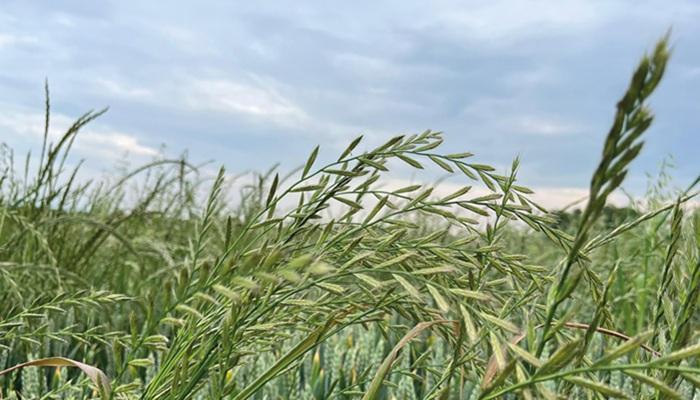
Vijaya Bhaskar, weed management Research Officer, highlights the increasing threat of Italian ryegrass resistance to cereal herbicides.
Last month, confirmation of the first case of an Italian ryegrass population resistant to glyphosate raised serious concerns across the industry.
The testing of resistance-suspect populations of Italian ryegrass from 2024 to ACCase/ALS herbicides has now been completed. Results reveal a concerning situation: 10 out of 11 submitted samples were found to be resistant.
The 11 suspect populations were grown alongside a sensitive population and sprayed at the two to four-leaf stage with recommended label rates of ACCase (Axial, Falcon, Stratos Ultra, Centurion Max) and ALS (Pacifica Plus, Broadway Star, Conviso one – only for use in Conviso-smart ALS-tolerant fodder beet varieties) herbicides (Figure 1).
- The populations LOLMU-01 to LOLMU-06 (Figure 1) and LOLMU-09 to LOLMU-11 (not shown here), were resistant to both ACCase and ALS herbicides.
- LOLMU-07 was resistant to ALS herbicides only.
- LOLMU-08 was sensitive to both ACCase and ALS herbicides.
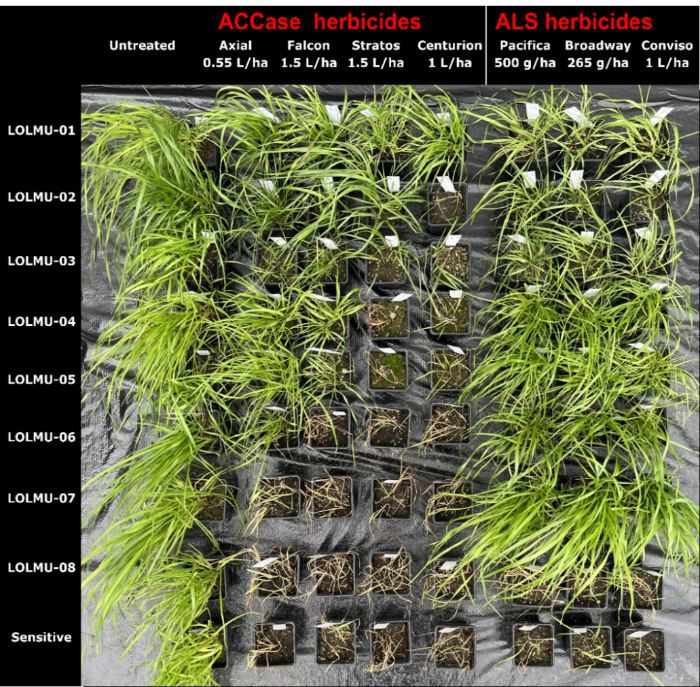
Figure 1: Overhead view of test pots showing the symptoms of sensitive and resistant (LOLMU-01 to LOLMU-08) populations of Italian ryegrass 28 days post-treatment with ACCase (Axial, Falcon, Stratos Ultra and Centurion Max) and ALS (Pacifica Plus, Broadway Star and Conviso one, only for use in Conviso-smart ALS-tolerant fodder beet varieties) herbicides, all applied at the recommended rate. Where treated-plants are absent or the foliage is brown/desiccated, full control was achieved.
Fields where Italian ryegrass has been identified as a problem since the 2020 harvest are shown in Figure 2. Of the 48 suspect Italian ryegrass populations tested to date, 39 (81%) were confirmed resistant.
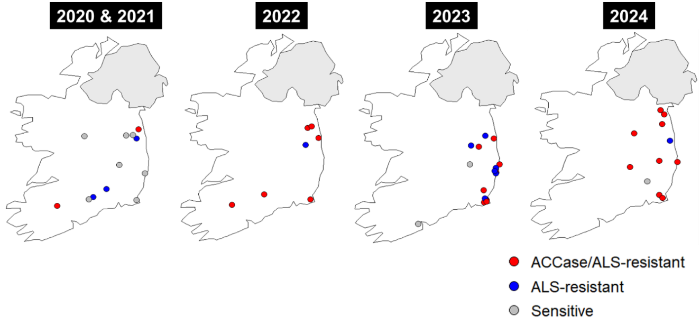
Figure 2: Confirmed cases of resistance in suspect Italian ryegrass populations submitted for testing, by year, since 2020.
The current resistance-risk in key grass weed species based on glasshouse sensitivity testing of suspect samples, is summarized in Table 1. It is clear that we are losing effective herbicide options for Italian ryegrass and blackgrass, and continued reliance on glyphosate poses a very high-risk. Immediate drastic action is crucial if these populations are present on your farm. Destroy affected crop areas to prevent seed return, and plan strict follow-up control measures.
| ACCase modes of action (full label rate) | ALS modes of action (full label rate) | EPSPS modes of action (1440 g ha-1) | |||||
|---|---|---|---|---|---|---|---|
| Axial | Falcon | Stratos | Centurion | Pacifica | Broadway | Glyphosate | |
| Blackgrass | – | R | R | R / S | R | – | S |
| Italian ryegrass | R | R | R/ S | R / S | R | R | R / S |
| Spring wild oats | R | R | R / S | – | S | S | S |
| Bromes | – | S | S | – | S | S | S |
| Lesser canary grass | S | S | S | S | S | S | S |
| Annual meadow grass | NT | NT | NT | S | R | – | S |
Table 1: Overview of confirmed resistance in key grass weeds based on sensitivity testing. Populations were classified as R – Resistant, S – Sensitive, and NT – Naturally tolerant.
Get your suspect weeds tested
The first step in tackling herbicide resistance is knowing if there is a problem. The Teagasc Weed Research team is currently offering free resistance testing for your suspect populations of any weed species. This limited-time opportunity is a part of the DAFM-funded EVOLVE research project, aimed at addressing the increasing threat of herbicide resistance.
More information on Herbicide resistance testing