
16 December 2024
Vincent Macken’s reflections after a ‘whirlwind’ year for tillage farming
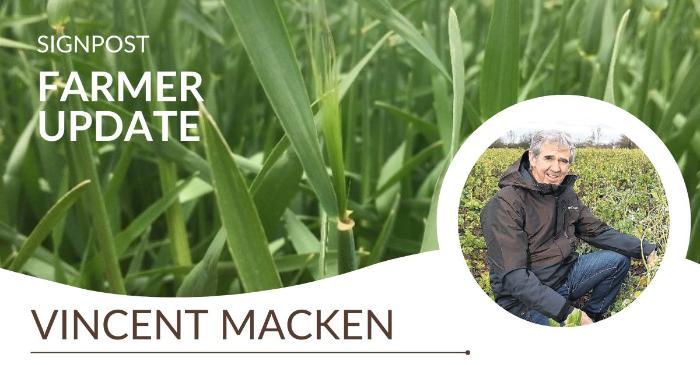
Looking back on the whirlwind year that’s been, Signpost tillage farmer, Vincent Macken takes time to reflect on his 2024 farming decisions and crop yields.
Harvest 2024 eventually finished for me on October 15 with late spring beans, yielding 2.0t/ac at high moistures (average moisture content of 26%).
Yields in general were upside down in Co. Meath. My spring barley averaged 3.5t/ac, which is uncommon around here, while whatever wheat survived last winter yielded 3.7t/ac. The cost of growing, problems controlling disease with reduced fungicide options and static yields have taken the gloss off winter wheat. It needs reassessing.
I decided to bale all cereal straw in the end for the Baling Assistance Payment due to demand, but did have issues with Geo-Tag photo co-ordinates which had to be taken again. Oilseed rape straw remained in the Straw Incorporation Measure, while I also chopped the bean straw to return organic matter and carbon to the soil.
Winter sowing
Sowing for 2025 began with oilseed rape on September 5. I planted LG Aviron at 55 seeds/m2, having broadcasted a compound fertiliser onto the min-tilled seed bed, which was worked in with the seed drill.
So far the crop has established well with the higher-than-normal soil temperatures, but due to the mild weather I had issues with phoma (stem canker) so decided to apply Proline fungicide at 0.4l/ha. It will receive Astrokerb for weed control and Boron once temperatures cool down and it hardens off.
Catch crops are doing quite well and taking up nitrogen from the ground this back end. I make up my own mix with straight phacelia, buckwheat and tillage radish.
This year, I felt it was worth adding oats to the mix as they were sown later in order to give good cover to the fields. The tillage radish has established really well and will improve the soil structure and reduce soil compaction, which are quite important in my min-till system.
I started sowing winter barely on September 23 at 370 seeds/m². Varieties sown were KWS Joyau (BYDV tolerant), KWS Tardis and KWS Cassia for toasting. I’m inclined towards crops offering a premium where I can.
Winter wheat sowing began on September 29 at 300 seeds/m², with a blend of KWS Dawson and Champion. All cereals were sprayed pre-emergence with herbicide (Firebird Met at 0.5 l/ha and DFF at 0.1 l/ha) to control grasses and broadleaved weeds. I finished my autumn sowing on October 13 with direct-drilled winter wheat as conditions were better than ever.
Other tasks
Elsewhere, the hedges have been trimmed, but I tried to follow Teagasc advice for maintenance, to increase carbon capture and biodiversity. I have allowed an extra foot to remain compare to last year, and tried to shape in a pyramid style, leaving a hawthorn uncut every 40 or 50 metres to rejuvenate and grow back.
Also, the riparian buffer zones sown in August have grown and established well as part of ACRES 2, enhancing my commitment to improve water quality on the farm.
Vincent Macken is a participant in the Teagasc Signpost Programme. Find out more about the Teagasc Signpost Programme here.
This article was first published in the Irish Independent.