
12 November 2024
The standout measures and practices from Tom Barry’s farm
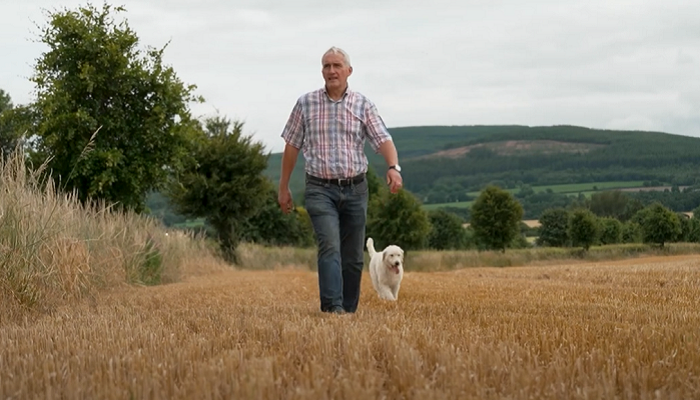
Tom Barry, a tillage farmer from Co. Cork, was crowned the winner of the Tillage Enterprise category of the Teagasc FBD Environmental Sustainability Awards 2024 last month.
Dr Siobhán Kavanagh, Signpost Programme Communications and Engagement Specialist, and John Mahon, Signpost Tillage Advisor, outline some standout measures and practices from Tom’s farming enterprise which help him to farm in a more environmentally sustainable manner.
Farming approximately 240ha in Kilavullen, Co. Cork with his wife Kathy and three children, Tom continues a strong tradition of farming in his father’s footsteps on the family farm. The farm was originally a dairy enterprise, but converted entirely to tillage in the late eighties / early nineties following the introduction of milk quotas in 1984.Tom’s philosophy has always been to try something new, not to be afraid of it, and learn by your mistakes if not successful.
Crop rotation
A strong rotation has been key to success on the farm. Tom tries to maximise his first winter wheat area as it is the most profitable, so break crops such as beans and oats were introduced onto the farm to achieve this. The crops grown include: winter beans; winter barley; winter wheat; winter oats; spring barley; spring oats; spring beans; cover crops; and wild bird cover. Tom is also conscious that his choice of crops each year allows him ample opportunity to spread his harvest and risk with ever decreasing harvesting windows due to climate change.
Soil carbon
Returning straw residue to the soil through straw chopping and incorporation forms a strong direct link in the return of carbon and organic matter to the soil. Having allocated whatever straw is required to his loyal, local straw customers, Tom tries to rotate straw chopping on parcels which have not received chopped straw in a number of years. At least 40ha of straw is chopped each year. He feels this greatly benefits the soil structure and biology which are very important to him.
Tom likes having a spade. There is a big emphasis placed on soil health on this farm, so the spade is pulled out regularly to “check for compaction, you check for life, for humus, for earthworms and you just see is your soil in a healthy state.”
Uniquely, all of the bean straw on the farm is baled and used to heat a biomass boiler to dry the grain on-site, saving thousands of litres of fuel and reducing drying costs.
Cover crops
Cover crops also form a large part of the rotation and soil story on the farm. Any land which is destined for spring cropping (excluding the compulsory 20-25% stubbles for farmland birds) is sown to a cover crop mix in order to have full ground cover, to protect soil over winter and mop up excess soil nutrients which would otherwise be lost to the local river Blackwater.
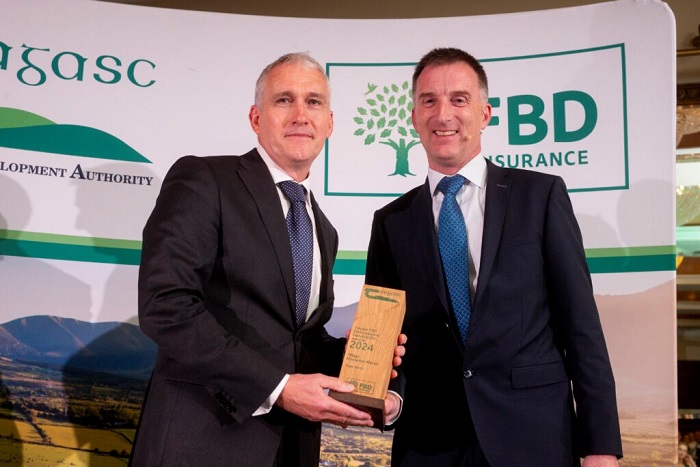
Tom Barry (left) receiving his award from Dr Tom O’Dwyer, Head of Signpost Programme at Teagasc, pictured at the Teagasc FBD Environmental Sustainability Awards 2024
Soil sampling and nutrient management planning
Tom believes that knowing exactly what the crop requirements are and what is available in the soil to feed the crop are vital to making the best possible management decisions on plant nutrition. Uniquely, Tom routinely takes soil samples each year to track changes and fine tune nutrient applications through his nutrient management plan.
Organic manures
A standout for the judging panel of the Teagasc/FBD Environmental Sustainability Awards was both the amounts and the attention to detail Tom pays to imported pig and cattle slurry to offset chemical fertiliser purchases on the farm.
Initially, this would all have been applied pre-sowing and was ploughed in within six hours of application. However, Tom was aware that he was most likely not getting full value from the nitrogen in the slurry and began experimenting with applications into standing crops of winter wheat and winter barley at first nitrogen timing in early March.
To do this, he built a purpose built underground storage tank which holds 30 articulated lorry loads in order to have slurry available when required, began testing the slurry on entry to the farm to know the exact nutrient content, and employed a local contractor with an umbilical application system who could spread up to two kilometres from the base.
This allowed Tom to learn optimum timings, ground conditions to prevent soil structural damage, and the required spread rates and, as a consequence, has led to a reduction of 50% in purchased chemical fertiliser nitrogen on the farm.
In the near future, Tom would like to try to apply a second application post growth stage 30 when the main split of nitrogen is due, using a 24m umbilical system on his 24m tramlines so no crop damage can occur driving on the crop. He would also like to trial the new NIR technology becoming available right now, which can tell him exactly the nutrients that are going on every inch of the field. This is GPS satellite mapped so the application rate and the quantity applied can be tracked and matched with final nitrogen application through variable rate on the fertiliser spreader.
Biodiversity on the farm
Farming with nature is the philosophy on the farm. When Tom began farming, he actively planted almost 20% of the farm in forestry, in areas of poorer production and areas where there was a risk to water quality. They have created ponds, wild bird cover, and try to plant approximately 1,000 hawthorn quicks annually as new hedgerow or to infill existing gappy hedges.
Conservation agriculture
Finally, Tom has also invested in a direct drill establishment system and is learning where he can introduce this technique to further reduce costs and maintain carbon stocks in the soil.
For more insights on Tom Barry’s farm, watch the video below:
Category winners
On Friday, November 15 at 9.30am, the category winners of the Teagasc FBD Environmental Sustainability Awards will featured on the Signpost Series webinar.
The farmers featuring include:
- Edwin Thompson, Tipperary, Dairy Farmer, Winner of the “Reducing Greenhouse Gas Emissions” Category
- James O’Keeffe, Meath, Tillage farmer, Winner of the “Improving Soil Health and Carbon Sequestration” Category
- Ken Gill, Offaly, suckler beef farmer, Winner of the “Enhancing biodiversity” category
- Martin Crowe, Limerick, Dairy farmer, Winner of the “Improving Water Quality” Category
Joining the farmers on the webinar will be Dr Siobhán Kavanagh, Signpost Communications and Engagement Specialist, and Noel Meehan, Head of ASSAP at Teagasc.
Register to attend the Signpost Series webinar here.
Also read: Championing environmental sustainability – what set the Walsh family apart
Also read: Balancing sheep, beef and tillage – Brian Nicholson’s route to partial organic conversion
Also read: Championing environmental sustainability – what set the Walsh family apart
Also read: How this suckler farmer is going the extra mile to protect water quality
Also read: Award winning Meath dairy-beef farmer prioritises farm-to-farm sourcing